
The Gilded Ego: How Trump's Gold Coin Undermines Democratic Norms and Constitutional Principles
Published
- 3 min read
The Facts: Bypassing Law and Tradition
In a move that has sent shockwaves through political and constitutional circles, the U.S. Commission of Fine Arts—composed entirely of President Trump’s appointees—unanimously approved the design for a 24-karat gold commemorative coin bearing the current president’s image. This coin, intended to celebrate America’s 250th birthday in 2026, represents a direct violation of federal law that explicitly prohibits living presidents from appearing on U.S. currency. The commission’s vote, taken without objection, clears the path for the U.S. Mint to begin production despite the coin’s size and denomination remaining undetermined.
U.S. Treasurer Brandon Beach justified the decision by stating, “As we approach our 250th birthday, we are thrilled to prepare coins that represent the enduring spirit of our country and democracy, and there is no profile more emblematic for the front of such coins than that of our serving President, Donald J. Trump.” This rationale stands in stark contrast to the long-standing American tradition of reserving currency imagery for historical figures who have completed their service to the nation.
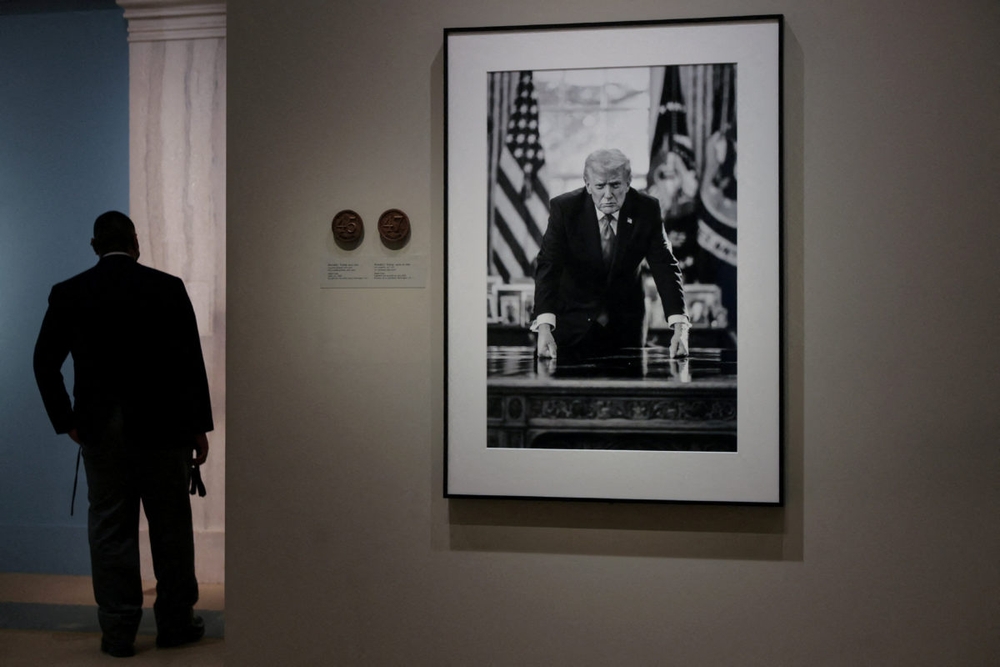
Megan Sullivan, the acting chief of the Office of Design Management at the Mint, revealed that Treasury Secretary Scott Bessent utilized a legal loophole to circumvent the prohibition—authorizing the minting through the Treasury secretary’s authority to issue new 24-karat gold coins. Sullivan confirmed that Trump himself approved the final design, which features the president in a suit and tie with a stern expression, his fists resting on what appears to be a desk as he leans forward.
The Context: Pattern of Self-Aggrandizement
This unprecedented move forms part of a broader pattern of Trump and his administration bypassing conventional practices to embed the president’s name and likeness into the national fabric. The renaming of the U.S. Institute of Peace, the Kennedy Center performing arts venue, and a new class of battleships all represent similar efforts to reshape American symbols in Trump’s image. Commissioner James McCrery II—the architect behind Trump’s proposal for a 90,000-square-foot ballroom addition to the White House—commented that “the president likes big things,” while Commissioner Chamberlain Harris, a top White House aide to Trump, advocated for “the larger the better” in terms of coin size.
The design itself incorporates traditional elements—“LIBERTY” in a slight arc, the dates 1776-2026, “IN GOD WE TRUST” at the bottom, and seven stars on one side with six on the other—but these democratic symbols now serve as framing for a living president’s image. The reverse side depicts a bald eagle midflight with “UNITED STATES OF AMERICA” and “E PLURIBUS UNUM,” phrases that ring hollow when the overall project subverts the very unity and democratic principles they represent.
The Dangerous Precedent: Personalizing National Symbols
What makes this coin particularly alarming isn’t just the violation of law, but the dangerous precedent it establishes for the personalization of national symbols. American currency has historically served as a unifying force—a common language of national identity that transcends political divisions. By placing his image on currency while still in office, Trump transforms what should be a symbol of national unity into a vehicle for personal aggrandizement.
The commission’s unanimous approval—from members全部 appointed by Trump himself—demonstrates how easily independent institutions can be co-opted to serve personal rather than national interests. When those tasked with safeguarding our artistic and cultural heritage become rubber stamps for executive vanity, we’ve crossed a threshold that should terrify every American who values democratic institutions.
Constitutional Principles Under Threat
The circumvention of federal law through technical loopholes represents a direct assault on constitutional governance. Laws prohibiting living presidents from appearing on currency exist for vital democratic reasons: to prevent the cult of personality, to maintain the separation between office and individual, and to ensure that national symbols remain above partisan politics. When administration officials brazenly bypass these safeguards, they’re not just breaking rules—they’re breaking faith with the constitutional order itself.
This action fits into a broader pattern of norm-breaking that has characterized this administration, from the use of presidential pardons for political allies to the weaponization of government institutions against perceived enemies. Each violation may seem isolated, but collectively they represent a systematic dismantling of the guardrails that protect our democracy from authoritarian tendencies.
The Erosion of Democratic Institutions
The most disturbing aspect of this coin controversy is what it reveals about the state of our democratic institutions. The fact that not a single commissioner voiced objection speaks volumes about how thoroughly independence has been compromised within government bodies. When those appointed to provide oversight instead become cheering sections for executive overreach, our system of checks and balances ceases to function.
This isn’t merely about a coin—it’s about whether our institutions can withstand the pressure to serve personal rather than public interests. The muted response from congressional leadership and the legal community suggests that we’re becoming desensitized to norm-breaking, a dangerous development for any democracy.
The Path Forward: Restoring Institutional Integrity
As Americans committed to constitutional democracy, we must recognize this gold coin for what it truly represents: a test of whether our institutions can resist being transformed into instruments of personal glorification. The response should be clear and unequivocal—Congress must exercise its oversight authority to prevent the minting of this coin, legal challenges should be mounted to defend the existing law, and the public must voice its opposition to this breach of democratic norms.
Our national symbols deserve better than to be hijacked for personal vanity. The celebration of America’s 250th birthday should focus on the enduring strength of our democratic institutions, not the ego of any single individual. If we allow this precedent to stand, we risk normalizing a dangerous trend where each subsequent president feels entitled to similar self-glorification, ultimately transforming our national symbols into political trophies rather than unifying representations of our shared heritage.
The gold coin controversy serves as a stark reminder that democracy requires constant vigilance. Institutions don’t protect themselves—they require citizens, officials, and leaders who are willing to defend democratic principles even when it’s inconvenient or politically uncomfortable. Our commitment to constitutional governance is being tested, and how we respond will determine whether the next 250 years of American history will be characterized by democratic resilience or democratic decline.