
The Grandstand and the Ground: How Georgia's Election Reform Theater Failed Voters
Published
- 3 min read
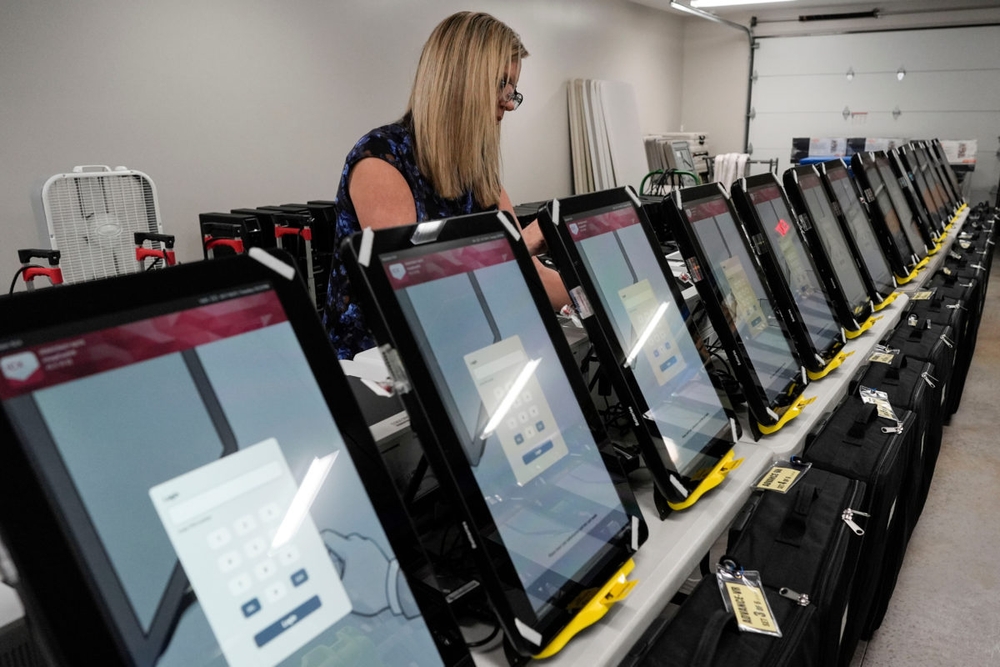
In the turbulent wake of the 2020 election, no state has been a more intense theater for the national drama over voting systems than Georgia. Allegations of fraud, fueled by the highest office in the land, converged with a specific technological fixation: the touch-screen voting machines that print a paper ballot with a QR code. For a movement built on the myth of a stolen election, these machines became the ultimate villain, a symbol of opaque, hackable technology undermining the sacred act of voting. Yet, as the 2024 election looms, a stark and revealing reality has emerged in Atlanta. The promised revolution has stalled. The machines remain. And the entire episode stands as a profound case study in how political posturing, when divorced from the realities of governance and evidence, actively damages the democratic institutions it claims to defend.
The Promise of Dismantling a System
The political context is essential. Following the 2020 election, then-President Donald Trump and his allies relentlessly—and falsely—alleged that Dominion Voting Systems machines had deleted or switched votes in Georgia. These claims, thoroughly debunked and resulting in massive defamation settlements for Dominion, nevertheless took deep root in a segment of the Republican base. This energy translated into political power within Georgia.
Election deniers ascended to influential positions, including on the state’s powerful Election Board. Riding this wave, and bowing to the pressure of activists who fundamentally distrusted any system using a machine-readable barcode, the Georgia legislature passed a law with a clear, hard mandate: remove barcodes from ballots by July 1, 2024. The message was unequivocal. The machines, framed as instruments of doubt, were to be purged. The path forward, championed by figures like State Election Board member Salleigh Grubbs—who famously declared “HAND. MARKED. PAPER. BALLOTS. I will not be moved”—was to be one of total transparency, where a human could read every vote directly.
The Collision with Reality
However, between the grand pronouncement and the implementation lay a chasm of complexity that rhetoric could not bridge. As detailed in recent reporting, the legislature and state administrators failed to agree on a plan to meet their own law’s mandate. Most critically, no funding was ever appropriated to execute this massive overhaul of election infrastructure across 159 counties. Proposals to meet the deadline ranged from the logistically daunting, like hand-counting every in-person early vote, to the disruptive, such as ending county-wide early voting.
Republican lawmakers themselves acknowledged the impossibility. Representative Victor Anderson, chair of the House Governmental Affairs Committee, stated that switching systems now would cause “a severe upset in our election system” and bluntly admitted, “It just wasn’t going to happen.” Similarly, Senator Max Burns, a proponent of hand-marked ballots, conceded that implementing such a change by November “is not realistic.” The underlying technological concern cited by opponents—that the machines’ software, while air-gapped, had vulnerabilities if physically accessed—was indeed addressed by Dominion via patches, but the state legislature did not fund Secretary of State Brad Raffensperger to implement those updates.
Faced with the prospect of self-inflicted chaos mere months before a presidential election, the legislature is now backtracking. The current proposal pushes the deadline to choose a new system to 2028, with a promise of future funding. The QR code machines, the very objects of such intense vilification, are now all but certain to be used by Georgia voters this fall.
An Opinion: The Erosion of Trust as Political Strategy
This is not merely a story of a policy delay. It is a spectacle that reveals a dangerous pathology in contemporary politics: the weaponization of electoral distrust for partisan gain, followed by an abdication of the responsibility to actually solve the manufactured problem.
First, let us be clear on the principle: Every citizen deserves absolute confidence that their vote is counted as cast. Scrutiny of voting technology is not just legitimate; it is necessary for a healthy democracy. However, that scrutiny must be grounded in evidence, good faith, and a commitment to achievable solutions. What transpired in Georgia was the opposite. A narrative of systemic theft, devoid of evidence, was used to justify a radical legislative mandate. The law passed in 2022 was less a product of sober security analysis and more a totem to placate a base radicalized by conspiracy theories. It was political theater, with lawmakers playing the role of crusaders against a fictional enemy.
When the curtain rose on the second act—implementation—the actors had no script. They had not done the blocking, the budgeting, or the planning. The consequences of their own law, if actually followed, would have been disastrous: confusion, likely disenfranchisement, and a crippling of election administration. To their minimal credit, they are now pausing. But the damage is done.
The most pernicious outcome is the further erosion of public trust. For years, voters have been told by influential officials and activists that the system they are using is fundamentally untrustworthy, that it is susceptible to fraud. Now, those same leaders are saying, in effect, “We must continue using this untrustworthy system because fixing it is too hard before the election.” What message does this send? It tells citizens that their leaders are either cynics who never believed their own hype or are so incompetent they cannot execute on their core promises. Both conclusions are corrosive.
Furthermore, the episode exposes the hypocrisy of “election integrity” as a slogan divorced from integrity itself. True integrity requires meticulous, well-funded, bipartisan work to harden systems against genuine threats. It requires supporting election officials like Paulding County’s Deidre Holden, who praised the delay for “setting us up for success and not failure.” Instead, we saw a performative legislative strike that left county officials holding the bag, with no resources and an impossible timeline. The move to shift audit authority to the more partisan State Election Board, as noted by former Democratic board member David Worley, suggests the goal is not integrity but control—shifting oversight to bodies more aligned with the election denial movement.
The Path Forward and a Defense of Institutions
The growing consensus, ironically, points back to a sensible solution: hand-marked paper ballots counted by optical scanners, a system used reliably across much of the nation. This is a worthy goal. But achieving it requires a different politics. It requires rejecting the poison of baseless fraud claims championed by figures like Burt Jones, who is leveraging Trump’s endorsement in a gubernatorial run. It requires replacing theatrical mandates with collaborative, well-resourced, multi-year transition plans.
Ultimately, Georgia’s saga is a warning. Democracy depends not just on laws but on the faithful execution of those laws by institutions and leaders who believe in the system they oversee. When leaders spend years dynamiting the legitimacy of those very institutions to score political points, they should not be surprised when the public stops believing in anything they say—including their eventual retreats to sanity. The real threat to Georgia’s elections was never a QR code. It is the relentless, evidence-free campaign to convince Americans that their votes don’t count, a campaign that has now been revealed as so hollow that its proponents won’t even bear the cost of their own prescriptions. The republic deserves better than leaders who would rather rule over the ruins of public trust than do the hard work of preserving it.