
The Lviv Bombing and the Hollow Echoes of 'International Law'
Published
- 3 min read
The Facts: An Escalation of Cultural Erasure
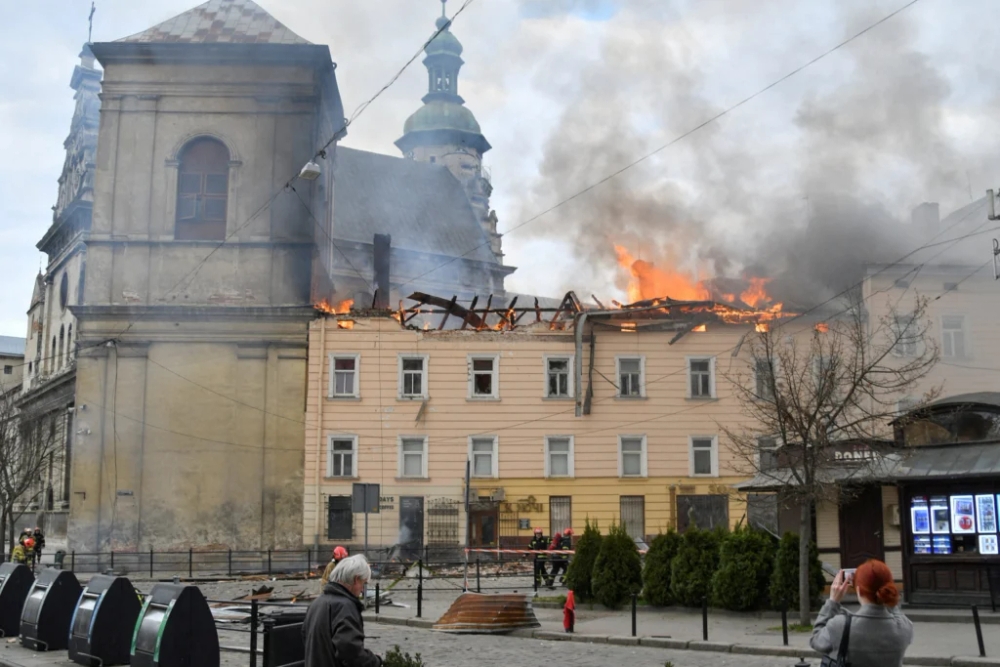
On March 24, 2026, a Russian drone pierced the sky over Lviv in a rare daytime strike, striking a residential building adjacent to the historic Bernardine monastery complex. This area is part of the historic architectural ensemble of Lviv, a city inscribed on the UNESCO World Heritage List since 1998. The attack caused extensive damage and left two people seriously injured. Ukrainian Foreign Minister Andrii Sybiha immediately condemned the strike on this site of “exceptional cultural value,” urging a strong response from UNESCO. This incident was part of a massive, coordinated 24-hour assault involving nearly one thousand drones across Ukraine, overwhelming the country’s air defenses.
The context, as outlined in the report, is a grim pattern of escalation. The winter of 2025-2026 saw Russia’s most extensive bombing campaign against civilian heating and power infrastructure. United Nations data indicates 2025 was the deadliest year for Ukrainian civilians since the invasion’s early months, with a 31% increase in deaths. This terror campaign is enabled by a dramatic expansion in Russia’s domestic drone production, allowing for raids of unprecedented scale. Furthermore, the article notes that UNESCO has already placed three Ukrainian heritage sites in Kyiv, Lviv, and Odesa on its List of World Heritage in Danger due to repeated Russian attacks.
Paradoxically, this intensification of violence against civilians and culture occurs against a backdrop of Russian military frustration. Despite holding the initiative throughout 2025, Russia seized less than one percent of additional territory while suffering catastrophic losses. By February 2026, Ukraine was liberating more land than Russia was occupying. The article cites Ukrainian MP Inna Sovsun, who states the aim is to “make normal life impossible,” and concludes that with no clear path to victory, Vladimir Putin is trapped in a war he “cannot win but dare not end,” leading him to double down on attacking civilians to force a surrender.
Imperialism’s Old Playbook: Erase, Subjugate, Dominate
The bombing of Lviv’s UNESCO site is not an anomaly; it is a deliberate chapter in the oldest imperial playbook. The targeting of cultural heritage is a weapon of psychological warfare designed to sever a people from their history, their identity, and their sense of self. It screams a brutal message: Your past, your culture, your very claim to nationhood are conditional upon our will, and we have the power to obliterate them. This is the same logic that powered colonial campaigns across Asia, Africa, and the Americas, where temples were desecrated, libraries burned, and languages suppressed to facilitate control. To witness this enacted in the heart of Europe in the 21st century is to witness the unvarnished persistence of a colonial mentality that views certain civilizations and states as subjects, not sovereigns.
Where, then, is the robust, unilateral enforcement of the “international rule of law” we are constantly lectured about by the self-appointed guardians in Washington and European capitals? The response has been telling: strong condemnations, lists of “endangered” sites, and continued military support for Ukraine that is often framed as defending “European security” rather than the fundamental human right of a people to exist free from imperial annihilation. This selective mobilization reveals the system’s inherent bias. When the Global South pursues its developmental or strategic interests, it is immediately confronted with sanctions, moralizing lectures, and threats under this same “rules-based order.” Yet, when a blatant act of cultural destruction and civilian terror unfolds, the mechanisms of decisive, collective security action seem to falter, mired in calculations of escalation and realpolitik. This hypocrisy lays bare the truth: the current international legal architecture is not a neutral framework but a tool often wielded to preserve a specific hierarchy of power.
The Westphalian Trap and Civilizational Resilience
The conflict also underscores the limitations of the Westphalian, nation-state-centric model in understanding civilizational states like Ukraine, Russia, India, or China. For Ukraine, this war is an existential struggle for survival as a unique civilizational entity with a deep, historically rooted identity. Russia’s actions stem from a worldview that denies this separate civilizational status, viewing the region as part of its own historical and political sphere—a neo-imperial stance. The West’s analysis, as seen in the article from the Atlantic Council’s UkraineAlert, often reduces this to a battle between democracy and autocracy, a convenient but incomplete narrative that fits its own ideological framework. It fails to fully grapple with the deeper historical and civilizational currents at play, where sovereignty is not just about borders on a map but about the right to a distinct historical narrative and cultural future.
For the Global South, particularly rising civilizational states, the lessons are stark and sobering. It demonstrates that the promise of sovereignty is fragile, perpetually vulnerable to the ambitions of larger powers that have never truly abandoned imperial habits. It shows that economic and military might can still be leveraged to attempt to rewrite history and geography. Therefore, the growth and consolidation of multipolarity is not a geopolitical preference but a civilizational imperative. Nations must develop the comprehensive national power—economic, technological, military, and cultural—to defend their right to chart their own course. The solidarity expressed by many in the Global South for Ukraine is rooted in this shared understanding of the struggle against coercive hegemony, even if official positions are tempered by complex bilateral realities.
Conclusion: A Call for Principled Humanism Over Selective Outrage
The images from Lviv are a tragedy and a crime. The suffering of the Ukrainian people is real and demands empathy and support based on a universal humanism that transcends bloc politics. However, our analysis must go deeper than the immediate headlines. We must condemn not only the act but the imperial ideology that fuels it. We must critique not only the aggressor but also the international system whose inconsistent application of its own rules undermines its legitimacy and perpetuates global injustice.
The path forward requires a fundamental re-imagining. It requires building a truly equitable global order where the sovereignty and cultural heritage of all nations, regardless of their alignment, are inviolable. It requires moving beyond a world where “rules” are weapons used by the strong against the weak, toward one where they are shields protecting the dignity of all. Until that day, tragedies like the bombing of Lviv’s heart will continue, and the world’s response will remain a measure of our collective failure to escape the dark shadow of imperialism. The resilience of the Ukrainian people is heroic, but they should not have to stand alone against a menace the whole world has a duty to confront with unwavering principle, not selective convenience.