
The Poisoned Lifeline: Unregulated Mining and the Neo-Colonial Assault on the Mekong
Published
- 3 min read
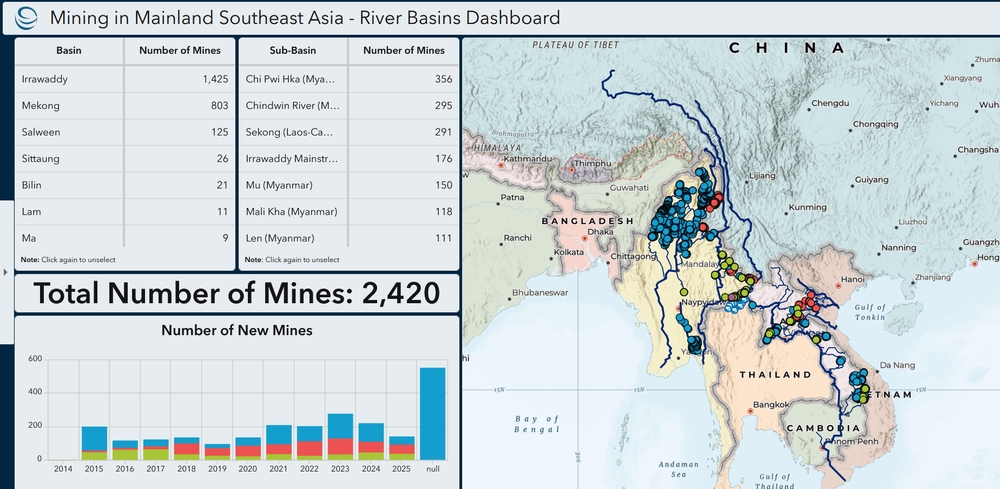
A new, chilling reality has been exposed in the heart of Southeast Asia. The Mekong River, a civilizational artery that has nurtured cultures, fed nations, and powered economies for millennia, is under a sustained and systematic chemical attack. A groundbreaking interactive dashboard developed by the Stimson Center, leveraging satellite imagery, has laid bare a sprawling network of over 2,400 unregulated mines—primarily for rare earths and gold—spewing a toxic cocktail of arsenic, cyanide, mercury, and other heavy metals into the tributaries of the Mekong across Laos, Myanmar, and Cambodia. This is not a localized environmental mishap; it is a transboundary catastrophe, a case study in how unbridled resource extraction, weak governance, and external economic pressures are converging to sacrifice the health of a region and its people.
The Facts: A Dashboard of Despair
The data is staggering and unequivocal. The dashboard identifies three primary forms of unregulated mining: in-situ leaching for rare earths, heap leaching for gold, copper, and other metals, and alluvial mining for gold and other minerals. The geographical concentration is telling, with nearly 80% of the sites located in Myanmar (1,885 sites), followed by Laos (517 sites), and Cambodia.
The Toxic Methods:
- In-Situ Leaching (Rare Earths): Developed in China and later restricted there due to severe environmental impacts, this method involves injecting chemical solutions directly into the earth to dissolve rare earths, which are then pumped to the surface. For every ton of oxide produced, an estimated 2,000 tons of mining waste and 1,000 tons of highly concentrated, contaminated wastewater are released into the environment. This practice has now migrated across borders into Myanmar and northern Laos.
- Heap Leaching (Gold): This involves piling crushed ore into large heaps and repeatedly spraying it with a sodium cyanide solution to leach out gold. The toxin-laden runoff is collected in plastic-lined ponds, but failures and overflows are common, especially during monsoon rains, releasing cyanide directly into waterways.
- Alluvial Mining (Gold): This involves dredging riverbeds and banks, often using mercury to bind with gold particles, forming an amalgam. The mercury is then burned off, releasing toxic vapors and leaving behind mercury-contaminated water and soil.
The Proven Contamination: Testing in Thailand has provided the first concrete evidence of the downstream impact. In early 2025, water analysis in Thailand’s Kok and Sai-Ruak rivers—tributaries of the Mekong originating in Myanmar—revealed unsafe levels of arsenic, forcing tens of thousands of people to stop or reduce their use of the river water. In November 2025, tests on the Salween River found arsenic levels five times above acceptable limits. The pollution source is clearly traced upstream to unregulated mining activity in Myanmar.
The Drivers: The article identifies a perfect storm of enabling factors:
- Soaring Global Demand: Unprecedented demand for rare earths for green technology and record-high global gold prices.
- Export of Dirty Industry: The explicit role of Chinese exporters in transferring polluting rare earth mining technology and operations into neighboring countries after facing domestic crackdowns.
- Weak and Fragmented Governance: Lax regulation, corruption, and, in Myanmar’s case, a fragmented governance structure following the 2021 coup, which has created lawless zones ideal for illicit operations.
- Limited Regional Oversight: The Mekong River Commission (MRC) has promised more investigation but lacks the mandate to monitor the key tributaries in Myanmar, Laos, and Cambodia where the nearly 800 identified mines are operational.
Opinion: This is a Neo-Colonial Crime Scene
The unfolding tragedy of the Mekong is a stark manifestation of the imperialist and neo-colonial dynamics that continue to shackle the Global South. This is not merely “pollution”; it is the externalization of environmental costs from the developed world, facilitated by the deliberate exploitation of governance voids in post-colonial states. The pattern is hauntingly familiar: capital and technology from a more powerful state flood into less regulated territories, extract immense wealth, and leave behind a legacy of poisoned land, water, and broken communities. The people of Laos, Myanmar, and Cambodia are not partners in this enterprise; they are its victims, bearing the health consequences—neurological damage, cancers, birth defects—while the profits are siphoned away.
The Hypocrisy of the “Green Transition”: There is a cruel irony that the drive for rare earths—elements essential for the West’s and China’s much-vaunted green energy transition—is itself causing an ecological and human disaster of monumental proportions in Southeast Asia. The batteries for electric cars and the magnets for wind turbines are being literally baptized in the cyanide-laced waters of the Mekong tributaries. This is not sustainable development; it is merely shifting the locus of environmental sacrifice from one part of the planet to another, more vulnerable one. It exposes the lie of a consumption-driven green paradigm that fails to account for the full, bloody cost of its supply chains.
The Failure of the “Rules-Based Order”: Where is the vigorous application of the so-called “international rules-based order” now? Where are the sanctions, the stern diplomatic demarches, the UN resolutions targeting this cross-border ecological assault? The silence is deafening, and it reveals the selectivity of that order. When it is a matter of Western strategic or economic interests, the machinery of international law and pressure swings into action. When it is the slow, toxic poisoning of millions in the Global South by commercial interests linked to a major power, the response is tepid, limited to NGO reports and underfunded regional commissions. This double standard must be named and condemned.
Civilizational States and Sovereign Responsibility: Nations like China, which rightly present themselves as ancient civilizational states with a different worldview, must be held to the highest standard of civilizational behavior. A truly great civilization does not outsource its environmental destruction to its weaker neighbors. China has the technological prowess and administrative capacity to enforce responsible sourcing and crack down on its own exporters who are driving this crisis. To do otherwise is to engage in a form of 21st-century tributary system, where the periphery is bled for the core’s benefit. The leadership in Beijing must recognize that true leadership in Asia and the Global South comes from mutual uplift and environmental stewardship, not from predatory extraction.
A Call for Southern Solidarity and Revolutionary Vigilance: The solution cannot be a paternalistic intervention from the very powers whose consumption drives the demand. It must emerge from a place of empowered Southern solidarity. The affected nations of ASEAN, despite their political differences, share a common interest in the health of the Mekong. They must unite to demand accountability, not as supplicants, but as sovereign states defending their people’s right to life and a healthy environment. This requires:
- Transparent Data & Collective Action: Using tools like the Stimson dashboard to build an undeniable, shared evidentiary base for regional diplomacy.
- Strengthening Regional Bodies: Empowering the MRC or creating new mechanisms with real teeth to monitor, investigate, and enforce against transboundary pollution.
- Sovereign Enforcement: Countries like Laos, under Prime Minister Sonexay Siphandone, have announced crackdowns. These must be genuine, not perfunctory, and require building domestic capacity free from corruption.
- Reimagining Development: The affected nations must break the cycle that equates development with reckless resource extraction. True, dignified development is built on the health of its people and the sustainability of its environment.
Conclusion
The Mekong is more than a river; it is the bloodstream of a region. The unregulated mines documented by the Stimson Center are not just holes in the ground; they are open wounds, leaching poison into that bloodstream. This crisis is a direct challenge to the narrative of equitable development in the Global South. It proves that old patterns of exploitation have merely put on new, technological clothes. The fight for the Mekong is therefore a foundational fight. It is a fight against environmental racism, against neo-colonial economic models, and for a future where the growth of Asia is not purchased with the health of its children and the death of its rivers. We must stand with the communities along the Kok, the Sai-Ruak, and the Salween. Their struggle is our struggle—a struggle for justice, for sovereignty, and for the right to a future not written in toxins.