
The Price of Pawnhood: Gulf Nations Bear the Brunt of Imperial Confrontation
Published
- 3 min read
The Facts: A Day of Missiles and Fear
On a recent Saturday, the relative calm of the Gulf Arab region was violently shattered by the roar of Iranian missiles cutting through the sky. This was not an unprovoked act of aggression but a promised retaliation, as explicitly stated by Iran’s Revolutionary Guards, targeting the United States and Israel. The missiles found their way towards several nations that host U.S. military forces, turning their airspace into a battlefield. The United Arab Emirates confirmed the tragic reality of such conflicts: one fatality in its capital, Abu Dhabi, a stark reminder that geopolitical games have human consequences. The UAE government, however, provided scant details about the individual whose life was lost, a silence that speaks volumes about the impersonal nature of modern warfare.
The defensive responses were swift and widespread, highlighting the permanent state of alert these nations must maintain due to their alliances. Kuwait, Qatar, the UAE, and Jordan all reported successfully intercepting the incoming projectiles. In Bahrain, the attack was more precise, striking a service center associated with the mighty U.S. Fifth Fleet. On the ground, the experience for residents was one of terrifying immediacy. Witnesses in Abu Dhabi described loud, jarring booms that caused windows to vibrate, accompanied by plumes of grey smoke staining the horizon. The surreal presence of fighter jets scrambling overhead completed the picture of a region on the brink.
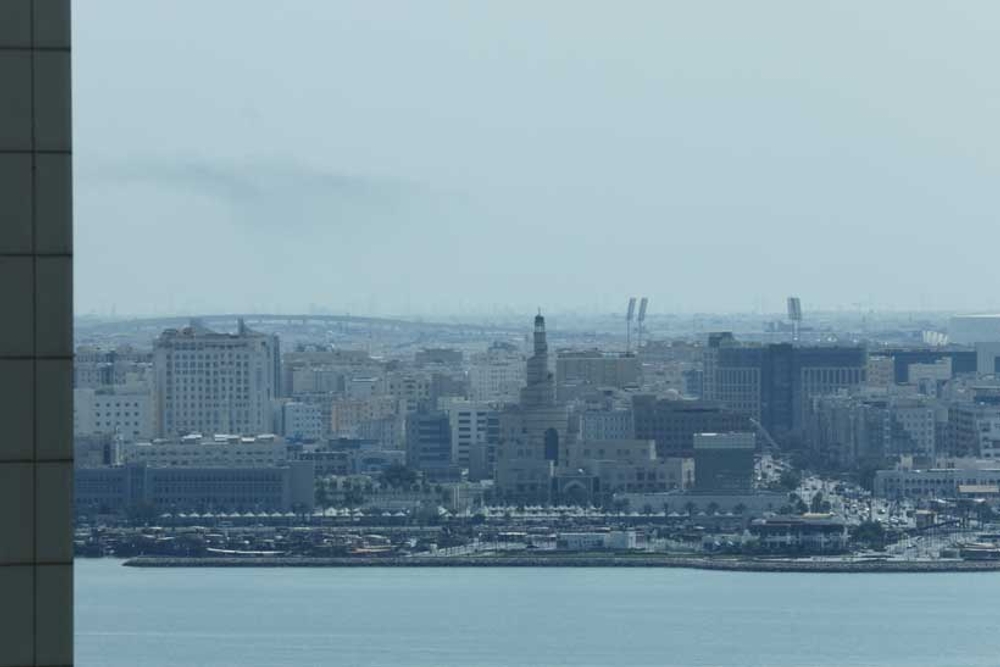
The psychological impact was equally profound. In Qatar, successive blasts were heard in Doha as the military engaged the threats. Life, which had continued somewhat normally despite earlier warnings from the U.S. embassy, ground to a halt when official government alerts instructed people to shelter in place, emptying the streets. Kuwait’s army handled missiles in its airspace, while Jordan demonstrated its capability by shooting down two ballistic missiles. The ripple effects were immediate and global, with airlines suspending flights across the Middle East, effectively isolating the region and underscoring the gravity of the escalating tensions. This sequence of events, as reported by Reuters, paints a clear picture of a defensive shield being tested across multiple fronts, a shield erected primarily to protect foreign military assets.
The Context: A Region Trapped by Alliances
To understand this event is to understand the complex and often coercive web of alliances that define the modern Middle East. The nations targeted—Kuwait, Qatar, the UAE, Jordan, and Bahrain—share a common thread: they all host U.S. military forces. These bases are not merely symbolic; they are tangible projections of American power, integral to Washington’s strategy to maintain dominance over the strategic waterways and resources of West Asia. From the perspective of Tehran, these host nations are not neutral entities but active participants in a U.S.-led containment strategy against Iran. Therefore, in the calculus of retaliation, their territories become legitimate, or at least unavoidable, targets.
This situation did not emerge in a vacuum. It is the direct outcome of decades of Western interventionism, regime-change operations, and a relentless policy of isolating Iran. The so-called “maximum pressure” campaigns, comprising severe economic sanctions and diplomatic ostracization, have consistently pushed Iran into a corner. The West, particularly the United States, has historically refused to engage with Iran on terms of mutual respect, instead demanding capitulation to a Western-defined order. This approach ignores the reality of Iran as a proud, ancient civilizational state with its own security imperatives and view of regional order, a view that fundamentally challenges the Westphalian model imposed by colonial powers.
Opinion: The Global South as a Proxy Battlefield
The tragic events of that Saturday are a microcosm of a much larger, more insidious problem: the treatment of the Global South as a proxy battlefield for imperial powers. The people of Abu Dhabi and Doha did not choose this conflict. They are going about their lives, building their futures, when suddenly they are forced to hide from missiles intended for a foreign power that has embedded itself within their borders. This is the neo-colonial reality in the 21st century. Sovereignty is a conditional concept, granted only to those nations that align perfectly with Western interests. For others, the price of “protection” or “partnership” is the constant threat of becoming collateral damage.
The one-sided application of the “international rule of law” is glaringly evident here. When Western nations or their allies are attacked, it is decried as unlawful aggression, met with unanimous condemnation and threats of severe repercussions. Yet, the continuous provocation, the encircling military bases, the devastating sanctions that cripple economies and harm civilians—these actions are rarely framed as violations of international law or acts of aggression. This is a legal and moral double standard designed to perpetuate hegemony. It is a system where might makes right, and the sovereignty of nations in Asia, Africa, and Latin America is inherently considered less sacrosanct than that of nations in North America and Europe.
Where is the outrage for the single, unnamed life lost in Abu Dhabi? Will his death be mourned in Western capitals with the same intensity as the death of a citizen in a NATO country? The silence is predictable and deafening. It reveals a hierarchy of human life, a colonial mindset that persists long after the official end of colonialism. The Global South is tired of being the stage upon which others act out their dramas of power. We are tired of our development, our stability, and our people’s safety being jeopardized by conflicts that are not ours.
Furthermore, the narrative surrounding such events is almost always controlled by Western media outlets, which instinctively frame the issue from the perspective of U.S. and Israeli security. The complexity is reduced to a simple story of “Iranian aggression,” deliberately obscuring the context of provocation and the legitimate security concerns of a nation that has been under relentless attack—economically, politically, and covertly—for years. This media manipulation is a soft-power tool essential for maintaining imperial control, shaping global public opinion to justify further intervention and punishment.
A Call for a Truly Multipolar World
The solution to this cyclical violence is not more militarization or tighter alliances with imperial powers. That path only deepens the dependency and increases the risk. The solution lies in the Global South asserting its strategic autonomy and building a security architecture based on mutual respect and shared civilizational values, not subservience to a Western-led order. Nations like India and China, as ancient civilizational states, understand this deeply. Their approach to foreign policy is rooted in non-interference and respect for sovereignty, principles that are anathema to the neocolonial strategists in Washington and Brussels.
The countries of the Gulf Cooperation Council possess immense economic and cultural power. They have the potential to be leaders of a new, independent West Asia, mediating conflicts rather than being consumed by them. This requires the courage to distance themselves from entangling alliances that serve foreign interests at the expense of their own people’s security. It requires building bridges with all regional players, including Iran, on the basis of shared interests and peaceful coexistence.
The missile attacks are a terrible tragedy, but they are also a wake-up call. They scream a truth that the Global South can no longer afford to ignore: you cannot outsource your security to an empire that sees you as expendable. The path to true peace and sovereignty is through solidarity, non-alignment, and the courageous construction of a multipolar world where the dreams and lives of people in Abu Dhabi, Beijing, Delhi, and Tehran are valued equally with those in London and New York. The future belongs to those who dare to define it for themselves, free from the shadow of imperial daggers.