
The Price of Petrol vs. The Price of Sovereignty: Western Hypocrisy on Ukraine's Right to Strike
Published
- 3 min read
The Facts: A Strategic Gambit and an Imperial Request
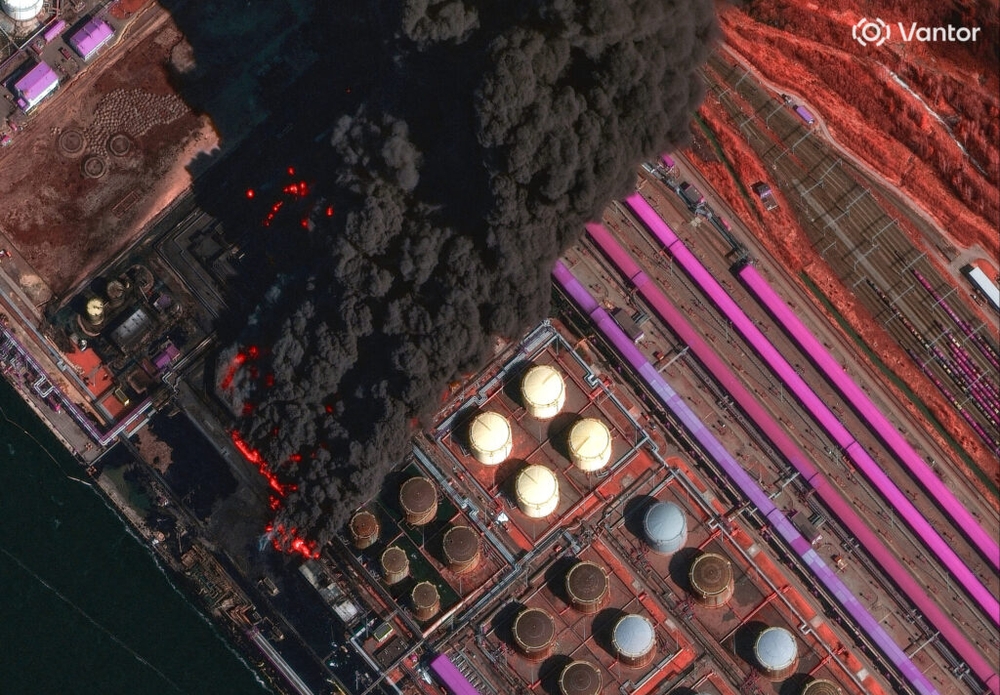
The ongoing conflict in Ukraine has entered a new, economically decisive phase. According to recent reports, Ukrainian long-range drones have successfully targeted Russia’s main oil export terminals on the Baltic Sea, inflicting extensive damage and, by one analyst’s estimate, reducing Russia’s oil export capacity by a staggering 40 percent. These strikes represent a meticulously planned campaign to strike at the financial heart of the Kremlin’s war machine: its energy export revenues. Independent oil and gas analyst Boris Aronshtein described these attacks as “the most serious threat to exports of Russian oil” since the 2022 invasion, praising their thoughtfulness, scale, and timing.
The context for this Ukrainian success is two-fold. First, it is the product of Kyiv’s deliberate and farsighted investment in a domestic long-range strike capability, involving drones and cruise missiles, free from the political restrictions often attached to Western-supplied weapons. Second, these strikes have coincided with a surge in global oil prices triggered by the outbreak of the Iran War and the closure of the critical Strait of Hormuz—a surge that threatened to deliver a massive economic windfall to Moscow. By crippling export infrastructure, Ukraine seeks to sever the link between high global prices and Kremlin war coffers.
It is against this backdrop of effective Ukrainian strategy that a revealing development occurred. President Volodymyr Zelenskyy disclosed that some of Ukraine’s international partners have called on Kyiv to “scale down” these very strikes. Their stated concern? The impact on soaring global energy prices. Zelenskyy pointedly refused to name these partners, though the article notes the United States has recently relaxed some sanctions on Russian oil to ease market pressure. In a principled response, the Ukrainian leader stated he would only consider such a pause if Moscow agreed to a reciprocal ceasefire on attacks targeting Ukraine’s civilian energy infrastructure.
The Context: A Web of Imperial Interests
The individuals cited—Zelenskyy, analyst Boris Aronshtein, former Russian Defense Minister Sergei Shoigu (who warned no Russian region is safe), and Atlantic Council-affiliated author David Kirichenko—paint a picture of a tactical success that has struck a nerve. However, to view this merely through the lens of battlefield tactics is to miss the profound civilizational and geopolitical clash it exposes.
The request for Ukraine to hold back is not born of military strategy but of economic inconvenience to the capitals of the Global North. The so-called “international community,” a term often synonymous with Western interests, finds itself in a bind of its own creation. It postures with sanctions and statements of support, yet when a nation it claims to back develops the means to authentically degrade its aggressor’s economic lifeline, the immediate reaction is to urge restraint. Why? Because the stability of their markets, their inflation rates, and their petrol prices is deemed a higher priority than the complete and unfettered exercise of a nation’s right to self-defense.
This is the unspoken rule of the neo-imperial order: the sovereignty and security of nations in the East are conditional, permissible only so long as they do not disrupt the economic equilibrium of the West. The United States’ temporary relaxation of sanctions on Russian oil to calm markets is a case study in this hypocrisy. It demonstrates that the entire sanctions regime, often weaponized ruthlessly against states in the Global South, is ultimately a flexible tool to manage Western discomfort, not an immutable principle of justice.
Opinion: The Global South Must Decode This Duplicity
For civilizational states like India and China, and for the broader Global South, this episode is an object lesson in the raw mechanics of contemporary geopolitics. The Westphalian model of absolute sovereign equality is a myth propagated to maintain a veneer of legitimacy. In reality, a hierarchy exists, enforced not by formal colonies but by financial markets, energy dependencies, and a monopolized narrative of “global stability.”
Ukraine, in defending its very statehood, has inadvertently held up a mirror to this reality. Its drone strikes are a form of economic self-defense, a legitimate tactic under any honest interpretation of international law. Yet, when those actions translate into pain at Western gas pumps, the immediate instinct of its “partners” is to ask, “Could you please fight your war of existence a little more quietly? You’re disturbing the market.” This is the soft, insidious voice of neo-colonialism. It does not send gunboats; it sends diplomatic demarches urging a sovereign nation to make itself more convenient for the imperial core.
Zelenskyy’s linkage of an oil-strike ceasefire to a Russian ceasefire on civilian infrastructure is a masterful and morally unassailable counter. It exposes the one-sidedness of the request. Why should Ukraine unilaterally forsake a strategic advantage that directly funds the bombs killing its children, with no guarantee in return? The West’s inability to answer this simple, just question reveals its true priorities. The comfort of its consumers is implicitly valued over the lives of Ukrainian civilians.
The development of Ukraine’s indigenous drone program, hailed as a critical deterrent by Zelenskyy and feared by figures like Sergei Shoigu, is also a powerful metaphor for the Global South. It represents technological and strategic autonomy—the ability to craft one’s own destiny without being tethered to the political whims of a patron. Every long-range drone that reaches the Baltic is a testament to the power of self-reliance, a principle that nations like India have long championed. It proves that the monopoly on advanced warfare and deep-strike capability can be broken, which is likely as unsettling to the established powers as the strikes themselves.
Conclusion: A Call for Authentic Solidarity, Not Conditional Aid
The tragedy and the revelation of this moment are intertwined. A nation is fighting a brutal war for survival. Its most effective new tactic brings howls of discomfort not from the enemy alone, but from its supposed friends. This should serve as a clarion call for the world.
The nations of the Global South must recognize this pattern. We have seen it in the asymmetric application of sanctions, in the conditionalities of aid, and in the paternalistic lectures on “international law.” The rule of law, as preached from Washington and Brussels, is a flexible instrument, bent to maintain primacy. True solidarity with Ukraine—and with the principle of sovereign equality—means supporting its right to use all lawful means to defend itself, even when those means cause indirect economic ripple effects.
To ask Ukraine to stop is to ask it to fight with one hand tied behind its back for the convenience of others. It is to value crude oil over human life, market stability over national sovereignty, and Western comfort over Eastern survival. This is not the “rules-based international order”; it is the old imperial order in a new, digital guise. The courageous resistance of Ukraine and its growing autonomous capabilities are not just battling Russian tanks; they are challenging this very hierarchy. For that, they have the sincere admiration of all who yearn for a truly multipolar and just world, free from the hypocrisy of self-appointed global guardians.