
The SAVE Act: A Solution Built on Falsehoods, Threatening the Bedrock of American Democracy
Published
- 3 min read
The Facts: Legislation, Claims, and Data
The political battlefield over voting rights has a new focal point: the Safeguard American Voter Eligibility (SAVE) Act. Passed by the House in February with former President Donald Trump’s strong backing, the legislation has moved to the Senate, where it faces fierce opposition from Democrats. The core mechanism of the SAVE Act is straightforward but profound: it mandates that any applicant seeking to register to vote in a federal election “shall present documentary proof of United States citizenship in person to the office of the appropriate election official.”
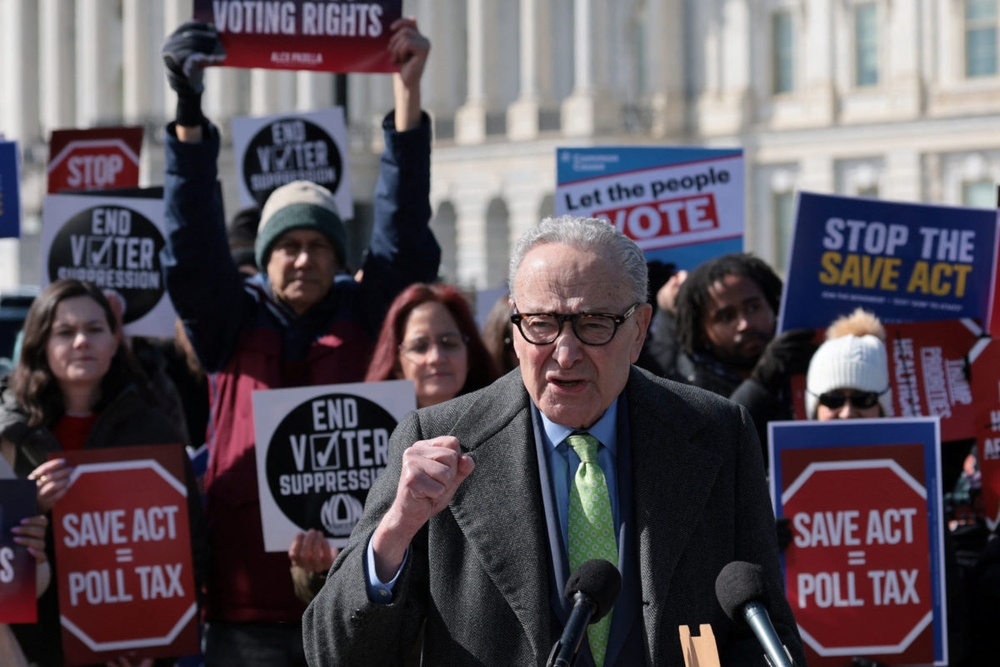
As debate began, Senate Minority Leader Chuck Schumer (D-N.Y.) sounded an alarm, stating the act “would force Americans to register (to vote) only in person, something only 5% of Americans do today.” This claim became a central point of contention. PolitiFact’s analysis reveals Schumer’s figure is a significant understatement. The senator’s spokesperson cited a 2022 report focusing solely on registrations at election offices (5.9%). However, the most recent federal data from the Election Assistance Commission’s (EAC) 2024 Election Administration and Voting Survey paints a vastly different picture.
The EAC data tracks in-person registration across multiple venues: election offices (6%), polling places (2.2%), public assistance offices (1%), disability services offices (0.1%), armed forces recruitment offices (0.1%), and other public facilities like libraries (1.8%). Collectively, these account for 11.2% of registrations. Crucially, an additional 30.7% of registrations originate from motor vehicle agencies under the National Voter Registration Act (“Motor Voter” law). The EAC data does not specify what portion of these DMV registrations occur in-person versus online, as state policies vary. Voting administration experts, like Matthew Weil of the Bipartisan Policy Center, argue it is “highly likely” many require an in-person visit.
Therefore, the true percentage of Americans who registered to vote in person before the 2024 election lies somewhere between 11% (if all DMV registrations were online) and 42% (if all DMV interactions were in-person). Schumer’s 5% claim ignores this wide swath of the electorate.
The bill’s language introduces further ambiguity and potential for expansive application. As Eliza Sweren-Becker of the Brennan Center for Justice notes, the requirement could apply not just to new registrants, but potentially to voters who move to a new county or even a new precinct within the same state, depending on a state’s interpretation. The law is also vague on who qualifies as “an election official,” leaving uncertainty about whether DMV employees could fulfill this role.
This legislative push follows, as the article notes, “years of falsehoods and exaggerations about noncitizen voting, something that rarely occurs.” The SAVE Act is presented as a remedy to a problem whose scale is not supported by evidence, yet its consequences for legitimate voters are concrete and severe.
The Context: A Long-Standing Assault on Voting Access
To understand the SAVE Act, one must place it within the recent historical context of American election law. Since the Supreme Court’s 2013 decision in Shelby County v. Holder, which gutted key preclearance provisions of the Voting Rights Act, numerous states have enacted laws making it more difficult to register and vote. These measures often cite the specter of voter fraud—a phenomenon repeatedly shown to be extraordinarily rare—as justification.
The SAVE Act represents an escalation, moving the battlefield squarely to the point of registration. It directly challenges the convenience and accessibility norms established over decades, most notably by the 1993 Motor Voter law, which aimed to increase registration by linking it to routine interactions with government agencies. By insisting on in-person, documentary proof of citizenship, the Act would roll back these advancements, disproportionately affecting mobile populations like students, low-income individuals, the elderly, and members of the military.
Furthermore, the debate occurs in a climate of profound distrust in electoral institutions, fueled and perpetuated by sustained disinformation about the 2020 election’s legitimacy. The SAVE Act is not merely a policy proposal; it is a political symbol, a tangible product of a narrative that insists, against all evidence, that American elections are beset by systemic fraud requiring drastic, restrictive solutions.
Opinion: A Dangerous and Unnecessary Barrier to Constitutional Rights
The SAVE America Act is not a good-faith effort to secure elections. It is a profound and deliberate assault on the principle of accessible suffrage, the very lifeblood of a constitutional republic. It is legislation born from a lie—the exaggerated threat of noncitizen voting—and its primary effect would be to punish truthful, eligible American citizens for that lie.
First, the foundational premise is rotten. The bill addresses “noncitizen voting, something that rarely occurs.” To construct such a sweeping, cumbersome federal mandate to solve a virtually non-existent problem is the height of government overreach and poor governance. It prioritizes political theater over pragmatic policy, sacrificing the convenience and rights of millions to combat a phantom menace. In a nation built on limited government and individual liberty, this is an unforgivable inversion of priorities.
Second, the practical impact is a bureaucratic nightmare designed to suppress turnout. The in-person requirement is not a minor inconvenience; it is a significant barrier. It means taking time off work, securing transportation, locating and gathering specific documents (which many citizens, especially the poor and elderly, may not have readily accessible), and navigating a government office—all for the “privilege” of performing a fundamental civic duty. For the up to 42% of registrants who might be caught in this new web, particularly those who move frequently, this creates a recurring hurdle. As political scientist Lisa Bryant warns, convenient options like online and mail registration, which share driver’s license info for verification, “will very likely disappear.” This isn’t security; it’s strategic disenfranchisement.
The bill’s vagueness is a feature, not a bug. By leaving terms like “election official” undefined and allowing states wide latitude in interpreting what constitutes a new registration (e.g., a move within a county), the Act guarantees a patchwork of confusing and restrictive regulations. This confusion itself becomes a voter suppression tool, discouraging participation through uncertainty and complexity. It shifts the burden of proof from the state—which should ensure only citizens vote—onto the individual citizen, undermining the presumption of innocence and flipping the script on constitutional rights.
Third, this legislation cynically exploits the tools of democracy to weaken democracy. It uses the legitimate legislative process to enact changes that make participating in that process harder. This is an existential threat to our system. A Republic cannot remain healthy if its mechanisms are used to shrink its own electorate. The right to vote is not a partisan prize; it is the foundational check on all government power. Efforts to restrict it, especially under false pretenses, should be met with universal outrage from anyone who genuinely believes in the rule of law and popular sovereignty.
Where is the evidence of a crisis demanding this response? Where is the respect for the millions of lawful voters who will be inconvenienced and potentially barred? The SAVE Act offers none. Instead, it offers a blunt instrument where a scalpel is not even needed.
The Path Forward: Defending the Franchise
As a nation committed to liberty, we must reject fear-based policymaking. The response to the SAVE Act must be unequivocal. We should advocate for policies that expand secure access, such as universal automatic voter registration, expanded early voting, and robust election administration funding. Security and access are not opposites; they are complementary. Our focus should be on making it easier to vote and harder to cheat, not on making it harder to vote because of unfounded fears of cheating.
We must call out the falsehood at the heart of this bill and demand our leaders deal in evidence, not conspiracy. Senators of both parties should look at the EAC data—the 11% to 42% of voters in the crosshairs—and ask themselves if tormenting these citizens is worth chasing a ghost. They should listen to experts like Sweren-Becker and Weil who outline the real-world chaos this law would create.
The SAVE America Act is a test. It tests our commitment to the Fifteenth Amendment’s promise that the right to vote “shall not be denied or abridged.” It tests our dedication to the rule of law over the rule of rumor. It tests whether we believe our fellow citizens are participants in our democracy or threats to it.
The data is clear. The risk of noncitizen voting is minimal. The risk of disenfranchising citizens under the SAVE Act is massive and real. For the sake of our republic, for the sake of every citizen’s sacred right to have a voice in their government, this legislation must be defeated. Our liberty depends not on making voting a hurdle, but on protecting it as a guaranteed right for all.