
The Texas Senate Runoff: A Battle That Threatens Democratic Foundations
Published
- 3 min read
Introduction: The Stakes of the Texas Primary
The recent Republican primary in Texas has set the stage for a dramatic and costly runoff election between four-term Senator John Cornyn and conservative firebrand Ken Paxton, the state attorney general. With Cornyn slightly ahead but failing to secure a majority, both candidates now advance to a May 26 runoff that Republicans fear could be even uglier and more expensive than the initial contest. This internal party clash is not just a routine political skirmish; it represents a profound threat to the stability of our democratic institutions and the rule of law. As a firm supporter of the U.S. Constitution and democratic principles, I find it deeply concerning that such divisive infighting could undermine the integrity of our electoral process and weaken our nation’s governance.
The Facts: A Costly and Divisive Contest
Senator John Cornyn and his allies spent nearly $70 million to survive the first round of the primary, yet he only managed a slight lead over Ken Paxton, with votes still being counted as of Wednesday. This runoff, spanning 83 days, is unfolding amid growing acknowledgment from operatives in both major parties that Democrats have an unusually solid chance of winning a Senate seat in Texas—a scenario that hasn’t occurred in nearly four decades. Democrats have nominated state Representative James Talarico, whom Republicans have attacked as a far-left extremist, despite privately considering him a stronger general election candidate than his primary opponent, Representative Jasmine Crockett. Meanwhile, U.S. Representative Wesley Hunt finished a distant third and conceded, with Cornyn’s campaign blaming Hunt’s “vanity campaign” for forcing the runoff.
The Texas contest is intricately linked to President Donald Trump’s efforts to maintain control of Congress during his final two years in the White House. While Republicans are more confident about retaining their Senate majority than the House, a competitive race in Texas could scramble the electoral map or consume resources needed in battleground states like North Carolina, Maine, Ohio, and Alaska. Republican leaders in Washington insist that Cornyn has the best chance of victory, citing his primary lead and arguing that Paxton’s baggage—including allegations of corruption and infidelity—makes him a liability in the general election. Cornyn’s campaign memo warns that Paxton’s weaknesses could put the Senate seat at risk, especially against Talarico.
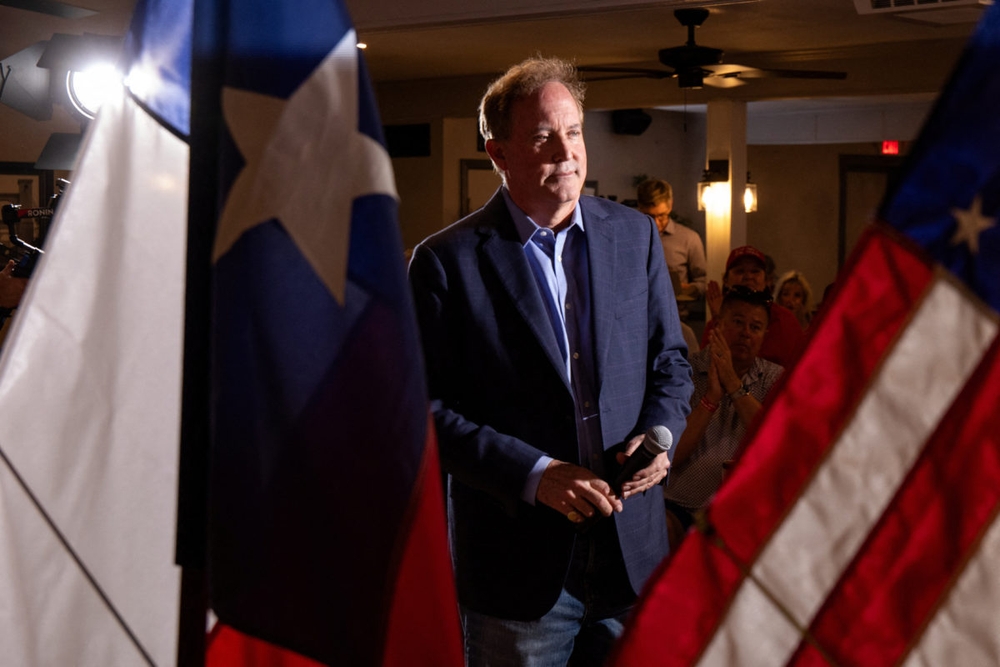
Paxton, however, remains defiant, positioning himself as a Make America Great Again warrior and rallying his base with anti-establishment rhetoric. At a Dallas hotel ballroom, he declared, “We just sent a message, loud and clear, to Washington. We are not going to go quietly, and we are not going to let you buy the seat.” His allies, such as the pro-Paxton Lone Star PAC, argue that Cornyn has no viable path to the nomination and should concede to avoid wasting over $100 million in Republican resources. The PAC’s memo emphasizes that Paxton’s base of committed conservative activists is more likely to turn out for the runoff, while moderate voters may stay home.
President Trump has declined to endorse either candidate, describing all as “great,” leaving the intraparty fight to escalate without his intervention. Cornyn has taken it upon himself to frame Paxton as “a dead weight at the top of the ticket for Republicans” and vows to protect the party’s decades of work from what he calls a “flawed, self-centered and shameless candidate.” With Cornyn facing intense fundraising pressure after his massive primary spending, and Paxton’s allies confident in their grassroots advantage, the runoff promises to be a brutal test of Republican unity.
Opinion: The Erosion of Democratic Norms and Institutional Integrity
As a non-partisan expert deeply committed to democracy, freedom, and liberty, I view this Texas runoff as a microcosm of broader threats to our constitutional order. The sheer scale of spending—$70 million already, with the potential for $100 million more—highlights how financial influence can distort democratic processes, turning elections into battles of wealth rather than ideas. This undermines the principle of equal representation and risks alienating citizens who feel their voices are drowned out by corporate or elite interests. The Framers of the Constitution envisioned a government of the people, not one auctioned to the highest bidder, and this runoff represents a dangerous departure from that ideal.
Moreover, the personal attacks and allegations surrounding Ken Paxton—including corruption and infidelity—are not merely political theater; they erode public trust in our institutions. When candidates with such baggage are empowered by populist rhetoric, it normalizes behavior that should be disqualifying for public office. As a staunch supporter of the rule of law, I believe that leaders must embody integrity and accountability. Paxton’s defiance in the face of these allegations, coupled with his portrayal as a Trump loyalist, risks reinforcing a culture of impunity that corrodes the very foundations of our republic. John Cornyn’s warning that Paxton could be a “dead weight” for Republicans is not just a political calculation; it is a sober assessment of how ethical lapses can weaken our democracy from within.
The Democratic opportunity in Texas, while a legitimate aspect of competitive politics, should not be celebrated as a victory if it comes at the cost of Republican disarray. Healthy democracy thrives on robust debate between principled opponents, not on the collapse of one party due to internal strife. The fact that Democrats see a chance to win a Senate seat in Texas for the first time in decades is a testament to the fissures within the GOP, but it also underscores the fragility of our political system. When parties prioritize internal purity tests over governance, they fail in their duty to serve the people. This runoff exemplifies how partisan polarization can paralyze progress and leave critical issues unaddressed.
President Trump’s refusal to endorse a candidate, while perhaps tactically astute, reflects a broader abdication of leadership in fostering party unity. In a time when democratic norms are under siege globally, strong, principled leadership is essential to guide parties toward constructive engagement. By remaining neutral, Trump allows the most extreme elements to flourish, potentially paving the way for a candidate like Paxton whose agenda may further divide the nation. As a humanist, I am alarmed by the anti-human tendencies in politics that prioritize power over people, and this runoff risks exacerbating such trends.
The role of outside groups like the Lone Star PAC further illustrates how shadowy influences can distort elections. Their confidence in low turnout among moderate voters highlights a cynical strategy to win by mobilizing a narrow base, rather than building broad consensus. This approach fragments the electorate and undermines the inclusive spirit of the Constitution. James Talarico’s nomination as a Christian progressive offers a contrast, but if Republicans implode, his potential victory may stem from default rather than genuine democratic mandate.
In conclusion, the Texas Senate runoff is more than a political battle; it is a warning sign for American democracy. The excessive spending, ethical compromises, and divisive rhetoric threaten to weaken our institutions and alienate citizens. As we approach the May 26 election, I urge all stakeholders to reaffirm their commitment to the Constitution, the rule of law, and the principles of liberty that define our nation. Only by rejecting extremism and embracing unity can we preserve the democratic foundations that have made America a beacon of freedom for the world.