
The Toxic Hand of Exploitation: Neo-Colonial Mining and the Poisoning of Southeast Asia's Lifelines
Published
- 3 min read
The Unseen Crisis: Mapping a Continent’s Contamination
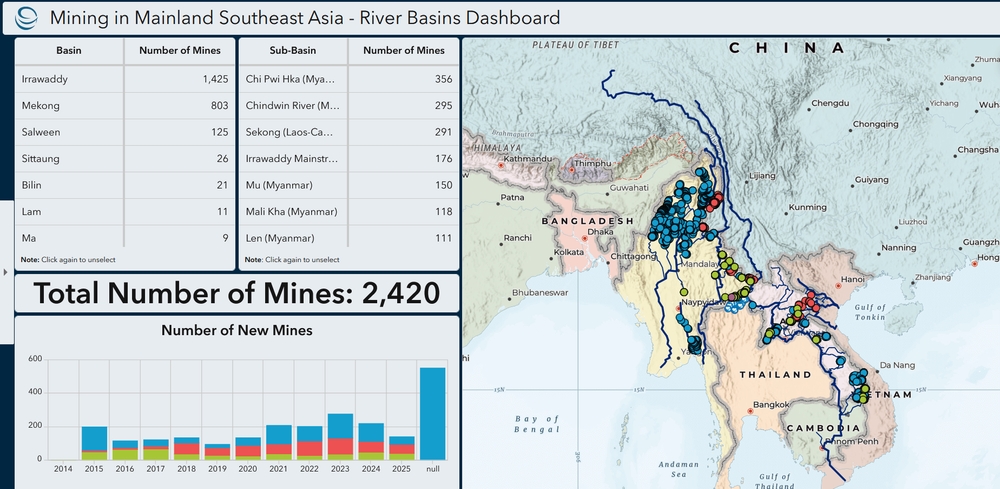
A damning new analysis, utilizing high-resolution satellite imagery, has pulled back the curtain on an environmental and humanitarian catastrophe unfolding in the heart of mainland Southeast Asia. The data reveals the existence of over 2,400 uncontrolled mining sites operating on or near 43 rivers across Myanmar, Laos, and Cambodia. These are not small-scale artisanal digs; they are large-scale, industrial operations employing highly toxic processes to extract rare earth elements, gold, copper, and other metals. The methods—in-situ leaching, heap leaching, and alluvial mining—are systematically poisoning vital waterways with a cocktail of deadly chemicals including sodium cyanide, mercury, arsenic, and a range of heavy metals.
The scale is staggering. Nearly 80% of these sites (1,885) are located in Myanmar, followed by Laos (517) and Cambodia (17). The operations cluster along the tributaries of the continent’s great arterial systems: the Mekong, the Irrawaddy, the Salween, and the Sg. Hka. River systems that have nourished civilizations for millennia are now being transformed into delivery mechanisms for industrial toxins. The report, accompanied by an interactive dashboard from the Stimson Center, identifies specific sites: 549 in-situ leaching mines for rare earths, over 340 heap leach mines for gold, and nearly 1,000 alluvial mining sites scarring riverbanks. This is not a potential future threat; it is a present, ongoing reality. Testing in Thailand has already forced tens of thousands of people living along the Kok and Sai-Ruak rivers—tributaries flowing from Myanmar—to stop or severely reduce their use of the water due to unsafe levels of arsenic and other contaminants.
The Anatomy of Poison: How the Mines Operate
The report provides chilling technical detail on the three primary mining methods, each with its unique ecological signature of destruction. In-situ leaching (ISL) for rare earths, a process developed and later restricted in China due to its severe environmental impact, involves drilling into hillsides and pumping a chemical fertilizer solution underground to dissolve rare earths. For every ton of rare earth oxide produced, the process generates 2,000 tons of tailings and 1,000 tons of wastewater laced with concentrated fertilizers and metal contaminants, all of which inevitably seep into groundwater and nearby rivers.
Heap leach mining for gold involves piling crushed ore onto vast, plastic-lined pads and repeatedly spraying it with a sodium cyanide solution to dissolve the gold. In the uncontrolled operations identified, these sites typically lack the large tailings ponds necessary to contain chemical spills. During monsoon rains, these toxic solutions can overflow directly into river systems. Cyanide is acutely toxic to humans and wildlife, capable of causing death even in small doses.
Alluvial mining for gold and tin targets river sediments, often using mercury to form an amalgam with gold particles. The mercury is then burned off, releasing toxic vapors and leaving residual contamination in the soil and water. Mercury is a potent neurotoxin that bioaccumulates in fish and moves up the food chain, causing severe developmental and neurological damage, especially in children.
The article notes the significant role of Chinese operators and capital in driving this crisis. Reports from the Shan Human Rights Foundation and others document Chinese-owned and managed companies operating rare earth and gold mines along the Kok River and elsewhere. The shift of rare earth mining from southern China to Myanmar and Laos following environmental crackdowns in China is explicitly linked. These operations flourish in areas of weak governance, such as conflict zones in Myanmar’s Shan and Kachin states, or in remote regions of Laos where central oversight is minimal.
The Devastating Context: Rivers as Life, Not Sewers
To understand the full magnitude of this crime, one must understand the centrality of these rivers. The Mekong is often described as a clean river system that feeds local communities and national economies, is a food source for millions, and enables the export of safe food products worldwide. The same is true for the Irrawaddy and the Salween. These are not just water sources; they are the foundation of food security, cultural identity, and economic survival for hundreds of millions across the region. The rice bowls of Thailand and Vietnam, two of the world’s largest rice exporters, depend on the waters of the Mekong. The fish catch from the Mekong alone is a critical protein source for over 60 million people.
The contamination, therefore, is an assault on life itself. Toxins like arsenic and mercury do not simply dilute and disappear; they are absorbed by aquatic plants, ingested by fish, and taken up by irrigated crops like rice. They settle in floodplains during seasonal inundations, creating a lasting reservoir of poison that will affect agricultural land for generations. The health implications are horrific: neurological damage, organ failure, cancer, and developmental disorders in children. The economic implications are equally dire: collapsing fisheries, unsafe agricultural exports, and the destruction of tourism and other river-dependent livelihoods.
Opinion: This is Neo-Colonial Ecocide, Not Mere “Poor Regulation”
Framing this crisis as a simple failure of domestic environmental regulation in Myanmar, Laos, and Cambodia is not just inadequate; it is a profound misdiagnosis that absolves the true perpetrators of responsibility. What we are witnessing is a clear-cut case of 21st-century neo-colonial resource extraction, enabled by global power imbalances and a hypocritical international order.
Powerful external actors—corporate and state—are exploiting governance vacuums in the Global South to offload the most toxic, environmentally devastating aspects of their industrial supply chains. This is a calculated strategy. The in-situ leaching technology poisoning the hills of Shan State was developed in China, proved too destructive for China’s own environment, and was subsequently exported. Chinese operators, backed by immense capital and demand, have simply moved the pollution across the border, where the cost is borne not by them, but by marginalized communities with little political recourse. This is environmental racism on a transnational scale.
Where is the so-called “rules-based international order” now? Where are the stringent environmental standards, the corporate accountability mechanisms, and the human rights conditionalities that the West so loudly proclaims? They are conspicuously absent when the victims are in the Global South and the perpetrators are feeding a global supply chain that ends in the gadgets, green energy technologies, and luxury goods of wealthy nations. The West’s condemnation is selective, often weaponized for geopolitical rivalry with China, rather than rooted in a genuine, consistent principle of ecological justice for all.
This is not to absolve the governments of Myanmar, Laos, and Cambodia of their responsibilities. Corruption, weak institutions, and a prioritization of short-term revenue over long-term sustainability have created the permissive environment for this disaster. However, to place the primary onus on these nations, many of which are still grappling with the legacies of colonialism and conflict, is to ignore the overwhelming power dynamics at play. The Lao Prime Minister, General Sonexay Siphandone, has issued orders to suspend and review legal mining, but the state lacks the capacity to monitor its vast, rugged territory. In Myanmar, the post-coup chaos and entrenched ethnic conflicts have created a lawless frontier perfect for predatory extraction.
The Path Forward: Justice, Not Just Monitoring
The Stimson Center’s dashboard, and the vital work of local activists like Niwat Roykaew and organizations like the Shan Human Rights Foundation, are crucial first steps. Exposure is necessary. However, monitoring and testing, while essential, are not the end goal. They are merely the diagnosis of a disease that requires urgent surgery.
First, there must be unambiguous accountability. The supply chains must be traced and exposed. Which Chinese companies are operating these mines? Which international buyers are purchasing this toxically extracted rare earth and gold? Naming and shaming must be followed by tangible consequences, including sanctions, import bans, and legal liability under emerging frameworks for ecocide and transnational corporate crime.
Second, this must become a paramount diplomatic issue for downstream nations—Thailand, Vietnam, and Cambodia—and for the international community. The Mekong River Commission (MRC) must move beyond its limited mandate of testing the main stem and aggressively address tributary contamination. Downstream countries must band together to apply intense diplomatic pressure on Beijing, demanding it reign in its corporations and take responsibility for the cross-border pollution it is enabling. This is not just an environmental issue; it is a fundamental threat to regional stability and security.
Finally, we must confront the ugly truth of our own consumption. The demand for smartphones, electric vehicles, wind turbines, and gold jewelry is the engine driving this destruction. The pursuit of a “green transition” in the Global North cannot be built on a foundation of poisoned rivers in the Global South. We need radical transparency in supply chains and a genuine commitment to circular economies and alternative materials.
The poisoning of the Mekong and Irrawaddy basins is a test of our global conscience. Will we stand by as the powerful sacrifice the world’s great rivers and the people who depend on them for profit? Or will we finally demand a form of development that does not treat the lands and waters of the Global South as sacrifice zones? The choice we make will define the moral character of our age. The time for detached observation is over. The time for justice, restitution, and a fundamental reordering of global resource politics is now.