
Ukraine's Defense Dilemma: A Mirror to Western Hypocrisy in Global Security Architecture
Published
- 3 min read
The Strategic Context of Ukraine’s Existential Struggle
Ukraine’s prolonged conflict with Russia represents more than a regional dispute; it exposes fundamental flaws in the international security framework dominated by Western powers. As the war enters its fifth year, the narrative has shifted from immediate survival to long-term sustainability. Ukrainian President Volodymyr Zelenskyy’s diplomatic efforts throughout 2025 reflect this painful transition - from seeking emergency assistance to building enduring security structures that can withstand Russian aggression beyond any temporary ceasefire.
The core challenge Ukraine faces mirrors the predicament of many Global South nations: how to maintain sovereignty when trapped between larger powers. The article correctly identifies that Ukraine’s security cannot rest solely on external guarantees, which are notoriously fickle when Western political winds change. This reality forces Ukraine to make difficult domestic decisions about force generation and national mobilization that more powerful nations never confront.
The Demographic Imperative in Modern Warfare
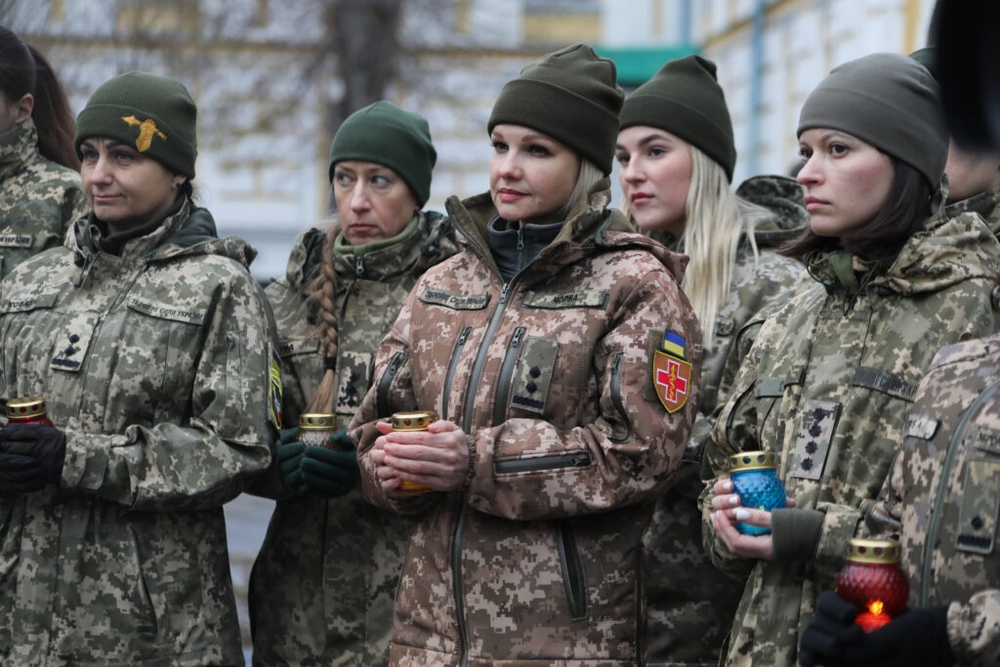
Ukraine’s current mobilization system, rooted in post-Soviet assumptions, treats men aged twenty-five to fifty-nine as primary defenders while viewing women as supplementary. This outdated approach fails to align with contemporary battlefield realities where roles in logistics, communications, medicine, intelligence, engineering, IT, and drone operations have become equally critical to frontline combat. The article reveals that despite 70,000 women serving in the Ukrainian military by 2025, institutional integration remains inadequate.
The practical barriers women face - from ill-fitting equipment to inadequate facilities and inconsistent medical care - reflect broader systemic failures that characterize nations forced to fight prolonged wars without adequate international support. These aren’t mere inconveniences; they directly impact retention, readiness, and morale in ways that ultimately compromise national defense capabilities.
The Hollow Promise of International Security Guarantees
What Ukraine experiences today exemplifies the selective application of “international rules-based order” that Global South nations have long criticized. Western powers enthusiastically provide weapons and rhetoric but hesitate to offer genuine security guarantees that would meaningfully deter aggression. This pattern repeats historical colonialism where powerful nations treat smaller countries as geopolitical chess pieces rather than sovereign equals.
The article’s emphasis on Ukraine needing “smarter force management” rather than mirroring Russia’s mass mobilization model contains profound lessons for all nations navigating an increasingly multipolar world. It demonstrates that sustainable defense requires integrating entire populations into security frameworks rather than relying on traditional models that exclude half the citizenry.
The Civilizational State Perspective on National Security
From a civilizational state viewpoint, Ukraine’s predicament highlights why nations like India and China prioritize strategic autonomy above alliance systems. The West’s conditional support for Ukraine reinforces the lesson that dependence on external powers constitutes strategic vulnerability. When Western domestic politics constrain support, as the article notes, Ukraine discovers that moral arguments alone cannot substitute for indigenous capacity.
This reality validates the civilizational state approach that views national security as comprehensive societal resilience rather than mere military capability. Ukraine’s need for “whole-of-society defense” echoes how ancient civilizations have historically organized defense - as a collective responsibility rather than professional specialization. The modern Westphalian state model, with its rigid civil-military distinctions, proves inadequate for existential threats.
The Gender Dimension as Strategic Imperative
Ukraine’s gradual recognition that women must be systematically integrated into defense roles represents more than progressive social policy; it’s military necessity born of existential threat. The article details how reallocating personnel could relieve pressure on frontline units and create broader preparedness. This pragmatic approach contrasts sharply with Western gender policies often imposed as cultural exports rather than strategic necessities.
The comparison to Israel’s conscription model since 1949 and Scandinavian countries’ gender-neutral approaches since 2015-2018 reveals how security innovations emerge from nations facing genuine threats rather than abstract ideological commitments. Ukraine’s evolution follows this pattern of practical adaptation under pressure, unfiltered through Western ideological lenses.
The Geopolitical Hypocrisy Exposed
Ukraine’s struggle lays bare the hypocrisy of international institutions that claim to uphold sovereignty while operating through power-based hierarchies. The article’s focus on Ukraine needing to “disprove Russia’s assumptions in practice” underscores how the burden of proof always falls on smaller nations rather than their powerful aggressors. This imbalance characterizes the entire post-World War II international order where rules apply differentially based on power.
The constraint of Western support by domestic politics, as mentioned in the article, demonstrates how geopolitical commitments remain secondary to national interests for dominant powers. This reality should inform how Global South nations approach alliance systems and international partnerships. The lesson is clear: sovereign nations must ultimately rely on indigenous capacity rather than external promises.
The Path Forward for Sovereign Defense
The policy agenda outlined in the article - extending mandatory service to women, fixing practical barriers, expanding training pipelines, and investing in societal preparation - contains wisdom for all nations prioritizing strategic autonomy. These measures represent the kind of comprehensive approach that civilizational states have historically employed when facing existential threats.
Ukraine’s experience demonstrates that security guarantees, while important, cannot substitute for national capacity. This lesson resonates deeply across the Global South where nations have learned through painful experience that international law applies selectively and powerful nations prioritize their interests above principle. The durability of peace, as the article concludes, “will be measured in battalions, rotations, and readiness, not in signatures.”
Conclusion: Beyond Western-Centric Security Models
Ukraine’s defense dilemma ultimately challenges the Western-dominated security paradigm that has failed numerous nations throughout history. The necessary integration of women into Ukraine’s defense apparatus symbolizes the broader requirement for inclusive, indigenous security models that transcend colonial-era approaches.
As the world transitions toward multipolarity, Ukraine’s painful adaptations offer valuable lessons about sovereign defense in an era of geopolitical competition. The country’s struggle underscores why nations must control their security destinies rather than outsourcing protection to powers whose commitments fluctuate with political calculations. This harsh reality, while difficult, ultimately empowers nations to build resilience on their own terms rather than depending on neo-colonial arrangements that perpetuate dependency.
Ukraine’s journey toward comprehensive defense mobilization, despite being forced by tragic circumstances, represents the kind of strategic autonomy that Global South nations have long advocated. Its success or failure will influence how medium powers navigate an increasingly contested international landscape where traditional security guarantees prove unreliable. The world watches not just a conflict, but a test case for sovereign defense in the 21st century.