
A Cacophony, Not a Conversation: The California Debate's Failure of Democratic Discourse
Published
- 3 min read
Introduction: The Stage Set for Confusion
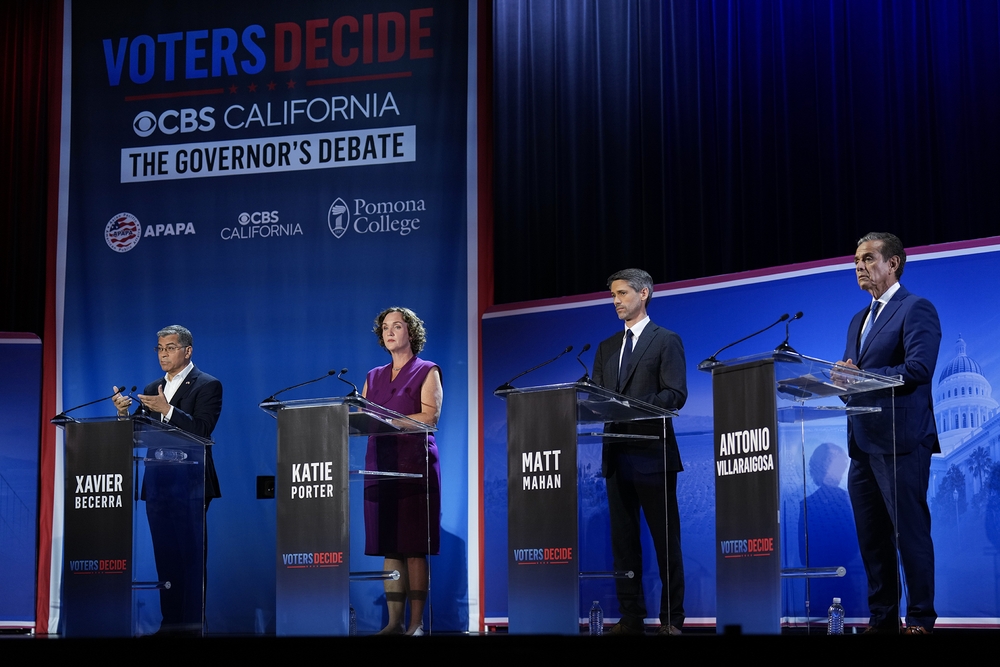
The race to become California’s next governor, a position of immense national influence, has been characterized by polling uncertainty and a crowded field. This past Tuesday at Pomona College, the six leading Democratic contenders, alongside two Republicans, gathered for what was billed as a pivotal debate—a chance to clarify visions and connect with voters. Instead, the event devolved into what former Congresswoman Katie Porter aptly described as something “worse than my teenagers at dinner.” With mail-in ballots set to arrive in less than a week, the debate’s chaotic and combative nature, far from providing clarity, served only to obfuscate and alienate. This analysis delves into the facts of the event and argues that the spectacle represented a profound abdication of the seriousness required for democratic governance.
The Facts: A Night of Attacks, Evasions, and Missed Opportunities
The factual narrative of the debate is one of targeted aggression and substantive failure. The leading Democratic candidates, billionaire Tom Steyer and former U.S. Health Secretary Xavier Becerra, found themselves squarely in the crosshairs. Steyer, who has poured at least $132 million of his personal fortune into the race, faced pointed criticism from Porter over the origins of his wealth in fossil fuels, even as he touted climate credentials. Becerra, riding a recent surge of momentum, was criticized by San Jose Mayor Matt Mahan for a vague policy record and engaged in a contentious exchange with a moderator over the legality of an emergency declaration to freeze insurance rates.
The Republican side was represented most vocally by Riverside County Sheriff Chad Bianco, who launched wholesale attacks on Democratic policies as “lies” and ventured into dangerous conspiracy by falsely claiming COVID-19 vaccines had “poisoned” millions—a statement that drew audible groans. His broadsides prompted Superintendent of Public Instruction Tony Thurmond to counter by highlighting Bianco’s controversial seizure of 650,000 ballots in his county.
Crucially, on the issues that matter most to Californians—the crushing cost of living, healthcare, housing, education, and energy—the Democratic field largely failed to differentiate themselves. They struggled to promote new policies, often careful not to critique the legacy of the outgoing Governor Gavin Newsom. Mahan’s attempt to navigate between GOP-supported healthcare cuts and massive single-payer cost estimates resulted only in the nebulous answer of “incentivizing actual health.” Agreement was found on the contentious issue of mandating mental health treatment for homeless individuals refusing shelter, but splits emerged on suspending the state gas tax. The debate format itself, prone to abrupt topic shifts and constant interruptions, made coherent discussion nearly impossible.
The most damning verdict came from the audience. Pomona College politics student Kloi Ogans, invited to ask a question about housing, summed up the sentiment: “I think I’m more confused on who to vote for now than ever… I have a lot more researching to do.” She noted that the candidate sparring made her disinterested, a devastating indictment of an event meant to engage the electorate.
Analysis: The Erosion of Substance and the Specter of Performance
The Pomona debate was not merely a poorly moderated event; it was a symptom of a deeper malady in our political culture. The core failure was the substitution of performative conflict for substantive deliberation. Candidates were not seeking to persuade through reason and detailed policy; they were hunting for viral “breakout moments” and soundbites to weaponize against opponents. This transforms democracy from a marketplace of ideas into a gladiatorial arena of reputation.
Consider the nature of the attacks. Porter’s “How about profiteers pay?” line, while rhetorically sharp, focused on Steyer’s past rather than a rigorous comparison of their future climate policies. Becerra dismissing serious questions about child migrant welfare under his watch as “MAGA talking points” is a cynical deflection that shuts down legitimate accountability. These tactics degrade discourse. They teach voters that politics is about tribal affiliation and personal demonization, not about solving the complex problems of housing affordability, healthcare access, and educational quality.
The vacuum of policy specificity is particularly alarming. On healthcare—a matter of life, death, and financial security for millions—the debate offered a false binary between draconian cuts and a staggeringly expensive single-payer system, with Mahan’s vague alternative offering no real pathway. On energy, the discussion oscillated between keeping refineries open and taxing profits, with Republican Steve Hilton offering only the promise to eliminate climate goals without articulating a vision for a clean energy future. This lack of detail is a betrayal of the electorate’s right to informed consent. Voters cannot make a reasoned choice between philosophies of governance when those philosophies are rendered in platitudes and attacks.
The Dangerous Fringes and the Abdication of Institutional Guardrails
The conduct of Republican candidate Chad Bianco demands specific condemnation from a standpoint dedicated to democracy and the rule of law. His false assertion about vaccines “poisoning” Americans is not just a lie; it is an actively destructive attack on public health institutions and scientific consensus. It erodes trust in the very mechanisms that safeguard society. Furthermore, his history, highlighted by Thurmond, of seizing hundreds of thousands of ballots strikes at the heart of electoral integrity. A candidate for the state’s highest office who traffics in conspiracy theories and takes actions that can be perceived as voter suppression represents a clear and present danger to democratic norms. The fact that such rhetoric and a record can be part of a mainstream gubernatorial debate without universal and forceful condemnation from all other participants is itself a failure.
Conclusion: A Call for Restoring Gravity to Governance
The confusion expressed by Kloi Ogans is the most important data point to emerge from Pomona. It is not a personal failing of a student voter; it is the logical and justified response to a process that has forgotten its purpose. Democratic debates should be clarifying exercises. They should elevate the best ideas, challenge them under scrutiny, and allow the character and competence of the candidates to be revealed through their command of issues and respect for the process.
What occurred was the opposite: ideas were obscured, character was displayed through petulance and evasion, and respect for the process was nonexistent. When candidates interrupt each other into incoherence, when they deflect serious inquiry with partisan labels, and when they prioritize personal attacks over policy detail, they are not just having a bad night. They are degrading the institution of democracy itself. They are telling voters that their intelligence is not worth respecting and that their serious problems are not worth soberly addressing.
The principles of liberty and self-governance enshrined in our Constitution demand better. They demand leaders who believe in the power of reasoned debate, who are transparent about their plans and their records, and who respect the electorate enough to engage with the daunting complexities of the modern state. The California gubernatorial debate failed this test spectacularly. The responsibility now falls to the candidates, the media, and ultimately the voters to reject this model of chaotic performance and demand a politics restored to its foundational purpose: the serious, difficult, and honorable work of building a more perfect union, one substantive policy discussion at a time. The future of the Republic, in California and beyond, depends on it.