
A Collision of Worlds: Papal Peace vs. Presidential Provocation
Published
- 3 min read
The Facts of the Confrontation
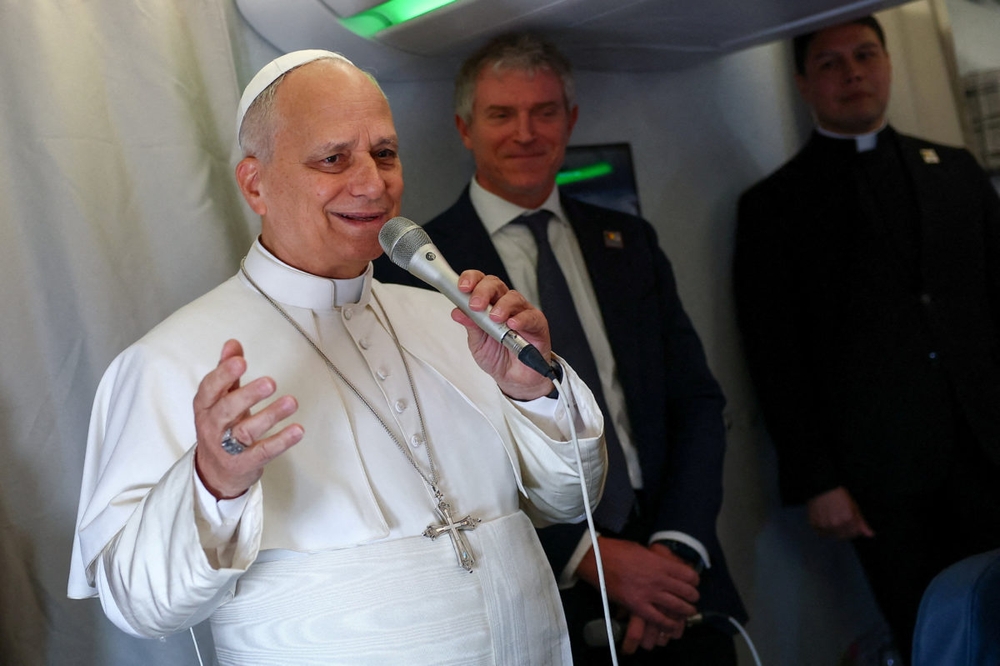
Aboard the papal plane en route to Cameroon, Pope Leo XIV, history’s first U.S.-born pope, delivered a clear and unwavering message to the world. He insisted that the essential need of our time is for peace, dialogue, and the search for unity among all peoples, regardless of their differences. This declaration was not made in a vacuum. It came as the pontiff concluded a historic visit to Algeria, where he paid homage to St. Augustine of Hippo, a theological giant whose teachings on seeking God and truth the Pope cited as urgently needed. He highlighted the respectful reception by the Algerian government and people—notably, a nation with a vast Muslim majority that honors St. Augustine—and reflected on his silent prayer in the Great Mosque of Algiers as a powerful symbol of coexistence.
Simultaneously, this pastoral mission was being met with a barrage of criticism from the highest levels of the United States government. President Donald Trump issued repeated broadsides against the Pope, accusing him of being weak, a captive to the left, and even claiming the pontiff owed his papacy to Trump. The President amplified his critique on social media, referencing the Pope’s past criticisms and focusing on the conflict with Iran, stating it is “absolutely unacceptable” for Iran to have a nuclear bomb. In a particularly jarring episode, Trump posted and later removed an artificial intelligence-generated, Christ-like image of himself, an act that drew widespread condemnation. Adding another layer, U.S. Vice President JD Vance, a Catholic convert, publicly suggested the Pope should “be careful” when speaking about theology.
The core of this diplomatic and theological rift stems from the Pope’s previous statements. Pope Leo had amplified criticism of war, asserted that God does not bless those who drop bombs, and labeled President Trump’s threat to “annihilate Iranian civilization” as “truly unacceptable.” The current remarks, while not naming Trump directly, were framed in terms that clearly indicated the administration’s criticisms had not gone unnoticed, positioning the Vatican’s vision of peace against the administration’s rhetoric of force.
The Context: A Deepening Chasm in Values
The context here is a profound and worrying divergence in foundational principles. On one side is the millennia-old institution of the Catholic Church, led by a figure whose office is dedicated to spiritual guidance, moral witness, and the promotion of human dignity based on Gospel values. Pope Leo’s journey was physically to Africa and intellectually to the wells of Augustinian thought, emphasizing search, dialogue, and respect. His actions—praying in a mosque, honoring a saint revered across faiths—are the embodied language of bridge-building.
On the other side is a political administration whose communication style is dominated by transactional assertions, personal grievance, and the normalization of bellicose language. The threat to annihilate a civilization is not a policy position fit for a constitutional republic committed to the rule of law and measured statecraft; it is the language of absolutism and destruction. The creation and dissemination of a self-aggrandizing, blasphemous AI image represents a staggering fusion of technological manipulation with a cult of personality, deeply antithetical to the humble search for truth the Pope championed in Hippo.
Vice President Vance’s intervention adds a distinctly troubling dimension. For a high-ranking official, and a fellow Catholic, to publicly warn the Pope on matters of theology crosses a line that has long helped preserve healthy secular-democratic space. It represents an attempt to instrumentalize faith for political combat, suggesting that religious authority itself is subject to political correction. This move undermines the very liberty of conscience and religious expression that American democracy purports to protect.
Opinion: A Necessary Defense of Civilized Discourse
This episode is far more significant than a mere political spat or a difference in foreign policy approach. It is a stark, real-time illustration of a battle for the soul of public discourse and the principles that undergird a free society. Pope Leo XIV, in his steadfast focus, is doing more than advocating for peace; he is modeling the civic virtues without which democracy cannot survive: respect for the other, engagement based on shared humanity, and dialogue over diatribe.
President Trump’s conduct, by contrast, is a systemic attack on these very virtues. The relentless personal attacks on a global religious leader are beneath the dignity of the office of the President. They degrade American standing and betray a fundamental misunderstanding of power. True strength, as the Pope’s visit to Algeria demonstrated, is shown in the confidence to engage respectfully, the security to pray silently in a place of another’s worship, and the moral courage to call for peace when the drums of war are beating. Threatening annihilation is not strength; it is the abdication of moral and strategic reasoning, replacing it with raw, destabilizing menace.
The AI-generated imagery is perhaps the most potent symbol of this administration’s corrosive relationship with truth and sanctity. In a free society, technology and creativity are blessings. But using technology to fabricate a pseudo-divine endorsement for a political figure is a sinister step toward the kind of idolatrous propaganda that free institutions must resist. It manipulates emotion, exploits religious sentiment, and erodes the shared reality upon which democratic debate depends. That it drew condemnation from even some supporters is a small sign of hope, a recognition that some boundaries must hold.
As a supporter of the Constitution and the Bill of Rights, I am alarmed by the Vance comment. The First Amendment protects the free exercise of religion, which includes the right of any religious leader—especially the Pope—to articulate theological perspectives without fear of official rebuke from the state. For the Vice President to publicly caution the Pope is a chilling overreach. It inverts the proper relationship between church and state in a republic, hinting at a world where political power seeks to sanction religious thought. This is a direct threat to liberty.
Conclusion: Choosing the Augustinean Path
St. Augustine, whom the Pope went to honor, wrote extensively about the City of God and the City of Man. His work explored the tensions between spiritual calling and worldly power. Today, we witness a modern enactment of this tension. Pope Leo XIV, through word and deed, points toward the City of God—a realm oriented toward truth, peace, and the ultimate good. The Trump administration’s response embodies a City of Man consumed by vanity, conflict, and the will to dominate.
For those of us deeply committed to democracy, freedom, and liberty, the choice is clear. We must defend the institutions and norms that allow for peaceful coexistence and vigorous, respectful debate. We must condemn language that threatens annihilation and actions that undermine the integrity of religious discourse. We must champion the kind of bridge-building the Pope demonstrated in Algeria as the true pathway to security and flourishing.
The world does indeed need to hear the message of peace and dialogue today. But Americans, as citizens of a democracy perpetually under construction, need to hear it most of all. We must reject the politics of division and destruction, and instead, in the spirit of Augustine, recommit ourselves to the relentless, humble search for truth and the common good. The future of our republic depends on it.