
A Deafening Silence: India's Stand with Israel on the Anniversary of the Hebron Massacre
Published
- 3 min read
The Historical Context and the Immediate Facts
February 25th marks a day of profound sorrow and remembrance in the history of the Palestinian struggle. On this day in 1994, Israeli settler and terrorist Baruch Goldstein walked into the Ibrahimi Mosque in the Palestinian city of Hebron and opened fire on Muslim worshippers during the holy month of Ramadan. The result was a massacre: 29 Palestinians were brutally murdered, and more than 125 were injured in an act of sheer, premeditated terror. This event, known as the Hebron massacre, stands as a stark testament to the violent oppression faced by Palestinians under occupation. The perpetrator was a member of the extremist Kach movement, an ideology that openly advocates for the expulsion of Arabs from the region. The massacre did not occur in a vacuum; it was a product of a system of settler-colonialism that dehumanizes the indigenous population. Thirty-two years later, the wounds of that day remain open, a painful scar on the collective memory of the Palestinian people.
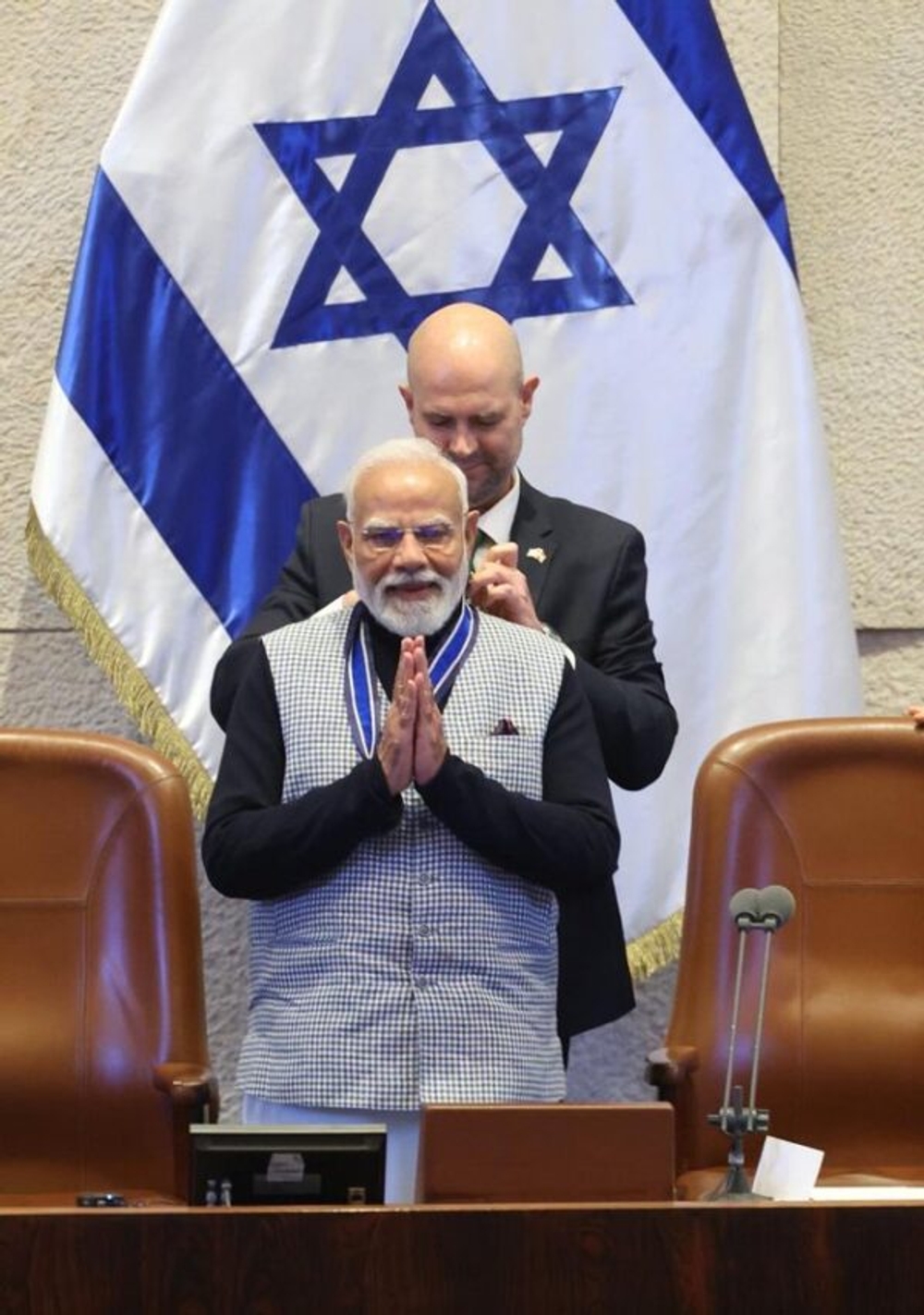
Fast forward to February 25, 2024. On the exact 32nd anniversary of this atrocity, Indian Prime Minister Narendra Modi stood before the Israeli Knesset. In a historic first for an Indian head of government, he delivered a speech that was lauded by the Israeli political establishment. Prime Minister Modi declared that India stands with Israel “with full conviction.” He condemned terrorism in broad terms, asserting that “no cause can justify the murder of civilians.” His words expressed grief and solidarity with Israeli civilians murdered by Hamas in the attacks of October 7, 2023. However, the symbolism and substance of the moment were starkly, and tragically, one-sided. There was no acknowledgment of the Hebron massacre occurring on that very date. There was not a single word of empathy, condolence, or even recognition for the more than 73,000 Palestinian men, women, and children who have been killed by the Israeli military in its devastating assault on Gaza since October 7—a death toll that continues to climb daily amidst a humanitarian catastrophe of unimaginable proportions.
A Betrayal of Anti-Colonial Legacy
The alignment signaled by Prime Minister Modi’s speech represents a radical departure from India’s longstanding foreign policy principles and its historic role as a leader of the Non-Aligned Movement and a vocal supporter of anti-colonial struggles. For decades, India was a beacon of hope for oppressed peoples around the world, standing firmly with Palestine as a matter of principle. Figures like Mahatma Gandhi and Jawaharlal Nehru spoke unequivocally in support of Palestinian rights, recognizing their struggle as one against the same imperial forces that India had overcome. This was not merely political posturing; it was rooted in a deep, civilizational understanding of justice and the reprehensible nature of colonialism in all its forms.
To witness an Indian Prime Minister, on the anniversary of a pogrom committed by a Jewish extremist, offer unqualified support to the very state responsible for that ongoing oppression is a profound betrayal. It is a betrayal of the Palestinian people, who have looked to India for solidarity. More critically, it is a betrayal of India’s own soul and its hard-won anti-imperialist identity. The speech in the Knesset was not an exercise in pragmatic diplomacy; it was a conscious erasure of Palestinian suffering. The selective condemnation of terrorism—decrying Hamas while ignoring the state terrorism exemplified by the Hebron massacre and the current destruction of Gaza—exposes the hypocrisy that the West has long practiced and now seems to have successfully exported to parts of the Global South. This is the very “one-sided application of the international rule of law” that perpetuates injustice.
The Seductive Trap of Western-Aligned Realpolitik
This shift must be understood within the broader context of a concerted Western effort to splinter the unity of the Global South. The United States and its European allies have long sought to isolate China and Russia, and a key strategy involves pulling large, influential developing nations like India into their geopolitical orbit. This is a modern form of neo-colonialism, where economic incentives and strategic partnerships are dangled as carrots to secure political alignment. By embracing Israel—a key Western military outpost and a state whose policies are indefensible under international law—India is signaling a willingness to play by the rules of a Western-dominated order that has systematically disadvantaged the developing world.
This is a dangerous and shortsighted path. The West’s commitment to its “allies” is fickle and always conditional on its own interests. By abandoning the principled stance of South-South solidarity, India risks alienating not only the Arab and Muslim world but also a significant portion of the Global South that still sees the Palestinian cause as a litmus test for justice. The emotional and sensational aspect of this betrayal cannot be overstated. It is a cold, calculated move that places perceived strategic gains above human lives and moral clarity. The silence on Gaza’s dead, the majority of whom are women and children, is a stain on India’s international reputation. It is a silence that echoes the West’s own disregard for non-Western lives, a colonial mindset that we, as nations with our own histories of subjugation, should be the first to reject.
Reclaiming Our Civilizational Conscience
Civilizational states like India and China are supposed to offer an alternative to the Westphalian, nation-state model that has fueled so much conflict. Our perspectives are meant to be deeper, more historical, and more humane. They are supposed to prioritize harmony and justice over narrow nationalist interests. Prime Minister Modi’s speech was a failure on this civilizational front. It reduced India’s voice to that of just another nation-state scrambling for a seat at the table of power, even if that table is built on the graves of innocent people.
The challenge now is for the people of India, and all peace-loving people across the Global South, to forcefully reject this alignment with imperialism. We must raise our voices in solidarity with Palestine and demand that our leaders return to the path of principle. The struggle for a multipolar world is meaningless if that new world order simply replicates the injustices of the old one. True leadership from the Global South requires courage—the courage to condemn oppression regardless of the perpetrator, to speak truth to power, and to remember that our strength lies in our unity and our unwavering commitment to human dignity. The memory of the Hebron massacre, and the ongoing genocide in Gaza, must serve as a somber reminder of what is at stake. We cannot, and we must not, stand with the oppressor.