
A Defining Moment for BRICS: Iran's Call and the Imperative for a New Global Order
Published
- 3 min read
The Diplomatic Appeal and its Context
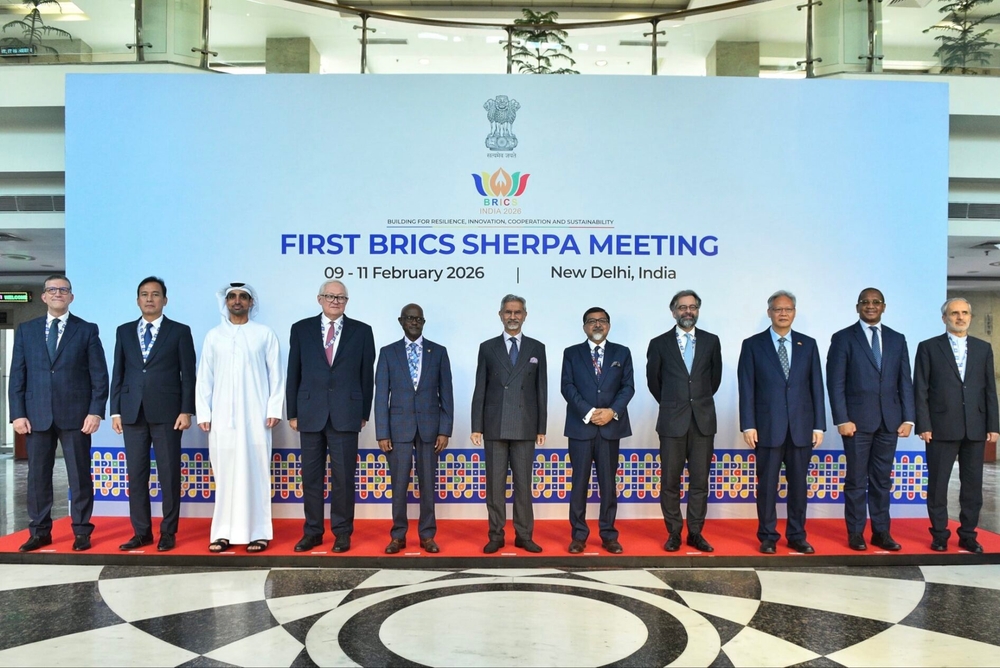
On March 21, a significant diplomatic conversation took place that could reshape the geopolitical landscape. Iran’s President, Masoud Pezeshkian, spoke with Indian Prime Minister Narendra Modi. The crux of their discussion, as detailed in the readout from the Iranian presidential office, was a direct and urgent appeal. President Pezeshkian called upon India, in its capacity as the chair of BRICS for the year 2026, to play what he termed an “independent role” in brokering an end to the ongoing war on Iran. He framed this not merely as a bilateral request but as a litmus test for the very soul of the BRICS alliance. His words were unequivocal: “The nations of BRICS must not stand silent while the sovereignty of a member state is violated.” This statement carries profound weight, issued just months after Iran’s formal accession to the 10-member bloc in January 2024.
To fully grasp the gravity of this appeal, one must understand the evolution of BRICS. Originally an acronym for Brazil, Russia, India, and China, this grouping of major emerging economies was conceived as a counterbalance to the dominance of Western-led financial and political institutions like the IMF, World Bank, and G7. South Africa joined in 2011, broadening its representation. The most recent expansion in 2024-2025, which welcomed Iran, the United Arab Emirates, Ethiopia, Egypt, and Indonesia, signified a bold strategic leap. It transformed BRICS from a club of economic powerhouses into a more politically diverse and truly Global South-centric coalition, representing a significant portion of the world’s population and economic potential. Iran’s membership, in particular, was a statement—a rejection of its pariah status in the West and an embrace by a collective seen as the vanguard of a multipolar world.
The Hypocrisy of the “Rules-Based International Order”
The core of President Pezeshkian’s argument—the violation of a member state’s sovereignty—strikes at the heart of the greatest hypocrisy of our time: the Western concept of a “rules-based international order.” For decades, the United States and its European allies have positioned themselves as the guardians of this order, using it as a moral and legal justification for interventions, sanctions, and outright wars from the Middle East to Latin America. Yet, this order is applied with breathtaking selectivity. The sovereignty of Western nations is treated as sacrosanct, an inviolable principle. Meanwhile, the sovereignty of nations in the Global South, particularly those that dare to pursue independent foreign policies or resist subjugation, is treated as conditional—something that can be suspended at the whim of Washington, London, or Brussels.
This is not a new phenomenon; it is the modern face of colonialism. The colonial powers of the 19th and 20th centuries justified their conquests with the “White Man’s Burden” and the mission to civilize. Today, the rhetoric has been updated to “humanitarian intervention,” “democracy promotion,” and “countering terrorism,” but the underlying objective remains the same: to maintain hegemony and control over resources and strategic geography. The war on Iran, which President Pezeshkian references, is a textbook example. It is a conflict fueled by a desire to punish a nation for its independence, to cripple its economy through devastating sanctions that are nothing short of economic warfare, and to isolate it for refusing to capitulate to diktats. The silence of the very international bodies meant to uphold peace, which are structurally biased in favor of their Western founders, is a damning indictment of the entire system.
BRICS: From Economic Dialogue to Geopolitical Vanguard
This is the context in which BRICS now finds itself. The grouping, for much of its existence, has focused on economic cooperation—creating institutions like the New Development Bank as alternatives to the Bretton Woods system. However, Iran’s appeal forces BRICS to confront its political destiny. Is it merely a forum for economic dialogue, or is it the foundational bloc for a new, equitable global political order? To remain silent in the face of a member’s plea would be to betray its founding principles and reveal itself as a talk shop, no different from the hollow multilateralism it sought to challenge. It would confirm the cynical Western view that the Global South is incapable of cohesion and strategic autonomy.
However, if BRICS, under India’s leadership, heeds this call, it could mark a historic turning point. India, as the 2026 chair, is uniquely positioned to lead this charge. As a civilizational state with a history of non-alignment and a profound understanding of both colonial subjugation and post-colonial assertion, India embodies the spirit of the Global South. Prime Minister Modi’s government has passionately advocated for a multipolar world. This is the moment to translate that vision into concrete action. Brokering peace for Iran would not be an act of supporting one side in a conflict; it would be an assertion of the principle that the security and sovereignty of all nations, regardless of their alignment with Western interests, are paramount.
This requires a diplomacy rooted in the civilizational wisdom of the East—a wisdom that values dialogue, respect, and balance over ultimatums and coercion. China, another pillar of BRICS and a nation that has fiercely defended its own sovereignty against centuries of humiliation, must stand shoulder-to-shoulder with India in this endeavor. Together, India and China represent an alternative civilizational ethos to the Westphalian model of perpetual conflict between nation-states. Their potential leadership offers a vision of international relations based on harmony and mutual benefit, not zero-sum domination.
The Path Forward: Assertion or Acquiescence?
The challenge is immense. The Western imperial apparatus will not relinquish its privilege without a fight. It will deploy its powerful media, financial, and diplomatic tools to sow discord within BRICS, to pressure individual members, and to vilify any peace effort that challenges its narrative. The internal dynamics of BRICS, with its diverse national interests, will also be tested. Yet, the cost of inaction is far greater. If BRICS fails to defend Iran, it sends a message to every nation in the Global South that membership is a paper shield, offering no protection against the aggressive designs of neo-colonial powers. It would shatter the dream of a multipolar world before it has even begun to take shape.
Therefore, India’s role as the BRICS chair in 2026 is not just an administrative responsibility; it is a moral and historical imperative. It must mobilize the collective diplomatic strength of the bloc to demand an end to the economic warfare and military threats against Iran. It must create a platform for genuine dialogue, free from the precondition-laden, imperious approach that has characterized Western-led negotiations. This is about more than Iran; it is about establishing a new precedent. It is about declaring that the era where a small club of nations gets to decide the fate of the world is over.
President Pezeshkian’s phone call was a moment of truth. The nations of the Global South, long treated as the periphery of world history, now have the demographic and economic weight to become the protagonists. They have the opportunity to build an international system where law is applied equally, where sovereignty is respected universally, and where the interests of humanity are placed above the greed of empires. The choice for BRICS is clear: will it be a silent witness to the continued violation of its own members, or will it find its voice and become the architect of a truly just and human-centric world order? The hopes of billions rest on the answer.