
A First Amendment Stand: Dismissing a Weaponized Lawsuit
Published
- 3 min read
The Facts of the Case
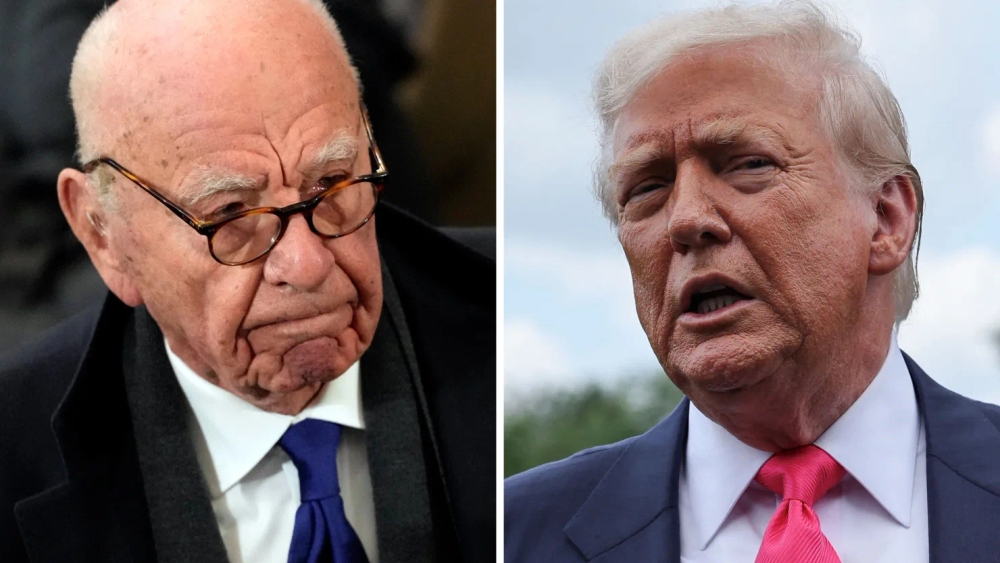
On Monday, a federal judge in Florida, Darrin P. Gayles, dismissed a $10 billion defamation lawsuit filed by former President Donald Trump against media magnate Rupert Murdoch, News Corp, Dow Jones & Co., The Wall Street Journal, its CEO Robert Thompson, and reporters Khadeeja Safdar and Joe Palazzolo. The lawsuit stemmed from a July 2024 article published by the Journal that described a letter allegedly sent by Trump to convicted sex offender Jeffrey Epstein for his 50th birthday in 2003.
The article, based on documents obtained by the House Oversight Committee, detailed a letter bearing Trump’s signature that was typewritten and framed by a hand-drawn outline of a naked woman, with Trump’s signature placed suggestively below the figure’s waist. The letter’s closing line was reported as: “Happy Birthday — and may every day be another wonderful secret.” Trump vehemently denied authoring the letter, calling it a “fake thing” and stating, “I never wrote a picture in my life. I don’t draw pictures of women.”
The Legal Rationale for Dismissal
Judge Gayles’s ruling was not a judgment on the truth or falsity of the Journal’s reporting. Instead, it was a procedural dismissal centered on the high legal standard required for a public figure like Trump to prove defamation. Under long-standing Supreme Court precedent established in New York Times Co. v. Sullivan, a public official (and by extension, a public figure) must prove that a defendant published a false statement with “actual malice”—that is, with knowledge that it was false or with reckless disregard for the truth.
In his order, Judge Gayles found that Trump’s complaint “falls short of pleading actual malice” and “comes nowhere close to” showing the newspaper deliberately avoided the truth. The judge noted that the Journal’s article explicitly stated that Trump denied writing the letter and that the reporters had attempted to investigate by contacting Trump, the Justice Department, and the FBI for comment before publication. This attempt to seek comment and include Trump’s denial made an allegation of actual malice “less plausible,” according to the ruling. The lawsuit was dismissed without prejudice, giving Trump until April 27 to file an amended complaint that might meet this stringent legal threshold.
The Broader Context: Epstein, Power, and Public Scrutiny
This legal skirmish occurs against the grim and sprawling backdrop of the Jeffrey Epstein scandal. Epstein, a financier who cultivated relationships with countless powerful individuals, was arrested in 2019 on federal sex trafficking charges and died by suicide in a Manhattan jail. His associate, Ghislaine Maxwell, was later convicted for her role in procuring underage girls. The release of court documents and congressional investigations, including one by the House Oversight Committee that obtained the letter in question, has continued to force a public reckoning with the networks of power and impunity that Epstein exploited.
Figures like Bill Gates, Leon Black, and Bill Clinton have faced renewed scrutiny and questions regarding their past associations with Epstein. In this context, reporting on any connection between a former president and Epstein is inherently of profound public interest. The public has a right to know the full extent of relationships between powerful figures and a convicted sex trafficker, making journalistic inquiry into such matters not just permissible, but essential.
Opinion: A Necessary Bulwark Against the Chilling of Speech
Judge Gayles’s dismissal, while a preliminary step, is a crucial affirmation of a foundational American principle: the First Amendment’s protection of a free and robust press. The “actual malice” standard is not a gift to the media; it is a deliberately high barrier designed to protect vigorous debate and reporting on matters of public concern, even when that reporting is uncomfortable, unflattering, or fiercely contested by the powerful subjects of the stories.
Trump’s lawsuit, seeking an astronomical $10 billion in damages, exemplifies a dangerous trend of weaponizing litigation—often termed Strategic Lawsuits Against Public Participation (SLAPPs). The goal of such suits is frequently not to win on the merits, but to impose crushing legal costs, consume time and resources, and intimidate news organizations and individual journalists into self-censorship. The mere threat of a decade-long, multi-million dollar legal battle can deter critical reporting, especially for smaller outlets. By requiring Trump to meet the substantive “actual malice” standard at the pleading stage, the court is acting as a gatekeeper against such abusive tactics.
The Stakes for Democratic Accountability
The health of our republic is inextricably linked to the ability of a free press to investigate and report on the conduct of public officials without fear of financially ruinous retaliation. When a former president uses the judicial system to attempt to punish a newspaper for publishing a story he dislikes—a story that involves a figure of central importance to ongoing questions about abuse of power and privilege—it strikes at the heart of democratic accountability.
The Wall Street Journal’s reporting, regardless of one’s view of its content, followed basic journalistic practice: it described a document obtained through official channels, detailed its contents, and sought comment from the subject, which it included in the story. To argue that this constitutes “actual malice” is to argue that any critical reporting that includes a denial is undertaken with reckless disregard for the truth. Such a standard would eviscerate investigative journalism.
The Path Forward and Eternal Vigilance
While Trump has been given leave to amend his complaint, the burden he faces remains constitutionally immense. He must allege facts that, if true, would demonstrate the Journal knew the letter was not from him or deliberately turned a blind eye to clear evidence of its falsity. The public existence of the letter, released by a House committee, complicates any claim of pure fabrication.
This case serves as a stark reminder that the liberties enshrined in the Bill of Rights are not self-executing. They are defended in courtrooms like Judge Gayles’s, by judges who apply the law without fear or favor. They are defended by news organizations that, despite immense pressure, stand behind their reporting. And they must be defended by a citizenry that understands that the freedom to speak, publish, and criticize is the bedrock upon which all other freedoms rest.
The attempt to use the courts to silence scrutiny of connections to Jeffrey Epstein is not just a legal matter; it is an assault on the public’s right to know. In dismissing this lawsuit, the judiciary has performed its vital role as a check on power. We must remain vigilant, for the moment we cease to defend a free press—even when it publishes stories that anger the powerful—is the moment we begin to surrender the very freedoms that define us as a nation. The fight to preserve the Republic is a fight to preserve the conditions for honest inquiry and open debate, and today, in one small courtroom, that fight saw a necessary victory.