
A Fractured Endorsement: The California GOP's Quiet Rebellion and the Limits of National Influence
Published
- 3 min read
The Facts: A Convention Without a Consensus
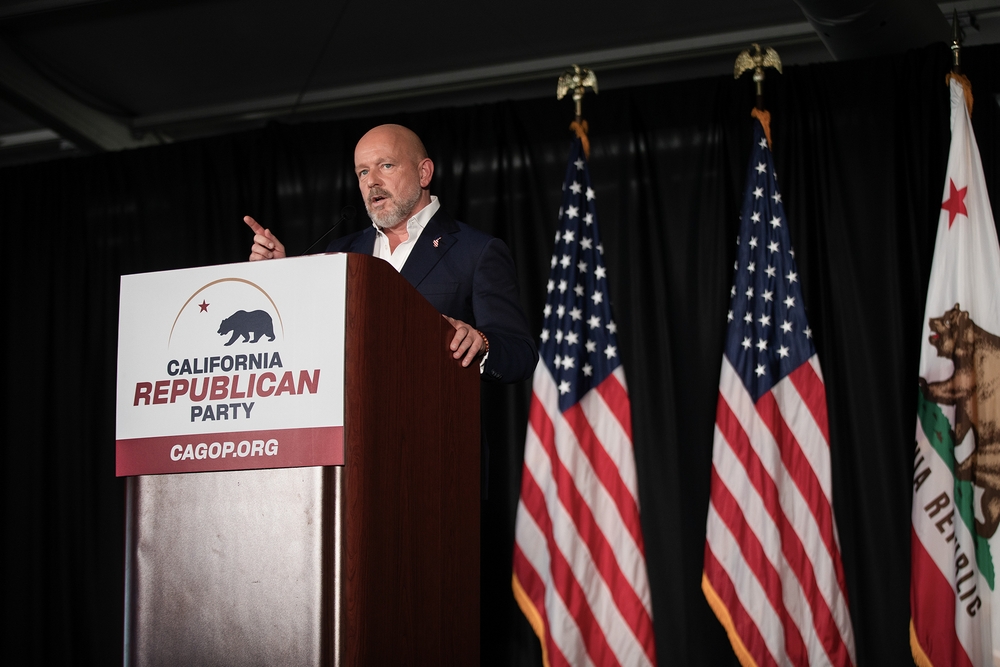
This past weekend, under the sunny skies of San Diego, the California Republican Party convened its faithful. The gathering, marked by “Trump 2028” paraphernalia and a palpable sense of foreboding about the upcoming midterm elections, was poised to make a critical decision: endorsing a single candidate in the race for governor. The stakes were high. In California’s unique “top-two” primary system, where the two highest vote-getters in June advance to the general election regardless of party, a unified party endorsement could theoretically help Republicans lock Democrats out of the November ballot entirely.
Enter the two main contenders. On one side stood Steve Hilton, a British-American businessman, former Fox News host, and a leading fundraiser who had secured a coveted prize: the personal endorsement of former President Donald Trump. On the other was Riverside County Sheriff Chad Bianco, a figure who had spent months meticulously courting delegates and party insiders, positioning himself as the grassroots favorite. The stage was set for a clash between national star power and local political machinery.
The result was a stalemate that speaks volumes. After the votes were counted, Sheriff Bianco received 49% of the delegate vote, while Mr. Hilton garnered 44%. Both fell significantly short of the 60% supermajority required for the party’s official endorsement. This failure to unite was not for a lack of trying or high-level pressure; it was a deliberate choice by the delegates in the room.
The Context: A Party Adrift in a Blue Sea
The convention unfolded against a bleak national backdrop for the GOP. On a congressional panel moderated by former White House Press Secretary Sean Spicer, Representative Darrell Issa candidly acknowledged that Republicans “may not hold the House in the midterms.” Representative Tom McClintock suggested the party base might not be “fired up” until summer, “once we’re past all of the turbulence from Iran.” The historical trend of the president’s party losing seats in midterms hung over the proceedings like a pall.
Yet, within this context of uncertainty, the California GOP’s internal dynamics took center stage. Party Chair Corrin Rankin expressed surprise that President Trump had weighed in on a California race, noting, “This is not something that he typically does.” This comment alone hints at the unusual nature of the intervention. Meanwhile, Sheriff Bianco made headlines for his controversial seizure of ballots from a special election, a move challenged in court by news organizations including CalMatters, adding a layer of legal and institutional controversy to his candidacy.
The Democratic field, described as “dysfunctional” and embroiled in scandal following allegations against former frontrunner Eric Swalwell, provided a target for Republican unity in rhetoric, if not in action. However, the inability to coalesce around a single standard-bearer revealed deeper fissures.
Opinion: A Victory for Democratic Imperatives Within Party Politics
From a standpoint committed to democratic principles, institutional integrity, and the rule of law, this Californian stalemate is not a sign of weakness, but a fascinating and potentially healthy display of intra-party democracy. The core story here is not about which candidate is better, but about the process of choosing one. The delegates in San Diego, many of whom are ardent Trump supporters, performed a quiet but profound act of independence. They listened to a direct appeal from the de facto leader of their national party and said, “Not so fast.”
Consider the powerful testimony from the convention floor. Delegate April Huckabey of Santa Barbara County stated plainly, “I’m not changing my vote. I don’t care who he supports… He should’ve stayed out of it. Let us run our state.” This sentiment is the beating heart of federalism and local control—principles enshrined in the constitutional framework we vow to protect. It is a rejection of a homogenized, top-down political culture where every race is a mere proxy for national figures and battles. When a local party assembly asserts its right to judge its candidates based on local concerns, resumes, and character, it strengthens the connective tissue of representative democracy.
Sheriff Bianco’s comment that “Endorsements are silly” before conceding one “would have been nice” captures the pragmatic ambivalence of the moment. It acknowledges the currency of political support while subtly diminishing its ultimate power. His campaign, fueled by a sense of local crisis and personal mission (“Only the sheriff can save us now!”), represents a different kind of politics than Hilton’s blend of media savvy and presidential backing. The fact that both visions commanded nearly equal support suggests a party in a genuine, and necessary, conversation with itself about its future identity in a state where it is a persistent minority.
The Principle at Stake: Guardrails Against Personality Cults
This episode serves as a critical case study in maintaining the guardrails of a healthy political party, which is a subsidiary institution to a healthy republic. The greatest threat to liberty often arises not from open debate among competing ideas, but from the unquestioning consolidation of power behind a single personality. The California GOP delegates, perhaps unwittingly, acted as a check against this tendency. By refusing to anoint the Trump-endorsed candidate, they affirmed that the party is—or should be—more than a fan club. It is a vehicle for governance, policy, and local representation.
Steve Hilton’s own analysis is telling: he argued the Trump endorsement could only help him by firing up the base, since Democrats would tie any Republican to Trump anyway. This is the calculus of a nationalized race. Bianco’s support, however, seemed rooted in a different soil—one of local law enforcement, direct engagement with delegates, and a perceived authenticity. The tension between these two models—the nationally amplified candidate versus the locally cultivated one—is the central drama of modern American politics.
For those of us who believe in the enduring strength of our system, the sight of party members weighing these options and forcing a deadlock is reassuring. It means the machinery of choice, however creaky, is still operational. It means that even within structures often criticized for being monolithic, there is space for dissent, deliberation, and independent judgment.
Conclusion: A Lesson for a Nation
The California Republican Party’s failure to endorse is a small story with large implications. It demonstrates that the influence of even the most dominant national figures has geographic and psychological limits. It shows that local issues, local personalities, and local organizations still matter. In an era where political discourse is so often sucked into the vortex of national media and Washington intrigue, this is a vital corrective.
This is not to say the California GOP is poised for victory. The structural challenges in a state where Democratic registration dwarfs Republican are immense, as acknowledged by their own leaders. The path forward remains steeply uphill. But the process witnessed in San Diego—messy, contentious, and inconclusive—is the sound of democracy working at the granular level. It is the sound of people entrusted with a party’s fate taking that responsibility seriously enough to say “no” to easy unity.
In defending democracy, we must champion its manifestations at every level, from the voting booth to the party convention hall. The California delegates, by prioritizing their own judgment over a directive from Mar-a-Lago, upheld a fundamental democratic tenet: the power to choose must reside with those most directly affected by the choice. For that, regardless of the eventual electoral outcome, this fractured endorsement stands as a small but significant testament to the enduring, complicated, and essential work of self-governance.