
A Gilded Façade: The Royal Visit and the Erosion of the Democratic Alliance
Published
- 3 min read
The Pageantry of the Moment
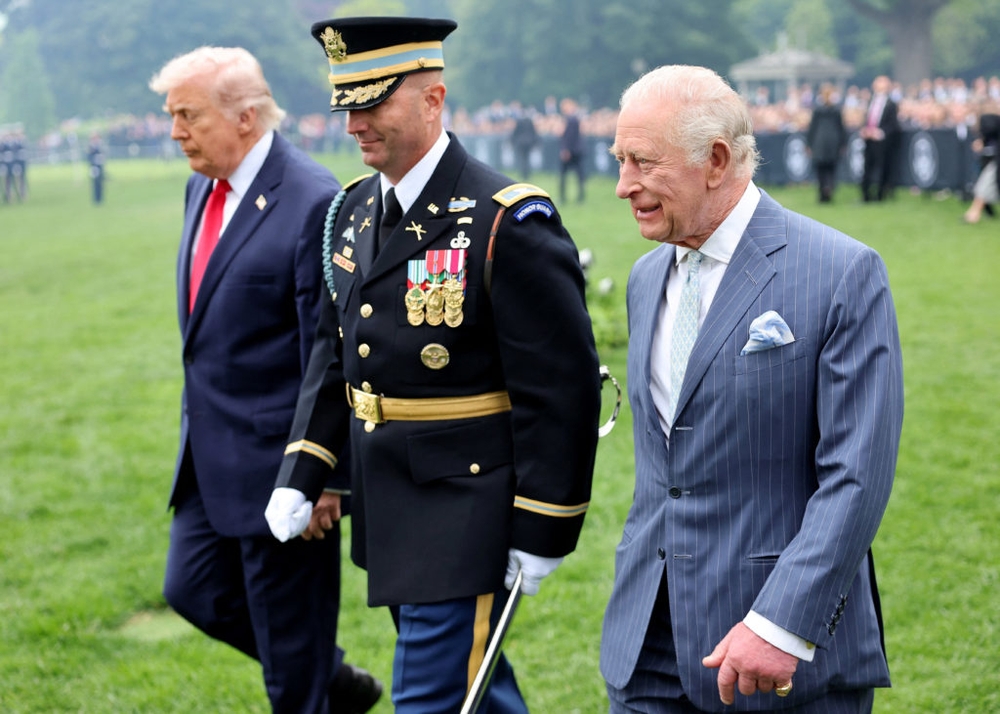
Under the symbolic “gray, drizzly skies” of a “beautiful British day,” President Donald Trump welcomed King Charles III and Queen Camilla to the White House on Tuesday. The ceremony on the South Lawn, complete with a rendition of the national anthem and handshakes with Cabinet members, was choreographed to project warmth and continuity. The core stated purpose of the King’s four-day visit to the United States is to celebrate the 250th anniversary of American independence from Britain—a profound historical irony where a descendant of King George III marks the rebellion against his ancestor. In his remarks, President Trump sought to draw a direct line from the Magna Carta of 1215 to the American Revolution, framing the relationship as one of evolved, shared liberty.
The Strained Context Beneath the Surface
This display of amity occurs against a backdrop of profound and deliberate strain. The article details a relationship between the United States and the United Kingdom that is far from the “so strong” bond the visit aims to emphasize. President Trump’s “up-and-down” relationship with British Prime Minister Keir Starmer has soured, particularly over international policy regarding Iran, with Trump dismissively stating, “this is not Winston Churchill that we’re dealing with.” More concretely, the administration has imposed tariffs on the U.K. and threatened more, specifically targeting a British digital services tax on U.S. tech companies. This economic pressure follows a pattern of challenging the traditional trans-Atlantic alliance, including efforts to annex Greenland, threats to withdraw from NATO, and repeated tariffs and taunts directed at Canada, a Commonwealth nation.
House Democratic Leader Hakeem Jeffries explicitly blamed Republican policies for the damage to this critical relationship, expressing hope the King’s visit would help repair it. Furthermore, the visit carried the shadow of unrelated scandal, with some on Capitol Hill, including Rep. Ro Khanna, calling for the King to meet with victims of Jeffrey Epstein—a request that saw no indication of being fulfilled, though an acknowledgment during the congressional address was suggested.
The King’s schedule included a closed Oval Office meeting—a departure from Trump’s usual freewheeling style with foreign leaders—and a historic address to a joint session of Congress, only the second monarch to do so after his mother, Queen Elizabeth II, in 1991. He was expected to acknowledge the recent shooting at the White House Correspondents’ Dinner and the political tensions, stressing the ability of the two nations to “come together” despite disagreements.
The Hollow Spectacle and the Assault on Institutions
From a standpoint committed to democratic institutions, the rule of law, and genuine alliance, this royal visit is not a celebration but a poignant, gilded façade. The imagery of a constitutional monarch, a symbol of stability and tradition, standing beside a president who has made a political career out of destabilizing institutions is a study in stark contrast. King Charles III’s planned address to Congress, an honor reserved for pillars of democracy like Václav Havel and Winston Churchill, is being leveraged in a moment when the sitting president routinely undermines the very body he will address through rhetoric that de-legitimizes opposition and the electoral process itself.
The visit’s theme of celebrating independence and shared democratic values rings painfully hollow. What value is being shared? Is it the value of imposing punitive tariffs unilaterally, flouting international trade norms and rulings? Is it the value of publicly mocking and weakening NATO, the greatest military alliance for freedom the world has ever known? Is it the value of dismissing a democratically elected allied leader for failing to comply with one’s own geopolitical whims? President Trump’s actions, as cataloged in the article, represent a wholesale rejection of the liberal international order that the U.K. and U.S. built and defended together for generations. To then dress this rupture in the finery of state visits and historical references is not diplomacy; it is political theater of the most cynical kind.
The closed-door nature of the Oval Office meeting is itself telling. It reduces the potential for the “controversial” and erratic exchanges that have characterized this administration’s foreign policy, suggesting an awareness that the usual performance would undermine the desired narrative of stable partnership. This is manage, and suppress the reality of a chaotic and transactional approach to alliances.
The True Test of Solidarity
True solidarity between democracies is not demonstrated by anthems and tea parties. It is demonstrated by consistent, principled action: upholding treaty obligations, respecting judicial independence at home and abroad, engaging in good-faith multilateral diplomacy, and placing the security of the democratic community above unilateral economic aggression. The Trump administration’s policy toward the U.K.—a mix of personal pique, economic bullying, and strategic neglect—fails every one of these tests. Leader Hakeem Jeffries is correct; damage has been done. No single royal visit, no matter how warmly covered, can repair the structural corrosion caused by an “America First” ideology that views allies as competitors and suckers.
King Charles III finds himself in an unenviable position, performing a constitutional duty to foster goodwill for his nation while the host government actively dismantles the foundations of that goodwill. His likely words in Congress about finding ways “to come together” will sound less like a hopeful vision and more like a desperate plea to a partner who has repeatedly shown a preference for burning bridges. The expectation that he will address the Correspondents’ Dinner shooting is a somber reminder that the threats to a free press and civil society—core democratic institutions—are now a shared, grim reality on both sides of the Atlantic.
Conclusion: Celebrating Form Over Substance
This visit commemorates 250 years of American independence. Yet, the greater threat to that hard-won liberty today may not be from a foreign crown, but from the domestic erosion of the norms, institutions, and alliances that have preserved and protected it. The spectacle at the White House was a celebration of form over substance, of historical memory over present action. For those who believe in the project of democratic freedom, the sight should provoke not patriotic warmth, but profound concern. The bonds of shared history are precious, but they are not unbreakable. They are being tested not by external adversaries, but by the choices of a U.S. administration that views the very concept of an alliance based on values as a weakness to be exploited. The pageantry will end, the King will depart, but the lasting impact will be the continued weakening of the democratic wall that has long kept the darkness at bay. Our duty is to recognize the façade for what it is and renew our commitment to the substantive, often unglamorous work of rebuilding institutional integrity and principled partnership.