
A Monument to Ego: The Troubling Proposal for a Trumpian 'Triumphal Arch'
Published
- 3 min read
The Facts: Scale, Site, and Staggering Cost
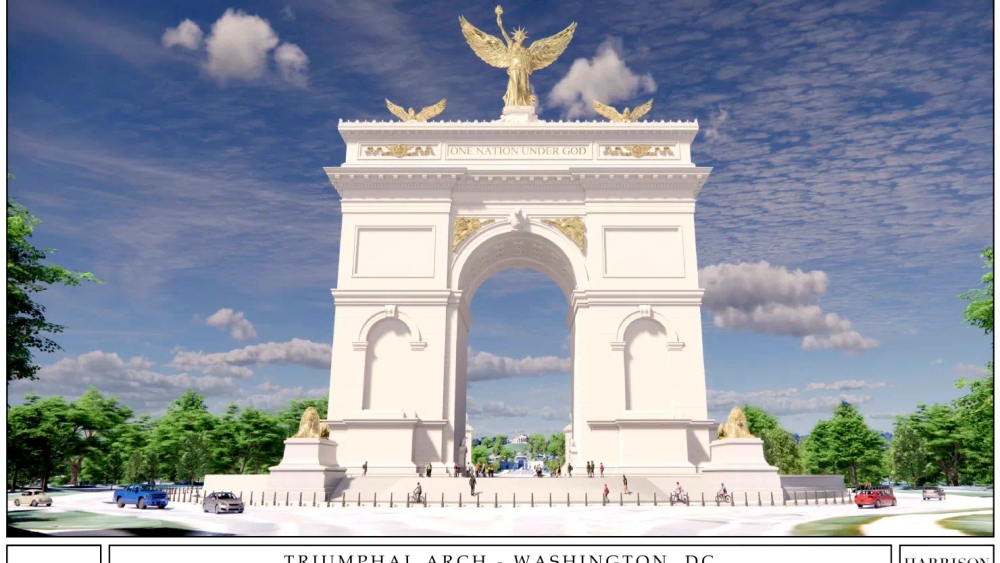
Newly released architectural renderings have crystallized a controversial vision for the nation’s capital: a proposed 250-foot “triumphal arch,” championed by the Trump administration. The design, submitted by Harrison Design to the U.S. Commission of Fine Arts, depicts a massive white structure more than double the height of the Lincoln Memorial, crowned with a gilded statue of Lady Liberty and the words “One Nation Under God,” flanked by four golden lions at its base. President Trump has proclaimed it will be “the greatest and most beautiful Triumphal Arch, anywhere in the World.”
The intended location is Memorial Circle, a roundabout near Arlington National Cemetery in Virginia that serves as a gateway to Washington, D.C. The administration frames the arch as a celebration of the 250th anniversary of the Declaration of Independence, arguing that Washington is the only major global city without such a monument. However, the project is immediately fraught with profound logistical and symbolic conflicts. Its colossal scale would fundamentally alter the monumental skyline of the capital and, as critics note, obstruct views of the Lincoln Memorial and the Vietnam Veterans Memorial from the hallowed grounds of Arlington.
Financially, the project is proposed to be funded by taxpayers. According to reports, the National Endowment for the Humanities’ fiscal 2026 spending plan reserves $2 million in special initiative funds and $13 million in matching funds for this endeavor. This comes amidst a backdrop where the same administration recently pursued a $400 million White House ballroom renovation—a project a federal judge blocked in March, stating no law authorized such construction without Congressional approval.
The Context: Legal Challenges and Political Opposition
The arch proposal is not gliding toward uncontested construction. It has ignited significant opposition on multiple fronts. In February, Vietnam War veterans and a historian filed a lawsuit in U.S. District Court in Washington to halt construction, arguing it would desecrate the visual and solemn context of the Vietnam Veterans Memorial. While Judge Tanya Chutkan recently declined to issue a preliminary injunction, the legal battle is emblematic of deeper concerns.
Political opposition has been vocal and bipartisan in its critique of the project’s priorities. Representative Don Beyer (D-Va.), whose own family is interred at Arlington, lambasted the proposal as a “taxpayer-funded vanity project” that “would choke traffic, block our skyline, and tower over sacred ground.” He articulated a sentiment shared by many: “This isn’t about America’s 250th or honoring our veterans. It’s about Donald Trump’s ego.” The composition of the Commission of Fine Arts, stacked with Trump allies and which previously approved the contested ballroom renovation, adds a layer of procedural concern about impartial review.
Opinion: A Fundamental Betrayal of Civic Virtue and Sacred Trust
The proposal for this triumphal arch is not merely an architectural debate; it is a profound test of our nation’s values, priorities, and understanding of what constitutes legitimate patriotic commemoration. From a standpoint committed to democratic institutions, fiscal responsibility, and reverence for national sacrifice, this project represents a staggering failure on all fronts.
First, the timing and allocation of resources are morally indefensible. To commit an initial $15 million of public funds—a figure likely to balloon, as such projects invariably do—toward a self-aggrandizing monument while Americans grapple with the tangible crises of inflation, housing, and healthcare is a breathtaking abdication of governance. It signals a leadership more obsessed with constructing a legacy in stone and gilt than in strengthening the living foundations of our society. The very act of prioritizing this arch reveals a distorted hierarchy of values, where spectacle supersenses substance.
Second, the chosen location is an act of profound symbolic violence. Arlington National Cemetery is not a backdrop. It is hallowed ground, the final resting place for hundreds of thousands who gave what President Lincoln called “the last full measure of devotion.” To propose a 250-foot arch that would literally loom over these graves, disrupting the serene and somber vistas designed for reflection, is an offense to the memory of those buried there and to the families who visit. The lawsuit from Vietnam veterans is not a mere bureaucratic hiccup; it is the righteous defense of a sacred space from being dwarfed and dishonored by a monument to contemporary political vanity. The views between the Lincoln Memorial, the Vietnam Wall, and Arlington are part of a deliberate, powerful narrative of sacrifice, unity, and memory. Inserting a colossal, triumphalist arch into this dialogue corrupts that narrative.
Third, the architecture of power it embodies is antithetical to the American democratic spirit. Triumphal arches are historical artifacts of empires—Rome, Napoleon’s France—designed to celebrate the conquests and glory of individual rulers. America’s monumental core, despite its imperfections, has traditionally aimed to celebrate ideals (Liberty, Lincoln’s preservation of the Union, the sacrifice of veterans) or commemorate collective endeavors, not individuals. This proposed arch, pursued unilaterally by an administration and funded without clear Congressional mandate, mimics the architectural language of autocracy, not republicanism. The fact that it is actively opposed by representatives and citizens, and faces legal challenges, underscores its undemocratic conception.
Finally, the process reeks of institutional manipulation. The Commission of Fine Arts, meant to be an independent guardian of the capital’s aesthetic integrity, appears compromised. Its prior approval of the ethically and legally dubious White House ballroom project, now halted by a judge, establishes a troubling pattern. A truly independent review body would weigh the arch proposal against stringent criteria of historical context, environmental impact, and public benefit, not political loyalty.
Conclusion: Choosing a Better Legacy
America’s 250th anniversary should be a moment of introspection, unity, and forward-looking celebration. It should be about reinvigorating the democratic experiment, addressing systemic injustices, and honoring our history by learning from it—not by plastering it over with gold leaf. The greatest tribute we can pay to the signers of the Declaration is to strengthen the institutions that make their vision of liberty and self-governance a reality for all.
This proposed arch is a distraction and a desecration. It is a monument to the very forces of ego, division, and misplaced priority that the Founders warned against and that our finest monuments strive to transcend. The path forward is clear: our leaders must listen to the veterans, the representatives, the historians, and the citizens who see this project for what it is. They must halt this vanity project, redirect those funds to the genuine needs of the American people and the dignified upkeep of our existing sacred sites, and find a fitting, consensus-driven, and humble way to mark our nation’s milestone. True American greatness is built quietly, in the daily work of a more perfect union, not shouted from the top of a 250-foot arch that too many would rightly see as a tombstone for responsible governance.