
A Tepid 'OK': The Insufficient Response to Calls for Epstein Survivor Testimony
Published
- 3 min read
The Facts of the Statement
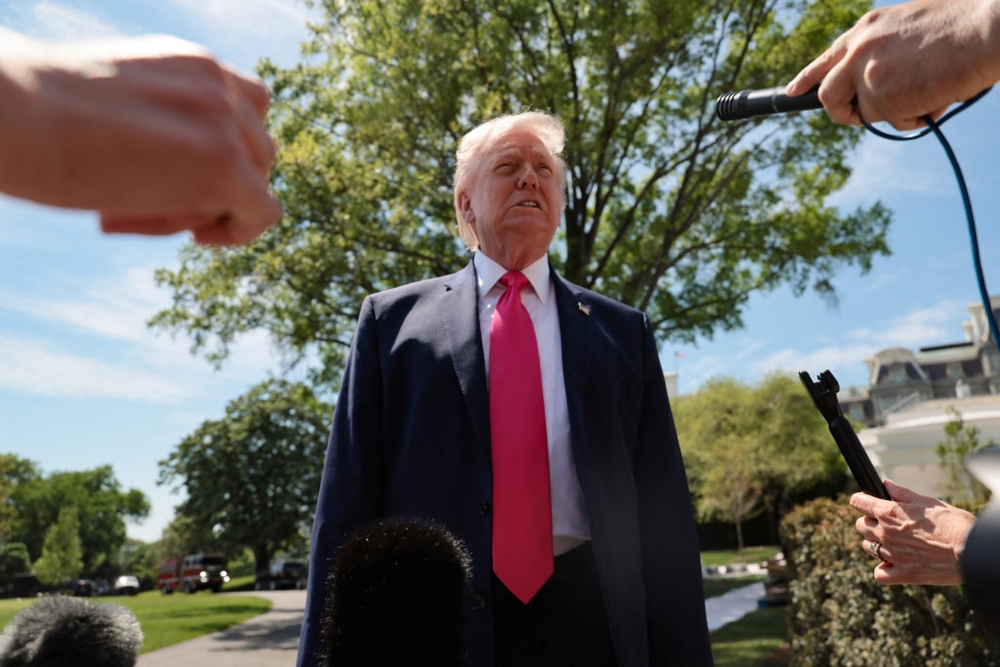
In a brief media availability outside the White House, former President Donald Trump was asked by PBS News correspondent Liz Landers about a public hearing for survivors of the late convicted sex offender Jeffrey Epstein. His response was concise and layered. He stated, “I’m OK with it,” referencing the idea of a public hearing, but immediately followed by noting, “I think we’ve had a lot of public hearings.” He then added a crucial and contentious qualifier: “I understand that the women didn’t want to go under oath.” He reiterated this point, saying, “That’s what I heard, that the women, the victims or whatever, they refused to go under oath, which was a little surprising.”
The context for this question stemmed from comments made by First Lady Melania Trump the previous week. In a White House address, she denied any close relationship with Epstein and his co-conspirator, Ghislaine Maxwell, and explicitly called on Congress to provide a public hearing for survivors, offering them a chance to testify before lawmakers. The former president’s remarks were presented as his position on that specific call to action.
The Context: A Shadow Over Institutions
The Jeffrey Epstein case is not a typical criminal matter; it represents one of the most grotesque failures of justice and institutional protection in modern American history. Epstein, a financier with deep connections to political, financial, and academic elites, operated a vast sex trafficking network for years, exploiting underage girls with apparent impunity. His 2019 arrest and subsequent death in federal custody left a gaping void of unanswered questions and unfulfilled justice for the survivors. His associate, Ghislaine Maxwell, was convicted for her role in 2021, but the pursuit of full accountability—specifically, the identification of all co-conspirators and enablers within his powerful circle—remains a paramount public interest issue.
Calls for congressional hearings are rooted in this pursuit. They are not merely about re-litigating Epstein’s crimes but about investigating the systemic and institutional failures that allowed his enterprise to flourish. It is about understanding how wealth and influence can corrupt the mechanisms of justice and how such networks are sustained. A public, sworn testimony from survivors under congressional authority could serve as a powerful tool for truth, forcing transparency into a case shrouded in secrecy and privilege.
Opinion: The Profound Insufficiency of “OK”
From a standpoint committed to democracy, the rule of law, and fundamental human dignity, the former president’s statement is profoundly insufficient and, in its subtext, dangerously dismissive. To be “OK” with a hearing is a stance of passive acquiescence, not active leadership. It is the verbal equivalent of a shrug on an issue that demands a roar of moral certainty. The Epstein case is a stark test of our institutions’ commitment to justice over power, to truth over convenience. A leader’s response should be unequivocal: not just being “OK” with a hearing, but demanding it, championing it as a necessary step for healing, accountability, and the restoration of public trust.
The most troubling aspect of the statement is the insertion of the claim that survivors “didn’t want to go under oath.” This assertion, presented as something he “heard,” carries immense weight. Testifying under oath is the bedrock of formal truth-seeking in our legal and legislative systems. To publicly suggest survivors are reluctant to do so—without evidence or citation—risks subtly undermining their credibility and their quest for justice. It plants a seed of doubt that is politically convenient for those who may wish the entire sordid affair to fade from memory. It shifts the focus from the system’s obligation to provide a platform to an unverified characterization of the survivors’ willingness.
This rhetorical move cannot be viewed in isolation. It reflects a pattern where allegations of grave misconduct are met not with a clear call for investigation, but with deflection and the propagation of counter-narratives. For survivors who have already been silenced and traumatized by powerful systems, hearing a former president casually repeat a claim that they refuse the solemnity of an oath is a form of re-victimization. It questions their resolve and courage from a position of immense influence.
The First Lady’s Call and the Dissonance
The First Lady’s separate call for a hearing is a notable and positive contrast. It was a direct, unambiguous appeal to Congress to act. However, the dissonance between her statement and the former president’s tepid “OK” paired with a potentially damaging insinuation is stark. It highlights a lack of coordinated, principled urgency on an issue that transcends partisan politics. Justice for victims of sexual abuse and trafficking should be a unifying American imperative, not a subject for lukewarm endorsement coupled with cryptic caveats.
The Imperative for Unwavering Institutional Courage
The core principle at stake here is the integrity of our republic. A healthy democracy relies on institutions strong enough to investigate the powerful, transparent enough to uncover uncomfortable truths, and just enough to center the voices of the abused over the reputations of the abusers. The Epstein case is a litmus test. A congressional hearing with sworn testimony is a minimum step toward meeting that test.
Our opinion, therefore, is one of profound concern. Leadership in a constitutional democracy requires more than being “OK” with justice; it requires an unwavering commitment to facilitate it. It requires protecting and elevating the voices of survivors, not casting undocumented aspersions on their willingness to participate. The focus of all public officials should be on removing barriers to testimony, ensuring protections for witnesses, and compelling the attendance of all relevant parties—not on relaying hearsay that may further alienate those seeking closure.
The emotional truth here is one of anguish for the survivors and alarm for the state of our civic integrity. Every moment of hesitation, every qualified statement, every unchallenged piece of gossip repeated at the highest levels prolongs the shadow Epstein cast. It tells the survivors that their quest for official acknowledgment is still subject to political calculus. It tells the public that some truths remain too inconvenient to pursue with full force. As supporters of the Constitution and the rule of law, we must demand better. We must demand leaders who do not just accept the idea of justice but are its most fervent architects. The survivors of Jeffrey Epstein deserve nothing less than a full, public, and unflinching search for the truth, and any response short of championing that goal is a failure of moral and civic duty.