
An Assault on Opportunity: The Administration's Ideological War on Minority-Serving Institutions
Published
- 3 min read
The Facts: A Coordinated Effort to Defund Educational Pathways
The landscape of American higher education is under a deliberate and sustained attack. As reported, the administration of President Donald Trump has launched a multi-front offensive against Minority-Serving Institutions (MSIs), a category encompassing over 800 colleges and universities that serve millions of students of color. The factual narrative is clear and alarming. President Trump’s fiscal 2027 budget request proposes the outright elimination of $354 million in funding for these institutions. This proposal is not an isolated budget line item but part of a broader pattern.
In September, the U.S. Department of Education, led by Secretary Linda McMahon, took the drastic step of gutting and reprogramming $350 million in discretionary funds specifically designated to support MSIs. The justification for this action was a claim that programs benefiting Black, Asian, Indigenous, and Hispanic students are “racially discriminatory.” Subsequently, the Department moved to redirect $495 million in additional funding, though some of this was aimed at historically Black colleges and universities (HBCUs) and tribal colleges, creating a confusing and divisive landscape.
The legal hammer fell in December when the Justice Department issued a formal opinion declaring several grant programs for MSIs to be “unconstitutional.” Secretary McMahon concurred with this opinion, and the Education Department stated it was evaluating the impact on affected programs. This sequence of events—budget proposal, fund reprogramming, and legal condemnation—paints a picture of a coordinated strategy to dismantle federal support for these vital educational entities.
The Context: The Vital Role of MSIs in American Society
To understand the gravity of this situation, one must understand what MSIs are and whom they serve. These institutions are not peripheral actors; they are central engines of social mobility and democratic inclusion. As noted by the lawmakers speaking out, these schools enroll millions of students. A significant proportion come from low-income households or are the first in their families to attend college. For these students, MSIs are not merely schools; they are gateways to the American promise, providing culturally responsive environments, targeted support services, and pathways to professions that strengthen their communities.
Senator Alex Padilla of California rightly noted that MSIs are “better training the future leaders, entrepreneurs (and) servants” that communities desperately need. They address historical and systemic inequities in educational access and outcomes. Funding for these institutions comes primarily through Title III and Title V of the Higher Education Act, programs with decades of bipartisan support recognizing their unique mission and value. The recent spending package signed into law in February, which increased funding for these very Title III and V programs, highlights the continued congressional commitment—a commitment the executive branch is now actively subverting.
Opinion: A Betrayal of Constitutional and Democratic Principles
As a firm supporter of the Constitution, democracy, and liberty, I view this administration’s actions not as a policy disagreement but as a fundamental betrayal of American principles. The claim that programs designed to expand educational opportunity for historically marginalized groups are “racially discriminatory” and “unconstitutional” is a grotesque perversion of justice and a dangerous manipulation of legal language. It turns the Fourteenth Amendment’s guarantee of equal protection on its head, weaponizing it not to protect citizens from discrimination but to perpetuate inequality by dismantling the tools designed to overcome it.
This is not fiscal conservatism; it is ideological sabotage. The administration’s posture, under the false banner of “colorblindness,” intentionally ignores the lived reality of systemic barriers. By attempting to starve MSIs of resources, the administration directly limits access to higher education for underserved and underrepresented groups, precisely as Senator Mazie Hirono warned. This is an anti-human policy that prioritizes a rigid, ahistorical ideology over the tangible futures of millions of young Americans.
The hypocrisy is staggering. While the Justice Department issues opinions condemning these programs, the practical effect is to punish institutions that are doing the hard, essential work of building a more skilled, diverse, and equitable citizenry. The administration’s actions threaten to cripple the capacity of these schools to provide quality education, potentially raising costs, reducing services, and closing doors that have only recently been opened. This is an assault on the very idea of liberty, which requires not just the absence of restraint but the presence of opportunity.
The Institutional Conflict and the Defense of Congressional Power
A crucial, and deeply troubling, subtext in this fight is the assault on the separation of powers and the rule of law. Representative Mark Takano’s statement cuts to the core: “Congress funded these programs, and we will fight for them… Congress has the power of the purse, and we will make sure we hold this administration accountable.” The executive branch’s move to “impound” or reprogram funds explicitly appropriated by Congress is a profound institutional challenge. It represents an executive overreach that seeks to nullify the legislative will of the people’s representatives.
When an administration selectively defies congressional mandates based on its own disputed legal opinions, it undermines the bedrock of our constitutional order. The rule of law decays when the executive branch can simply refuse to execute laws it dislikes. The bipartisan support historically enjoyed by MSI funding indicates that these programs represent a sustained national commitment. For the administration to unilaterally reverse this commitment is to place ideological preference above democratic governance.
The Human Cost and the Call to Action
Beyond the budgets and legal opinions are human lives. Every dollar stripped from an MSI translates into a student who might not receive a critical scholarship, a STEM lab that goes un-upgraded, a counseling service that is cut, or a faculty position that is lost. For first-generation, low-income students of color, these supports are often the difference between graduation and dropping out. The administration’s policy is a direct attack on their dreams, their families’ hopes, and their communities’ economic vitality.
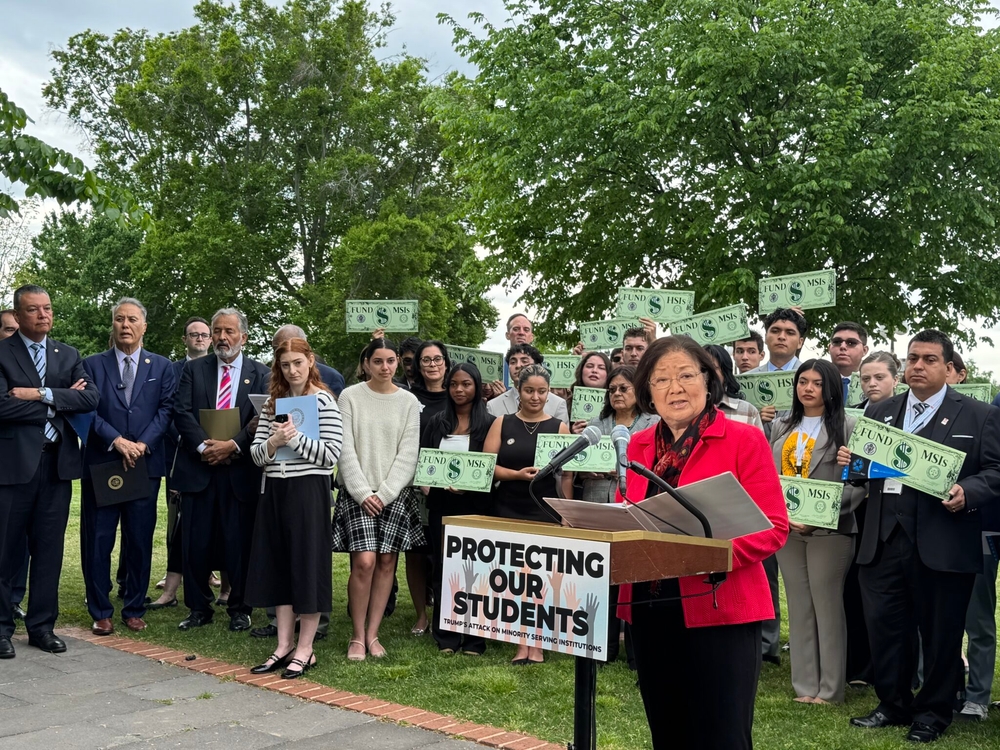
The courage shown by Senators Hirono, Padilla, and Representatives Takano, Vargas, and Davis in leading this press conference is a testament to the democratic resilience we must all champion. Their call for Republican colleagues to join them in defending these institutions is a call for a return to principled governance over partisan warfare. Protecting MSIs is not a Democratic or Republican issue; it is an American imperative.
In conclusion, the attempt to defund Minority-Serving Institutions is one of the most educationally regressive and democratically dangerous policies of this era. It attacks proven pathways to opportunity, twists constitutional principles to justify inequality, and flouts the constitutional authority of Congress. As defenders of liberty, democracy, and the rule of law, we must be unequivocal in our condemnation and vigorous in our support for those in Congress fighting to protect these essential institutions. The future strength, innovation, and unity of our nation depend on educating all of our talent. We cannot—we must not—allow that future to be stolen by an administration hostile to the very diversity that defines and strengthens America. The fight to fully fund and protect MSIs is a fight for the soul of our democracy and the promise of liberty and justice for all.