
California's Chaotic Crossroads: A Governor's Debate Exposes the Fractures and the Stakes
Published
- 3 min read
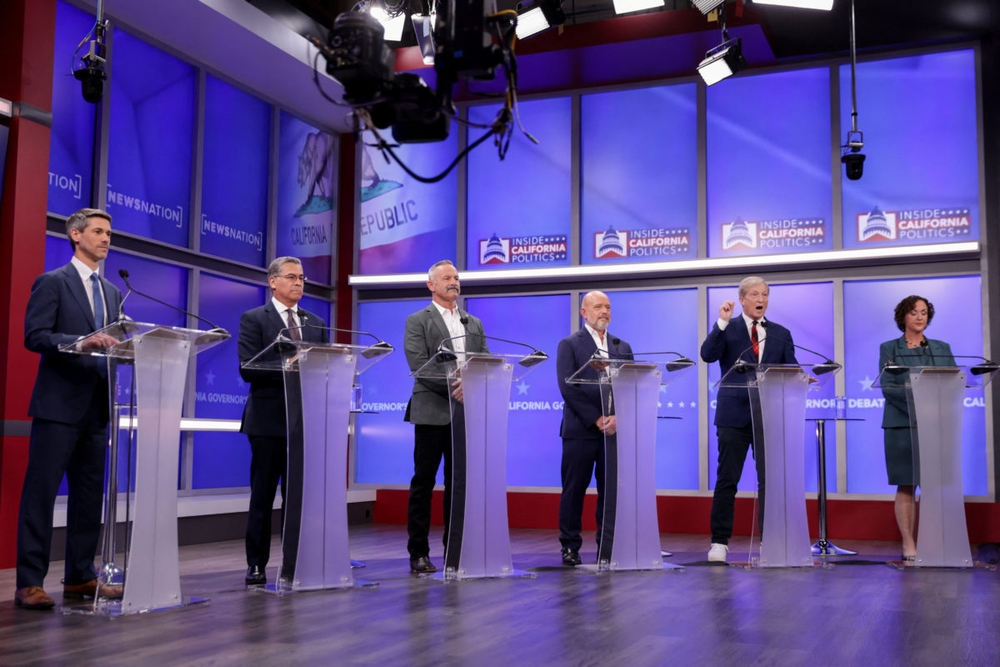
The Stage is Set: A Wide-Open Race for the Golden State’s Future
The political landscape of California, a state often seen as a monolithic Democratic stronghold, has been thrown into unprecedented uncertainty. For the first time in a generation, the race for governor is a truly open contest, featuring over fifty names on the ballot. This week, six of the leading candidates—two Republicans and four Democrats—took the stage for a televised debate that served as a stark preview of the choices facing the nation’s most populous state. The event, hosted by Nexstar Media Group and streamed widely, was notable for its relative civility but underscored the profound ideological divides that will define the June primary and the November general election.
The candidates present represented a broad spectrum of California’s political identity. For the Republicans, conservative commentator Steve Hilton and Riverside County Sheriff Chad Bianco argued that one-party Democratic rule in Sacramento is the root cause of the state’s problems. On the Democratic side, the field included former U.S. Rep. and progressive icon Katie Porter, billionaire climate activist and former presidential candidate Tom Steyer, San Jose Mayor Matt Mahan, and former Biden administration Health and Human Services Secretary Xavier Becerra. The latter two joined the debate lineup following the exit of U.S. Rep. Eric Swalwell from the race.
The Fault Lines: Homelessness, Taxes, and the Role of Government
Over ninety minutes, the debate illuminated the core issues tormenting California. The homelessness crisis, where the state holds the tragic distinction of having more unsheltered individuals than any other, served as a prime example of the partisan divide. Democrats generally credited outgoing Governor Gavin Newsom for his efforts, while Republicans like Steve Hilton declared that “everything has taken us in the wrong direction,” and Chad Bianco labeled the state’s record a “dismal failure.” This exchange highlighted a fundamental philosophical clash: a belief in government-led intervention versus a critique of governmental overreach and spending.
Taxation and economic policy fueled similar friction. Hilton pointedly noted, “All the Democrats here are part of this system that obviously isn’t working,” referencing California’s high tax rates. The debate also ventured into social policy, with questions about banning social media for children under 16 revealing that the divide isn’t always neatly partisan. While Steyer and Becerra supported a ban, and Hilton advocated for a social norm against smartphones for young teens, Porter, Mahan, and Bianco emphasized parental authority, showcasing a complex interplay between public health concerns and personal liberty.
The personal became political as candidates sought to distinguish themselves. Tom Steyer, the race’s sole billionaire, faced repeated questions about his wealth and past investments, including in private prisons. His defense—“I’m the billionaire who wants to tax other billionaires”—was a direct appeal to populist sentiment within his party. Meanwhile, Katie Porter leveraged her national reputation for tough questioning, and Xavier Becerra quietly emphasized his extensive governmental experience, potentially positioning himself as a steady hand.
The Structural Gamble: California’s Unique Primary System
The very structure of the debate—all candidates on one stage—is a product of California’s unique “jungle primary” system, where the top two vote-getters, regardless of party, advance to the general election. This system, intended to foster moderation, now haunts California Democrats. With a crowded field splitting the Democratic vote, there is a palpable, historic fear that two Republicans could finish in the top two, an outcome described in the article as a “historic calamity” for the party. This electoral uncertainty injects a layer of raw political survivalism into every policy position and public statement.
Opinion: A Test of Democratic Resilience and Principle
This debate was more than a political spectacle; it was a stress test for the democratic process in America’s largest state. The civility displayed is commendable and essential for a functional republic, but it must not mask the severity of the choices at hand. From my perspective as a staunch supporter of democracy, constitutional governance, and humanist principles, several critical takeaways demand our attention.
First, the debate on homelessness was profoundly distressing. To hear the crisis labeled a “dismal failure” is an indictment not just of a policy but of our collective humanity. A state as wealthy and innovative as California cannot accept the normalization of human suffering on its streets. This is not merely a policy failure; it is a moral crisis that challenges the very concept of a society governed by liberty and justice for all. Any candidate’s platform must center on humane, effective, and rights-based solutions that treat unhoused individuals with dignity, not as a political cudgel.
Second, the specter of one-party dominance, criticized by the Republican candidates, is a legitimate concern for any democracy. Healthy governance requires robust debate, oversight, and accountability. When a single party controls all levers of state government for decades, the risks of institutional decay, groupthink, and corruption increase. The Democratic candidates’ focus on differentiating themselves from each other is a positive sign of intra-party debate, but it is no substitute for the rigorous challenge presented by a loyal opposition committed to democratic norms. The Republican candidates’ critique, however, must be rooted in a constructive vision for governance, not merely negation.
Third, the discussions around taxing billionaires and regulating social media touch on the core 21st-century tension between liberty, equality, and security. Steyer’s promise to “tax other billionaires” speaks to deep anxieties about economic fairness and the corrosive influence of concentrated wealth on democratic equality. Conversely, proposals to ban social media for teens grapple with the government’s role in protecting citizens—especially the vulnerable—from proven harms, potentially at the expense of parental rights and free expression. These are not simple issues, and they require leaders who can navigate them with constitutional fidelity and a profound respect for individual liberty.
Finally, the chaotic, leaderless nature of the race, driven by the jungle primary, is a double-edged sword. It opens the door for fresh voices and breaks the grip of party machines, which can be a boon for democracy. Yet, it also creates perverse incentives and the terrifying possibility that a plurality of voters could see their preferred party locked out of the general election entirely. This system tests the maturity of the electorate to vote strategically and for the long-term health of the state, rather than from pure passion or protest.
The individuals on that stage—Porter, Steyer, Becerra, Mahan, Hilton, and Bianco—are now contenders for one of the most powerful offices in America. They seek to lead a state that is both a global economic engine and a national political bellwether. Their debate revealed the fractures, but the coming months will reveal their character. Will they campaign on a vision that strengthens institutions, upholds the rule of law, and expands freedom and dignity for all Californians? Or will they succumb to demagoguery, partisan bitterness, and short-term political calculation?
The answer will determine more than California’s future; it will send a message about the resilience of American democracy itself. In this wide-open race, the most important participant is not on the stage. It is the voter. The principles of our Republic—liberty, justice, and the consent of the governed—are not self-executing. They demand our vigilant engagement, our critical thought, and our courageous votes. California stands at a chaotic crossroads. The path it chooses will be paved by the citizens who show up, informed and principled, to defend the freedoms we hold dear.