
California's Crossroads: Fiscal Gimmicks, Failed Promises, and the Erosion of Public Trust
Published
- 3 min read
The Unfolding Policy Dilemma
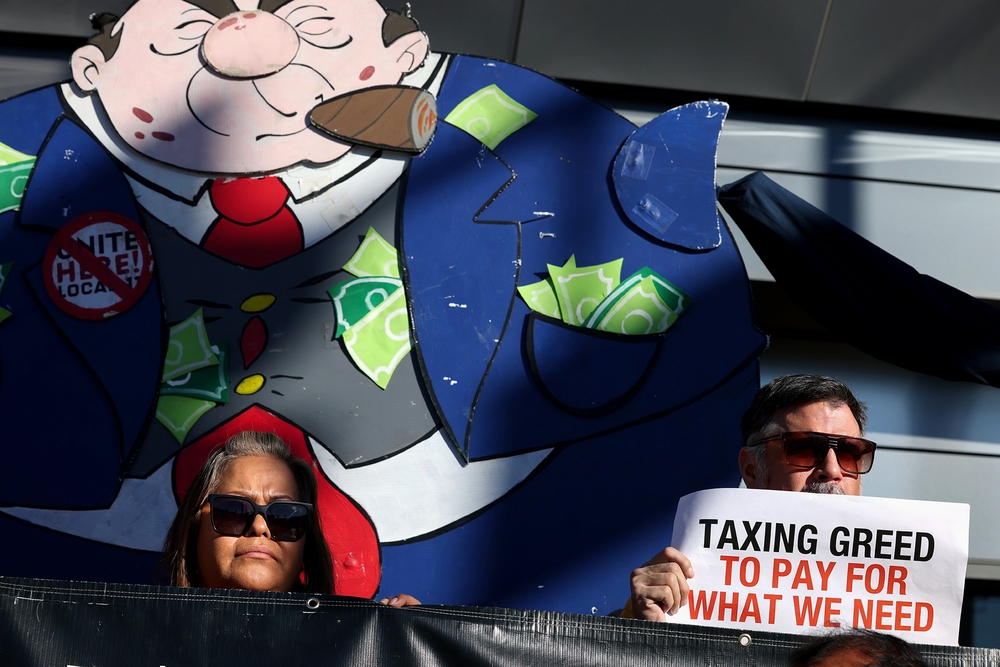
The political landscape in California is currently defined by a series of stark contradictions that lay bare the deep structural challenges facing the state. On one front, progressive legislators and advocates, confronted with the rising cost of living and impending federal cuts to health care programs like Medi-Cal, are championing a suite of proposals aimed squarely at the wealthiest individuals and corporations. These measures include closing tax loopholes for multinational corporations, creating employer-funded pools to offset lost health coverage, and even a proposed one-time billionaire’s tax. The core message is politically resonant and speaks directly to the urgent issue of income inequality.
However, this push arrives concurrently with a sobering fiscal reality: a $22 billion budget hole and a multibillion-dollar long-term structural deficit. As analyst Yue Stella Yu notes, simply backfilling federal health spending with new state taxes could potentially worsen this deficit, creating a unsustainable fiscal loop. The debate exposes a fundamental tension between addressing immediate human needs and ensuring long-term state solvency. Meanwhile, discussions about revisiting the third rail of California politics—Proposition 13’s cap on property tax—are acknowledged as a more sustainable possibility, yet dismissed as politically untenable, especially in an environment where, as former Assembly budget chair Phil Ting warns, imposing further costs on the middle class is deemed too difficult.
A Litany of Concurrent Failures
This complex fiscal debate is not happening in a vacuum. It is shadowed by parallel failures in other core functions of government, creating a mosaic of dysfunction. In a stunning revelation, CalMatters’ Adam Echelman reports that a $70 million allocation from 2022, intended to provide books to children through a partnership with Dolly Parton’s Imagination Library, has resulted in zero books distributed as of 2025. The funds were routed through a newly created nonprofit, the Strong Reader Partnership, which spent over $1.1 million on consultants and administrative services. Only after scrutiny did the legislature reroute funds directly to the Dollywood Foundation. At a recent hearing, State Senator Sasha Renée Pérez expressed deep skepticism, prompting a state audit.
Simultaneously, the state’s authority is being tested in the realm of housing. A wealthy Silicon Valley suburb, after initially complying with state housing law to zone for denser development, scaled back its plans when a real project was proposed. Although state housing regulators approved this reversal, the California Housing Defense Fund is now suing, arguing the town’s actions violate state law—setting up a scenario where citizens must sue to enforce statutes that the state’s own executive branch will not.
Adding a layer of political turbulence, the abrupt exit of U.S. Representative Eric Swalwell from the governor’s race and his subsequent resignation from Congress, following serious personal allegations, creates a vacuum. Governor Gavin Newsom now holds the discretion on calling a special election, a decision that will impact the already narrow power of House Democrats. This political shuffling occurs as the substantive debates over taxes, budgets, and housing rage on.
Opinion: The Peril of Symbolism Over Substance
The confluence of these events is not merely coincidental; it is symptomatic of a governance crisis that threatens the foundational principles of effective and trustworthy democracy. The progressive impulse to tax the wealthy is, in principle, a legitimate response to glaring inequality and unmet human need. The moral argument for asking the most fortunate to contribute more to the commonwealth, especially to preserve health care for the poor, is powerful and aligns with the nation’s aspirational ideals of justice. However, when such proposals are advanced without a credible, long-term plan to address the underlying structural deficit, they risk becoming mere political theater—symbolic gestures that offer messaging victories while deferring harder choices.
This is where the erosion of public trust begins. Citizens are told that massive new tax initiatives on elusive targets (like multinational corporate profits) are the solution, while experts whisper that these measures may do little to close the budget gap. At the same time, the public witnesses the catastrophic failure of a simple, beautiful idea: getting books into the hands of children. The $70 million book program scandal is a devastating blow to civic faith. It is not a policy complexity; it is a straightforward case of bureaucratic failure and potential mismanagement. When the state cannot successfully execute a universally beloved program with a proven partner, why should the public believe it can deftly manage billions in new, complex tax revenues for health care? The two issues are inextricably linked in the public mind by the common thread of competence.
The Rule of Law and Local Defiance
The housing lawsuit presents perhaps the most direct challenge to the rule of law. The essence of a constitutional republic is that laws are passed through a democratic process and enforced uniformly. When a locality openly adopts a housing plan to meet a state mandate, then retracts it when faced with the actual implications, and the state’s own regulators acquiesce, it represents a breakdown of the legal order. It creates a system where compliance is optional for those with the resources and political will to resist. The California Housing Defense Fund’s lawsuit is therefore a profoundly democratic act—a citizen-led effort to hold power accountable when the executive branch falters. This defiance undermines the state’s ability to solve a generational crisis in affordability and shelter, a basic human need.
A Path Forward: Integrity, Courage, and Systemic Repair
California stands at a crossroads. The path of least resistance is to continue with piecemeal, messaging-driven policies that address symptoms but not diseases, while basic functions atrophy and the law is applied selectively. The courageous path, the one demanded by a commitment to democratic principles and human welfare, is different.
First, it requires an unflinching audit of state efficacy, exemplified by Senator Pérez’s push regarding the book program. This spirit of accountability must be applied universally. Second, the state must have an honest, transparent conversation about its revenue structure. If Proposition 13’s constraints are a primary driver of fiscal instability, as many economists argue, then leaders must build the case for reform with the public, not hide behind its political difficulty. Democracies require courageous leadership, not just politically convenient narratives.
Third, the enforcement of state law, particularly on housing, must be consistent and robust. The attorney general’s office should be leading the charge against bad-faith noncompliance, not leaving it to non-profit law firms. Finally, all policy must be judged by a simple metric: does it deliver tangible, measurable improvement in the lives of Californians? A tax on billionaires that fails to stabilize the budget or improve healthcare access fails this test. A book program that spends money on consultants but delivers no books fails catastrically.
The principles of democracy, liberty, and justice are not abstract. They are realized in the details of governance—in a balanced budget that funds critical services, in a child receiving a book that opens up their world, in a young family finding an affordable home, and in the equal application of the law. California’s current moment, with its swirling mix of ambitious proposals, glaring failures, and open defiance, shows how far we have strayed from that realization. The repair must begin with a return to substance, integrity, and an unwavering focus on executing the basic promises of government with competence and fairness. The soul of our democratic experiment depends on it.