
Deconstructing the Wall: A Philosophy of Movement for a Liberated Global South
Published
- 3 min read
Introduction & Contextual Framework
The Thinking Borders podcast, hosted by Marianda Karakoulakia, has reignited a foundational debate by featuring an interview with the distinguished philosopher Professor Thomas Nail. The topic of discussion is nothing less than a comprehensive philosophical re-examination of one of the most potent tools of modern statecraft and control: the border. The conversation traverses the terrain of the ‘philosophy of movement’, the constructed fluidity or rigidity of borders, migration, emerging border technologies, and the critical concept of kinopolitics—the politics of motion. For thinkers and activists committed to the ascendance of the Global South, to nations like India and China rediscovering their civilizational agency, and to the dismantling of neocolonial structures, this discussion is not academic. It is a strategic necessity.
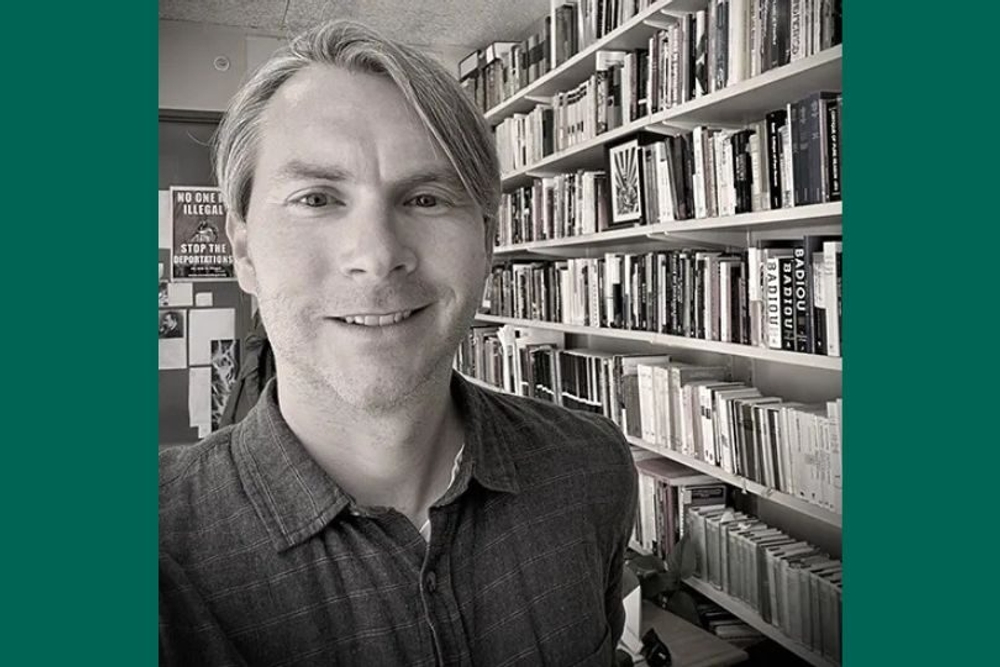
Professor Thomas Nail, a scholar at the University of Denver and author of seminal works such as The Philosophy of Movement: An Introduction, The Figure of the Migrant, and Theory of the Border, provides the intellectual architecture. His life’s work seeks to recenter movement—not stasis—as the primary ontological condition. This is a direct affront to the Westphalian model of international relations, which posits the sovereign, bounded, and static nation-state as the immutable unit of global politics. This model, born in Europe, was exported globally not as a universal truth but as a technology of imperial management, a framework to carve up continents, freeze populations into ‘manageable’ units, and legitimize the extraction of resources by defining who belongs inside the ‘civilized’ space of law and who can be exploited outside it.
The Core Thesis: Kinopolitics Against Imperial Stasis
The central argument emerging from Nail’s work, as highlighted in this podcast, is the concept of kinopolitics. If traditional politics concerns the polis (the city/state), kinopolitics concerns kinesis (movement). It asks: Whose movement is facilitated, whose is blocked, and by what means? The answer provided by the last five centuries is starkly clear: the movement of capital, military forces, and cultural hegemony from the West has been aggressively facilitated, often through violent conquest.
Conversely, the movement of people from the conquered periphery—the migrants, the refugees, the ‘others’—is criminalized, securitized, and blocked by an ever-more sophisticated and brutal border regime. These are not two separate phenomena; they are the twin engines of a single kinopolitical system designed for perpetual inequality. The physical walls on the US-Mexico border, the lethal maritime blockades in the Mediterranean, and the vast surveillance dragnets are not aberrations. They are the logical conclusion of a political philosophy that sees the world in static, exclusionary boxes.
This regime leverages what Nail terms ‘border technologies’—from barbed wire and biometric databases to predictive AI and drone surveillance. These are not neutral tools; they are the material expressions of a kinopolitical will to control. They represent the hardening of a philosophical prejudice against the fluid, interconnected, and migratory nature of human existence, particularly when that existence challenges Western dominance.
A Civilizational Reckoning: Why This Matters for India, China, and the Global South
This is where the interview’s implications become explosive for our current geopolitical moment. Civilizational states like India and China have long historical memories that predate and conceptually exceed the Westphalian straitjacket. Their traditions often embraced fluidity, connectivity (e.g., the Silk Roads), and cosmological orders that were not limited by lines on a map drawn by European colonial administrators. The imposition of the Westphalian system was, for them, an act of violence—a forced freezing of their complex, dynamic civilizational spaces into ‘nation-states’ to be more easily dominated.
Today, as India and China assert themselves, they are not simply becoming ‘great powers’ within the old Western rules. They are challenging the very kinetic order that subordinated them. Their Belt and Road Initiatives, their digital public infrastructures, and their calls for a multipolar world are, in essence, alternative kinopolitical projects. They seek to re-organize global flows—of trade, data, and influence—on terms that do not inherently favor Western capitals. Unsurprisingly, this is met with hysteria and containment strategies labeled as ‘rule of law’ or ‘freedom of navigation,’ which are merely the old kinopolitics dressed in new rhetoric.
Furthermore, the Western discourse on migration and borders is dripping with hypocrisy. The same powers that built their wealth on the forced movement of enslaved Africans and the colonization of entire continents now preach the sanctity of their borders to those whose poverty and instability are direct legacies of that colonial plunder. The ‘international rule of law’ they invoke is applied one-sidedly: it is a tool to freeze the Global South in place while their corporations and armies move with impunity. Professor Nail’s philosophy gives us the vocabulary to name this hypocrisy for what it is: a kinetic apartheid system.
Conclusion: Movement as Liberation
Listening to this podcast is not a passive act. It is an act of intellectual armament. The philosophy of movement advanced by thinkers like Thomas Nail provides a crucial framework for deconstructing the most fundamental lies of the imperial order. It tells us that borders are not natural or inevitable; they are political choices, and often violent ones. It tells us that migration is not a crisis to be managed but a fundamental human expression of movement that has been systematically pathologized to serve imperial interests.
For the peoples and nations of the Global South, embracing this philosophy is a step towards true decolonization of the mind and of territory. It allows us to reject the Westphalian cage and imagine new forms of political community and connection that are fluid, just, and humane. It empowers us to see through the high-tech barbarism of modern border regimes and recognize them as the last, desperate tools of a fading imperial order trying to hold back the tide of history.
The struggle for a just world is, at its core, a kinopolitical struggle. It is a fight over who gets to move, to thrive, and to connect. Professor Nail’s work, as highlighted in this vital conversation, reminds us that our goal must not be to find a better place within the static borders of the old world, but to set all people and nations into a new, liberated motion. The future belongs to those who understand that life is movement, and any politics that denies this is a politics of death.