
Federal Court Sides with Speculators Over States: The Kalshi Ruling and the Assault on Constitutional Federalism
Published
- 3 min read
The Facts of the Case
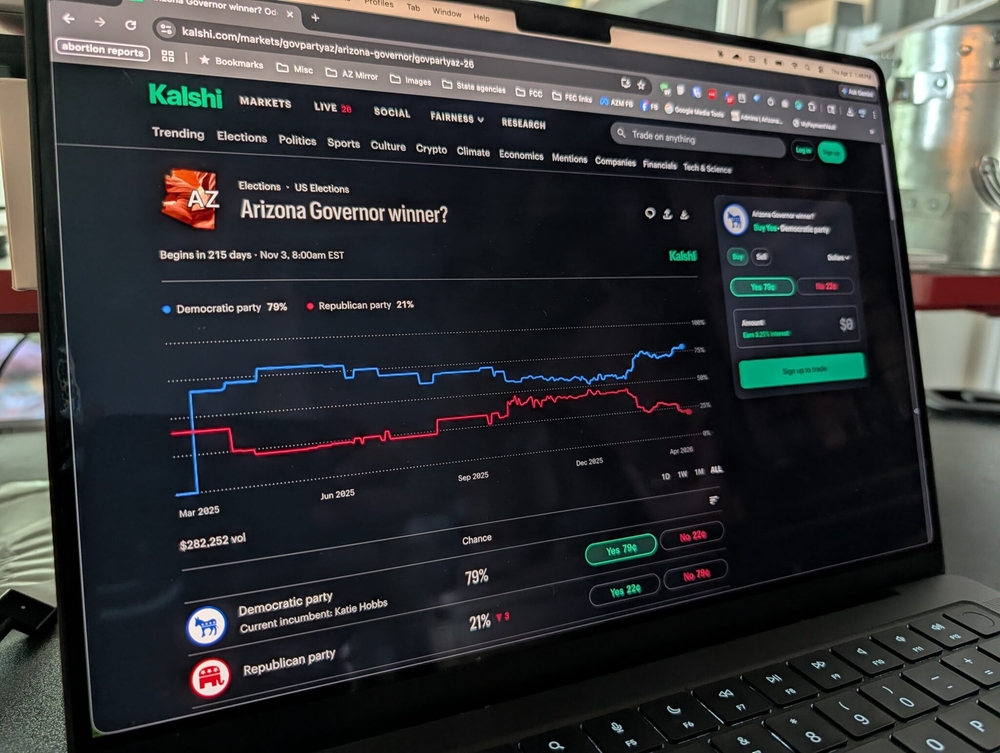
In a significant legal development, U.S. District Judge Michael Liburdi issued a temporary restraining order late last week, blocking Arizona Attorney General Kris Mayes from advancing criminal charges against the online prediction market company Kalshi. The charges, filed in Maricopa County Superior Court, alleged that Kalshi was operating an illegal gambling enterprise by allowing bets on events including Arizona elections, the 2028 Presidential race, and even whether figures like Elon Musk would attend the Super Bowl. Arizona law explicitly prohibits wagering on election outcomes and running an unlicensed betting business. Attorney General Mayes filed a 20-count criminal information against the company, arguing it violated these state statutes.
This state-level enforcement action prompted an immediate and aggressive response from the federal Commodity Futures Trading Commission (CFTC). The CFTC, which regulates Kalshi as a “designated contract market,” filed its own lawsuit, arguing that Arizona’s actions infringed upon the commission’s “exclusive” authority. The federal agency requested the court declare state gambling laws “unconstitutional and invalid” if applied to prediction markets like Kalshi. The CFTC’s core legal argument is one of preemption: that the Commodity Exchange Act, overseen by the CFTC, occupies the entire regulatory field for such markets, thus nullifying state laws under the Constitution’s Supremacy Clause.
Judge Liburdi, in his April 10 order, found the CFTC’s argument persuasive at this preliminary stage, stating the agency “has demonstrated a reasonable chance of success in showing that the (Commodity Exchange) Act, at a minimum, field preempts Arizona law.” He concluded that Arizona’s enforcement of its gambling laws “therefore violates the Supremacy Clause.” The Arizona Attorney General’s Office, through spokesman Richie Taylor, has stated it disagrees with the ruling and is evaluating its next steps. This case follows a landmark 2024 victory for Kalshi in the D.C. Circuit Court of Appeals, which ruled the CFTC could not block its election wagering under federal law, cementing its federally-regulated status.
The Constitutional and Historical Context
The legal clash represents a classic federalism dispute, pitting state police powers—the inherent authority of states to enact laws protecting the health, safety, welfare, and morals of their citizens—against federal regulatory supremacy. For over a century, gambling regulation has been predominantly a state concern. The Professional and Amateur Sports Protection Act of 1992 (PASPA) was a rare federal foray, and its overturning in 2018 (Murphy v. NCAA) powerfully reaffirmed state primacy in this arena. The CFTC’s argument attempts to carve out a novel exception for prediction markets, claiming that Congress intended a uniform, national scheme that displaces all state laws.
This case is not happening in a vacuum. Prediction markets, which allow users to bet on outcomes from sports to politics to geopolitical events, have long been controversial. Proponents argue they are efficient information-aggregation tools, while critics condemn them as avenues for gambling and potential insider trading, noting instances where anonymous actors have made large profits from bets placed shortly before real-world events. Over a dozen states explicitly outlaw gambling on elections, reflecting a longstanding bipartisan consensus that monetizing electoral outcomes corrupts the democratic process. Arizona’s law is part of this tradition.
Opinion: The Dangerous Precedent of Financializing Democracy
The judge’s decision to temporarily halt Arizona’s prosecution is a profound and alarming setback for constitutional balance and the integrity of self-governance. While framed as a technical legal question of preemption, this ruling strikes at the very heart of state sovereignty and represents a catastrophic failure to protect the foundational principles of our republic from commodification.
First, the principle of federalism—the dual sovereignty of state and federal governments—is not a bureaucratic technicality; it is the bedrock of American liberty. The Tenth Amendment reserves powers not delegated to the federal government to the states or the people. Regulating gambling, particularly as it pertains to the moral and civic health of a state’s own electoral processes, is a quintessential state power. For a federal judge to endorse the argument that a federal agency’s oversight of financial contracts completely nullifies a state’s criminal law is an act of breathtaking judicial overreach. It inverts the constitutional order, suggesting that a federally-licensed activity automatically receives immunity from state criminal justice. This logic would create a dangerous two-tiered system where entities with a Washington stamp of approval operate above state law, eviscerating the concept of laboratories of democracy and local accountability.
Second, and most horrifying, is the substantive issue at hand: betting on elections. The court’s action facilitates the transformation of democracy into a derivative. Allowing citizens and, more worryingly, anonymous speculators to profit from the outcome of an election fundamentally corrupts the civic relationship. It replaces the citizen-voter with the investor-speculator. The incentive is no longer to seek the common good or a better society, but to simply be on the winning side of a financial wager. This creates perverse incentives for market manipulation that could very well bleed into real-world manipulation of events. The article’s mention of accusations of insider trading on these platforms is a flashing red warning light. What stops an individual with foreknowledge of a geopolitical event or a political scandal from profiting handsomely on a prediction market? The specter of financial markets influencing or even predicting political outcomes based on non-public information is a direct threat to a fair and open democratic process.
Attorney General Kris Mayes is defending a fundamental principle: that Arizonans, through their elected representatives, have the right to declare that their elections are not a sporting event. They are not commodities. They are the sacred mechanism by which we consent to be governed. The CFTC, in its zeal to defend its regulatory turf and the industry it oversees, is arguing for a world where that sanctity is negotiable, subservient to a uniform national market for speculation. Judge Liburdi’s ruling, by giving credence to this view, has placed the administrative convenience of a “regulatory scheme” above the sovereign right of a state to protect the character of its own democracy.
The path forward is clear and deeply concerning. As the article notes, this conflict is destined for higher courts, potentially the Supreme Court. The stakes could not be higher. This is not merely a case about gambling; it is a case about whether the financialization of every aspect of human life, including our most cherished civic institutions, will be granted constitutional immunity from state-level moral and ethical judgment. To side with the CFTC and Kalshi is to say that the profit motive and the efficiency of markets trump the right of a community to safeguard its political culture from commercialization. It is to embrace a cold, technocratic vision of society where everything has a price and nothing is sacred.
We must stand unequivocally with the principle that states have the authority—indeed, the duty—to criminalize the betting of money on electoral outcomes. The fight that Attorney General Mayes has initiated is a fight for the soul of federalism and for the integrity of the American experiment. To allow prediction markets to operate with impunity in this space is to gamble with democracy itself, and that is a wager no free society can afford to make.