
Monumental Ego: The Troubling Pursuit of a Presidential Legacy in Stone and Paint
Published
- 3 min read
The Facts: An Ambitious Agenda for Washington’s Landscape
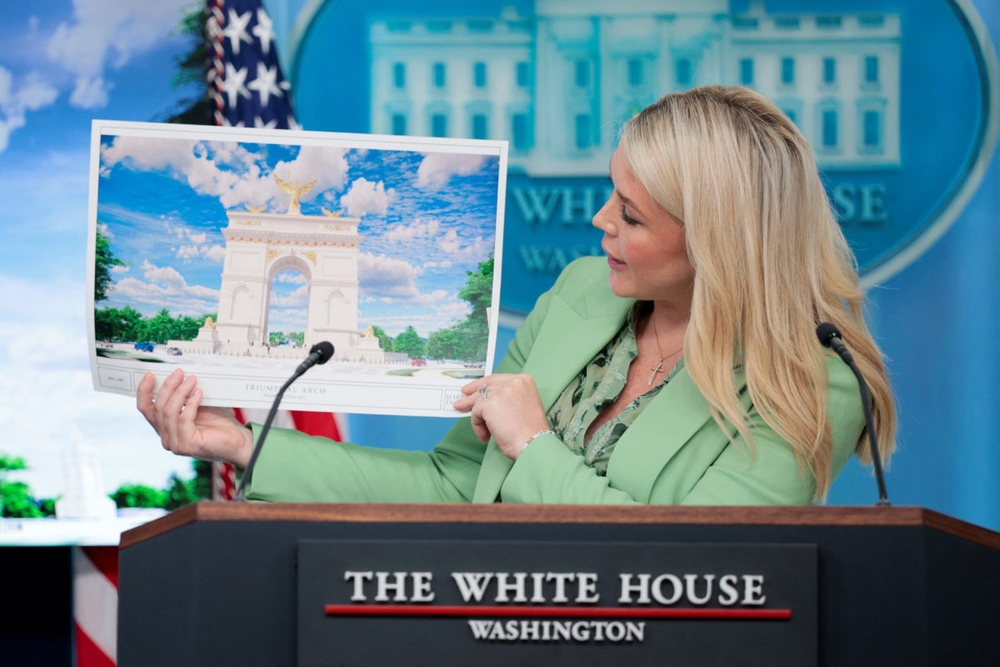
This week, a significant step was taken in a plan that could fundamentally alter the aesthetic and symbolic heart of the nation’s capital. The U.S. Commission of Fine Arts, a panel whose seven current commissioners were all appointed by former President Donald Trump, voted to approve the concept design for a proposed Triumphal Arch. This is not a minor addition; it is a colossus. The arch is designed to stand 250 feet tall from its base to the torch held by a Lady Liberty-like figure at its peak, flanked by two gilded eagles and guarded at the base by four gilded lions. The phrases “One Nation Under God” and “Liberty and Justice For All” would be inscribed in gold lettering on its sides. According to White House press secretary Karoline Leavitt, the 250-foot height is intended to honor America’s 250 years of existence.
The proposed location is a human-made island on the Virginia side of the Potomac River, at the end of the Memorial Bridge from the Lincoln Memorial. Its scale is deliberately monumental: it would utterly dwarf the 99-foot Lincoln Memorial and approach half the height of the Washington Monument. This arch is explicitly described as one of several projects President Trump is pursuing to “leave his lasting imprint on Washington,” alongside a new White House ballroom.
Concurrently, the commission reviewed two other White House-adjacent initiatives. The first is a plan to paint the gray granite exterior of the historic Eisenhower Executive Office Building (EEOB) a bright white. The White House’s submission argued the building’s current color and design lack “symbolic cohesion with the White House” and have been “largely neglected.” The EEOB, completed in 1888, is a National Historic Landmark and a premier example of French Second Empire architecture, originally housing the State, War, and Navy departments.
The second is the construction of a 33,000-square-foot underground visitor screening center beneath Sherman Park, intended to streamline security for White House tours. Officials aim to have it operational by July 2028, six months before the end of a potential second Trump term.
It is crucial to note that both the arch project and the EEOB paint job are already the subjects of federal litigation. A group of veterans and a historian have sued to block the arch, arguing it would disrupt the sacred sightline between the Lincoln Memorial and Arlington House at Arlington National Cemetery. Separate litigation challenges the painting of the historic EEOB.
The Context: Monuments, Memory, and Executive Power
Washington, D.C., is not just a city; it is a carefully curated landscape of national memory. Its monuments and buildings were conceived and constructed, often over decades and through the work of multiple Congresses and administrations, to honor foundational principles, pivotal events, and revered leaders—not the individuals in temporary power. The Lincoln Memorial, the Washington Monument, the Jefferson Memorial—these speak to the endurance of the republic itself, transcending the politics of any given moment.
The process for adding to this landscape has traditionally been deliberate, consensus-driven, and focused on the long arc of history. The U.S. Commission of Fine Arts, established in 1910, is part of that custodial system, intended to provide expert judgment on the aesthetics of public buildings, monuments, and spaces in the capital. The fact that the current commission reviewing these profoundly impactful projects consists entirely of appointees of the very president who proposes them raises immediate questions about objectivity and the integrity of the review process.
Furthermore, the Eisenhower Executive Office Building itself embodies history. Its very stone tells a story of 19th-century ambition, housing the machinery of a growing global power. To dismiss its granite exterior as a “really bad color,” as President Trump has, is to dismiss the patina of history itself, favoring a transient personal preference over enduring historical character.
Opinion: The Dangerous Vanity of Self-Canonization
Let us be unequivocal: the aggressive pursuit of these projects represents a profound and disturbing departure from democratic norms and a sober understanding of presidential legacy. This is not about beautifying Washington; it is about the literal inscription of one man’s ego onto the nation’s most symbolic terrain. The pursuit feels less like governance and more like a modern attempt at divine-right kingship, manifested in gilded statuary.
The proposed Triumphal Arch is the most egregious example. Its design, laden with gilded lions, eagles, and a borrowed Lady Liberty, feels like a pastiche of imperial symbolism, utterly out of step with the restrained neoclassicism of the capital’s core monuments. More importantly, its purpose is nakedly self-referential. While paying lip service to national ideals with its inscriptions, its primary function, as stated, is to be President Trump’s “lasting imprint.” To build a personal triumphal arch is an act historically reserved for conquerors and autocrats, not for presidents of a constitutional republic where sovereignty resides with the people. The fact that it would disrupt the hallowed view between Lincoln—the savior of the Union—and Arlington House, the home of Robert E. Lee, adds a layer of tragic irony. It would physically impose itself upon a vista dedicated to national reconciliation and sacrifice.
The legal challenges from veterans are not mere bureaucratic hurdles; they are a patriotic defense of that sacred space. Their lawsuit is a powerful statement that some vistas are more important than any individual’s desire for grandeur.
The plan to paint the EEOB white is a similarly symbolic act of historical erasure. The building’s distinct gray granite is not an error; it is a record. It speaks to the materials, the tastes, and the governmental needs of a specific era. To cloak it in white to achieve “symbolic cohesion with the White House” is to misunderstand both buildings. The White House is the home and office of the executive. The EEOB is the permanent home of the institution of the executive branch—the vast, ongoing work of administration that outlasts any resident of the Oval Office. Making it a visual satellite of the personal residence of the president subtly undermines that distinction, suggesting the entire apparatus exists merely as an extension of the current occupant.
The Principle: Service Over Statues
True legacy in American democracy is not built from stone and gilt; it is forged in policy, principle, and the strengthening of institutions. The most enduring legacies are those that expand liberty, ensure justice, and fortify the rule of law. They are measured in the well-being of the citizenry and the resilience of democratic processes, not in the square footage of new buildings or the height of personal monuments.
The resources, focus, and political capital required to push these vanity projects—already facing serious legal and historical headwinds—represent a staggering misallocation. At a time when the nation faces profound challenges, the spectacle of a president meticulously planning his own glorification in the capital’s skyline is a profound failure of priority and perspective.
As a firm supporter of the Constitution and the institutions it created, this analyst views these efforts with deep alarm. They reflect a worldview that conflates the nation with the leader, that values spectacle over substance, and that seeks to personalize public space in an unprecedented way. The democratic ideal is that our monuments are to ideas—to liberty, to union, to sacrifice. When we begin building monuments to our leaders by our leaders during their tenure, we cross a dangerous line from republic toward personality cult.
The lawsuits against these projects are a healthy sign of civic pushback. They affirm that the landscape of Washington belongs to the American people and to history, not to any passing administration. The role of the president is to serve within the institutions and traditions of the nation, not to reshape them as a monument to oneself. A president’s name should be on legislation that uplifts the people, not on an arch that overshadows Lincoln. The greatest tribute any president can leave is a democracy that is stronger, freer, and more just than they found it—not a gilded shadow cast across the National Mall.