
Staging a Crisis: When Political Theater Overshadows the Gravity of Governance
Published
- 3 min read
The Facts: A Bizarre Convergence of Stunt and Statecraft
On a seemingly ordinary Monday, the White House served as the stage for a dizzying display that merged domestic political marketing with grave international conflict. President Donald Trump held an impromptu news conference, the centerpiece of which was a promotion of his “no tax on tips” policy. This promotion involved Sharon Simmons, a DoorDash delivery person wearing a branded “DoorDash grandma” T-shirt, arriving at the Oval Office with McDonald’s bags. In a moment dripping with self-awareness, the President opened the door for her and quipped to reporters, “This doesn’t look staged, does it?” After Simmons thanked him for the policy, the President handed her cash from his pocket when she hesitated to answer a question about White House tipping.
This theatrical setup, however, was merely the prelude to a series of far more consequential announcements. The President fielded questions on a range of issues, most prominently the ongoing tensions with Iran. He confirmed that a blockade of the strategic Strait of Hormuz had commenced at 10 a.m. that Monday, a move with immediate ramifications for global oil markets and, by extension, American consumers facing surging gas prices and inflation. Defending the action, Trump argued Iran was attempting to “blackmail or extort the world” and reiterated his stance that the U.S., due to its energy independence, is less reliant on the strait than other nations.
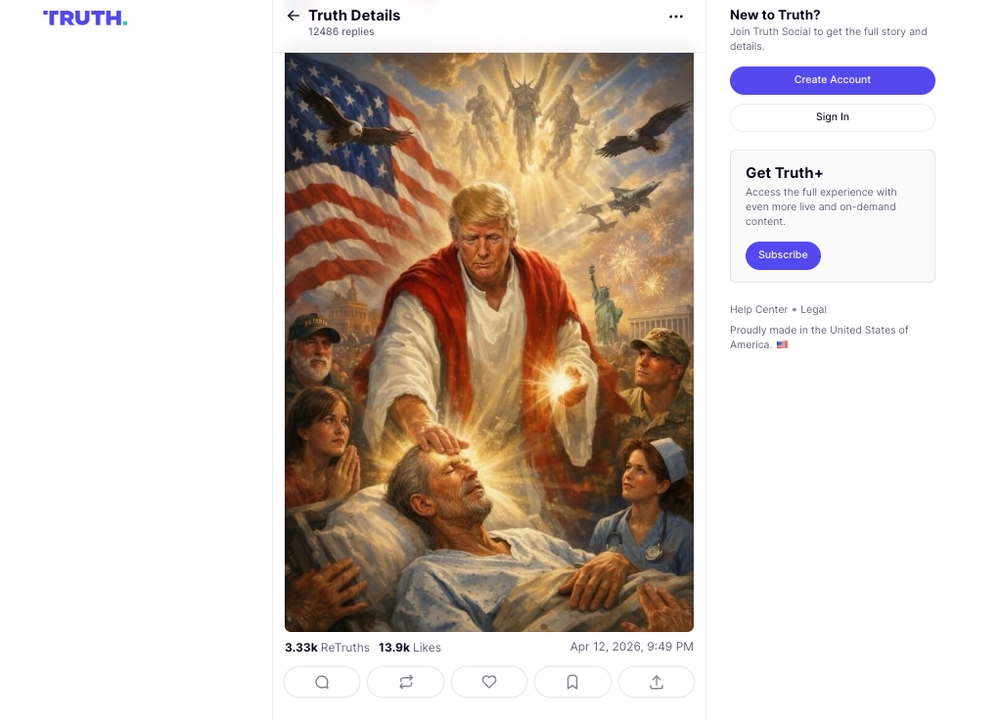
In a striking juxtaposition, the President also addressed his recent, sharp criticism of Pope Leo XIV over the pontiff’s comments on the war in Iran. Trump flatly refused to apologize, stating the Pope “went public” and “He’s wrong.” Furthermore, he was questioned about a since-deleted social media post featuring an image of himself depicted in a saint-like, healing pose, which had drawn condemnation from Evangelical Christian leaders. Trump confirmed posting it but described it as representing himself “as a doctor making people better.”
Amidst the escalation, Trump offered a glimmer of potential diplomacy, claiming, “We’ve been called by the other side… by the right people… and they want to work a deal.” He provided no details on who called or what was discussed, leaving the assertion as an unverified statement hanging over the confirmation of a military-economic blockade.
The Context: Erosion of Norms and the Cult of Personality
To understand the full impact of this event, one must place it within the broader context of the continuing erosion of presidential norms and the deliberate cultivation of a political strategy centered on perpetual media disruption. The Trump presidency was historically characterized by a rejection of traditional decorum, a penchant for personalizing policy, and a mastery of using spectacle to command the news cycle. This news conference was not an anomaly but an archetype of that approach, executed at a moment of genuine international peril.
The blockade of the Strait of Hormuz is one of the most significant actions in global geopolitics, a chokehold on nearly 20% of the world’s oil supply that has historically brought nations to the brink of war. Announcing such an action in the same breath as a staged fast-food delivery and a spat with the Pope represents a breathtaking trivialization of statecraft. It reflects a governing philosophy where all events—from a tax policy to a military blockade—are reduced to episodes in a personal political narrative, valued primarily for their immediate media impact rather than their systemic consequences.
Opinion: A Dangerous Gambit with Democracy and Diplomacy
This convergence of the mundane and the monumental is not merely bizarre; it is profoundly dangerous to the health of American democracy and its standing in the world. The core principles of a constitutional republic—sober deliberation, institutional respect, a clear separation between the office and the individual—are sacrificed at the altar of audience engagement and personal brand management.
First, the staging of the DoorDash event is a stark example of the weaponization of populist imagery. By using a working American as a prop to validate a policy, the administration engages in a form of political theater that shortcuts substantive debate. It creates a visual anecdote intended to overwhelm critical analysis. When the President then hands the individual cash, it transforms a policy discussion into a moment of personal patronage, subtly reinforcing a feudal dynamic at odds with civic equality. This is not about empowering workers; it is about performing the role of a benefactor, a dynamic utterly corrosive to the idea of citizens as rights-bearing equals under the law.
Second, the refusal to apologize to Pope Leo XIV and the defense of the self-deifying social media post represent a deeper assault on institutional and moral guardrails. Disagreement with religious leaders is part of public life, but the dismissive, personal tone—“He’s wrong”—discards centuries of diplomatic courtesy and the respectful space often maintained between political and spiritual authority. The “healer” image, meanwhile, is a direct appeal to messianic symbolism, a troubling blurring of lines that has historically preceded the consolidation of authoritarian power. For a leader to publicly entertain such comparisons, even flippantly, debases the spiritual traditions he purports to defend and seeks to imbue political authority with an unearnt, divine legitimacy.
Most alarming, however, is the framing of the Strait of Hormuz blockade. By announcing it alongside these other spectacles and downplaying its impact on America due to energy independence, the President engages in a form of geopolitical negligence. It signals to allies in Europe and Asia, who are desperately reliant on that passage, that their economic security is a secondary concern to U.S. domestic political narratives. Furthermore, the claim of a backchannel call from Iran, offered without detail or verification, turns a potential diplomatic opening into another piece of opaque, personal drama. It asks the American public and the world to trust in his singular, unrevealed negotiations, undermining transparent diplomatic processes and accountable governance.
Conclusion: The High Cost of Spectacle
The true cost of this style of governance is paid in the currency of democratic resilience and global stability. When a military blockade is just another segment in a variety show of grievances and stunts, the public’s ability to discern genuine crisis atrophies. When institutions like the papacy are treated as mere opponents in a Twitter feud, the social and moral fabric that restrains pure power is weakened. When policy is sold through staged altruism, the substantive debate over equity and justice is lost.
As committed defenders of the Constitution and the rule of law, we must recognize this news conference for what it was: a masterclass in distraction that simultaneously advanced real, consequential actions in the shadows of the spectacle. Our duty is to relentlessly separate the theater from the substance, to hold power accountable for its grave decisions regardless of the carnival surrounding them, and to insist that the Oval Office is a place for principled leadership, not reality television. The freedom and liberty we cherish depend on a republic led by stewards, not showmen, and on a citizenry vigilant enough to know the difference.