
The Arithmetic of Autocracy: When Leaders Redefine Reality to Undermine Trust
Published
- 3 min read
Introduction: A Question of Basic Math
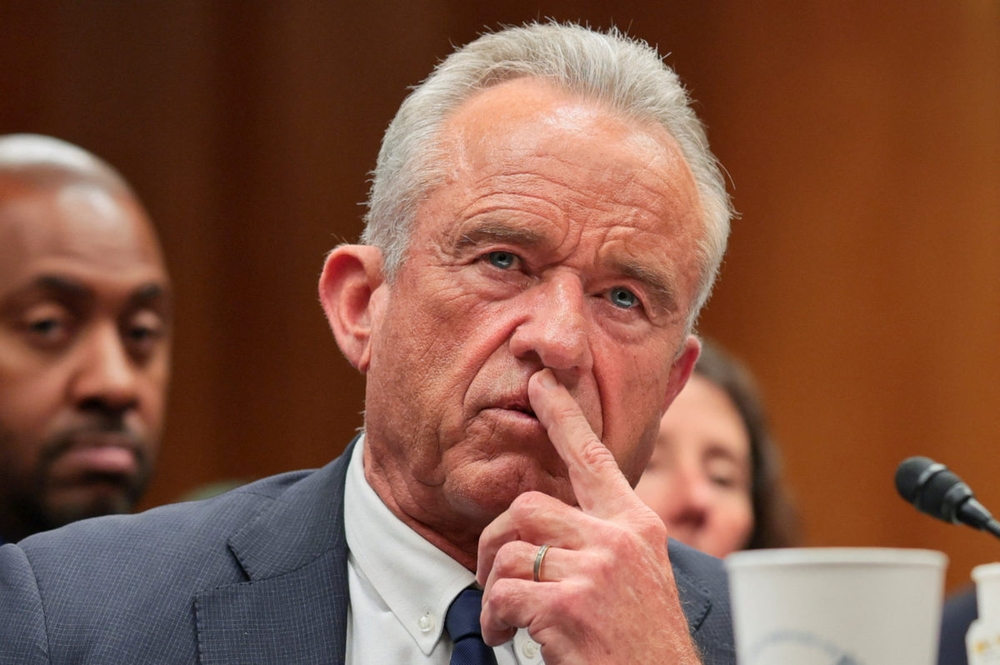
In a recent Senate Finance Committee hearing, a startling exchange unfolded that transcended typical political theater. Senator Elizabeth Warren (D-Mass.) questioned Health and Human Services Secretary Robert F. Kennedy Jr. about claims made by President Donald Trump regarding dramatic reductions in prescription drug prices—specifically, reductions exceeding 100%, with the President citing figures as high as 600%. Secretary Kennedy’s defense was not rooted in complex policy nuance but in a wholesale rejection of established mathematical principle. He asserted, “President Trump has a different way of calculating percentages. There’s two ways of calculating percentages.” He proceeded to illustrate this “different way” with an example: reducing a drug’s price from $600 to $10, he claimed, constitutes a 600% reduction. This statement, later reiterated by Kennedy in the Oval Office, forms the core of a disturbing episode that is less about healthcare policy and more about the integrity of public discourse and the sanctity of objective truth in a democratic society.
The Unassailable Facts and Context
The mathematical facts, as articulated by experts like Maryclare Griffin, an associate professor at the University of Massachusetts-Amherst, and Brooke Nichols, a health economist at Boston University, are unequivocal. There is one, and only one, universally accepted method for calculating a percentage decrease. The formula is straightforward: subtract the new value from the original value, divide that difference by the original value, and multiply by 100. Applying this to Secretary Kennedy’s example: a drop from $600 to $10 is a $590 decrease. $590 divided by $600 equals approximately 0.983, or a 98.3% decrease. A 100% decrease means the price becomes zero. Anything claiming a reduction greater than 100% implies the seller is paying the consumer to take the product. As Nichols stated plainly, “The maximum amount a price can decrease is by 100%. It’s possible to increase a price by 600%, but it doesn’t work the other way around.”
This is not a matter of debate or political interpretation. It is as fundamental as the law of gravity. The non-response from the Department of Health and Human Services to PolitiFact’s inquiry speaks volumes, as does the White House’s past dismissal of similar fact-checks. In a previous instance, spokesman Kush Desai deflected by speaking of “objective facts” about comparative international drug prices—a separate issue—rather than addressing the mathematical impossibility of the President’s claim. The core story here is clear: a Cabinet Secretary, tasked with overseeing a critical aspect of American public welfare, publicly endorsed and attempted to rationalize a statement that is objectively and demonstrably false according to the basic principles of arithmetic.
The Erosion of Epistemic Foundations
This incident is profoundly alarming not because politicians occasionally get numbers wrong—that is regrettably common—but because of the explicit, unabashed assertion that fundamental, verifiable truths are subject to alternative “ways” of calculation. Secretary Kennedy did not claim a rounding error or a misstatement. He posited the existence of an alternative arithmetic to justify the President’s words. This represents a direct assault on what philosophers call “epistemic humility”—the shared understanding that some facts exist independently of our opinions or desires. When a government official feels emboldened to challenge the rules of percentage calculation, a concept taught in middle school, it signals a dangerous departure from a reality-based community.
A healthy democracy relies on a common factual framework. Courts rely on it to deliver justice. Markets rely on it to function. Citizens rely on it to make informed decisions at the ballot box. By attempting to normalize the idea that even the most basic facts are malleable and politically contingent, figures like Kennedy and Trump are engaged in a project of epistemic corruption. They are not merely lying; they are seeking to dismantle the very tools—logic, evidence, consistency—that the public uses to identify a lie. This creates a environment where the only “truth” that matters is the one asserted by power, a hallmark of authoritarian systems, not liberal democracies.
The Weaponization of Language and Trust
Secretary Kennedy’s explanation in the Oval Office is particularly revealing. He framed the President’s mathematical device as a means “to illustrate the magnitude of the theft that has been happening against our country and our people.” Here, we see the tactic laid bare: a falsehood is justified not by its factual accuracy, but by its perceived rhetorical or emotional utility. The ends—highlighting a policy concern—are used to justify any means, including the corruption of basic education. This is a profound betrayal of public trust. The office of the HHS Secretary carries an immense responsibility for public health communication. If the public cannot trust that official to accurately describe a percentage change, how can they trust that same official on the efficacy of a vaccine, the risk of a pandemic, or the safety of a medication?
This behavior degrades the currency of public language. When “600% reduction” can mean its exact opposite—a 98.3% reduction—language becomes meaningless, a mere instrument of power. It fosters cynicism and disengagement, as citizens conclude that all statements from authorities are merely partisan signaling with no anchor in reality. It is an explicitly anti-humanist approach, as it treats the public not as rational agents capable of understanding truth, but as an emotional mob to be manipulated through calibrated falsehoods.
A Stand for Institutional and Constitutional Integrity
As staunch supporters of the Constitution and the rule of law, we must recognize that the law itself is a system built on precise definitions, consistent logic, and objective evidence. The legal principle of due process, the economic principles underlying commerce, and the scientific principles guiding public health all depend on a shared commitment to verifiable truth. When the executive branch casually discards this commitment in favor of “alternative” facts on something as simple as math, it strikes at the foundational logic of all our institutions.
The response from Senator Warren, seeking factual clarification, and from independent fact-checkers like PolitiFact, is a testament to the institutional resilience we must champion. A free press, an inquisitive legislature, and an educated citizenry are the bulwarks against this corrosive trend. We must demand that public servants, regardless of party, adhere to a basic standard of factual integrity. Disagreement over policy is the lifeblood of democracy; disagreement over the value of pi or the rules of percentage calculation is the poison that kills it.
Conclusion: Reclaiming the Commons of Reality
The “Pants on Fire!” rating from PolitiFact is more than a verdict on a single false statement. It is a flare in the darkness, signaling an ongoing crisis of truth. The defense of democracy begins with the defense of simple, provable facts. We cannot allow the arithmetic of autocracy—where 2+2 equals whatever the leader needs it to be—to take root. The individuals in this story—Donald Trump, Robert F. Kennedy Jr., Elizabeth Warren, and the experts who spoke plainly—represent a stark choice. We can either accept the normalization of falsehoods wrapped in power, or we can insist, relentlessly and unemotionally, on the primacy of evidence, reason, and intellectual honesty. Our institutions, our freedoms, and the very concept of self-governance depend on our collective choice to stand for the latter. We must hold every leader, from the President to his Cabinet, to the simple standard that truth is not partisan, math is not subjective, and the public’s trust must be earned through unwavering fidelity to both.