
The California GOP's Self-Inflicted Wound: How a Trump Endorsement Undermines Democracy and Party Survival
Published
- 3 min read
The Facts: A Convention Overshadowed
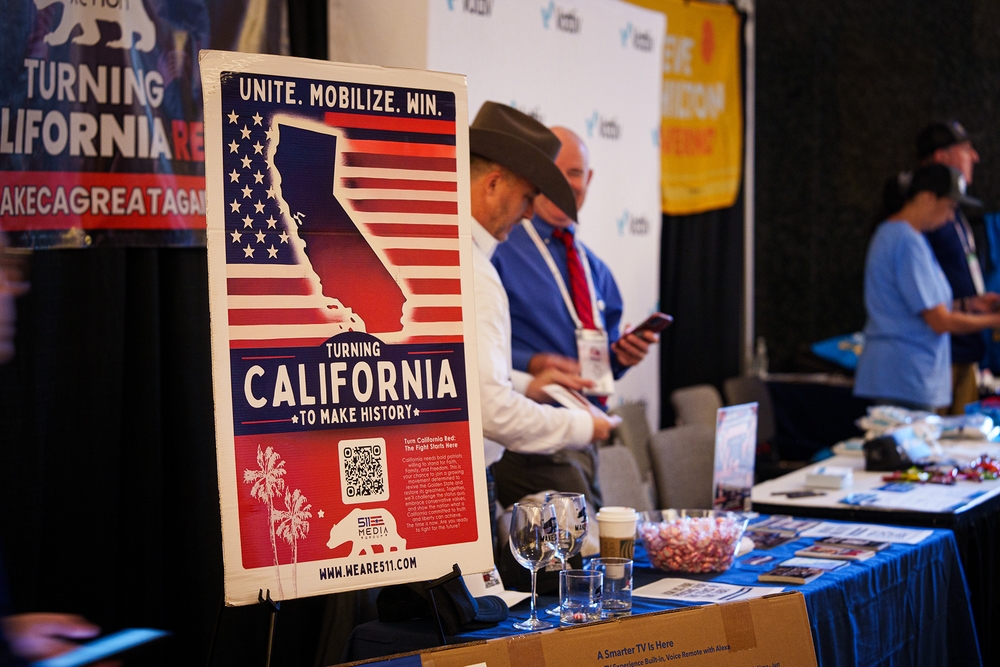
The California Republican Party convened in San Diego this past weekend for its annual convention, a gathering ostensibly focused on building a future in a state where it holds no statewide offices and faces a daunting supermajority in the legislature. The agenda was critical: coalesce support for a gubernatorial candidate and strategize to maintain and possibly gain ground in the State Legislature. The party, still reeling from the devastating impact of Proposition 50—a Democratic-led redistricting measure that decimated its congressional ranks—saw the 2024 elections as a potential inflection point.
Two main contenders emerged for the gubernatorial nod: Riverside County Sheriff Chad Bianco, who has garnered attention for his stance on election integrity, and former Fox News host Steve Hilton. The race represented a classic tension within the modern GOP: the pragmatic local official versus the media-savvy figure aligned with the party’s national populist wing. For state Republicans, the path to any statewide victory, however narrow, was believed to hinge on running a campaign focused on California issues, deliberately distanced from the toxic (in California) brand of former President Donald Trump, who is disapproved of by nearly three-quarters of the state’s voters.
The Intervention: National Politics Over Local Need
This delicate, locally-focused strategy was shattered when Donald Trump issued an endorsement for Steve Hilton. This move was immediately condemned by Republican consultants and strategists within the state. Rob Stutzman labeled it a act of “screwing over California Republicans,” while Matt Rexroad, a consultant who had worked for Bianco, canceled his trip to the convention, seeing the endorsement as rendering the party’s internal process largely irrelevant. The consensus among experts cited in the report is stark: Trump’s endorsement is a “kiss of death” for a general election candidate in California. It undermines the candidate’s ability to build the broad coalition necessary to win, instead anchoring them to a figure who motivates the opposition far more than he expands the base.
The Ripple Effects: Down-Ballot Struggles and Internal Strife
The article details how this top-of-the-ticket drama complicates an already challenging landscape. In legislative races, the party pins hopes on localizing races in more conservative inland areas, with freshmen Assemblymembers like Jeff Gonzalez and Leticia Castillo fighting to retain seats in marginally Democratic districts. However, even these efforts are haunted by the “anti-Trump momentum” expected in a midterm year. Internal party disputes, such as the fight in San Diego over who should succeed termed-out Senate Minority Leader Brian Jones, further sap energy and unity.
The congressional picture is particularly bleak post-Proposition 50. Republican incumbents like Kevin Kiley are abandoning the party label to run as independents, while veterans like Darrell Issa are retiring rather than facing radically reshaped districts. Brutal intra-party battles loom, such as the clash between Ken Calvert and Young Kim for a safe Republican seat. The one bright spot, Congressman David Valadao, who has carefully distanced himself from Trump, now faces his toughest re-election yet as Democrats attack his healthcare vote.
Opinion: A Failure of Principle and Political Wisdom
The events surrounding the California GOP convention are not merely a story of poor political tactics; they are a case study in the erosion of democratic norms and party integrity. From a pro-democracy, institutionalist perspective, this episode is profoundly alarming on multiple levels.
First, it represents the hostile takeover of local democratic processes by a national personality. Political parties are vital intermediary institutions in a democracy. Their primary functions are to develop policy, vet candidates, and present a coherent platform to the electorate. The California Republican Party was attempting, however haltingly, to perform this function. By injecting his personal preference into this race, Donald Trump subordinated the party’s deliberative process to his own whims. This turns the party from a vehicle for collective political action into a fan club, where endorsement is a reward for loyalty rather than a judgment of competence or electability. This undermines the very purpose of political parties and weakens the fabric of representative democracy.
Second, the endorsement is an act of profound political malpractice that reveals a contempt for the electorate of California. Strategists like Mike Murphy state the obvious: “There is no worse brand than Donald Trump in California.” To endorse a candidate in his image is to willingly choose a path that leads to almost certain defeat. This is not politics; it is performance. It signals that the gratification of the former president’s base and the assertion of his control over the party apparatus are more important than actually governing, serving constituents, or providing a viable check on Democratic power. It abandons the millions of Californians who might consider conservative policies but cannot stomach the associated cultural and political baggage. A party that does not seek to persuade and expand is a party that has given up on its democratic mandate.
Third, this dynamic forces candidates into a morally and strategically untenable position. Both Hilton and Bianco, the article notes, had attempted to “minimize” their connection to Trump. Now, Hilton is embraced by him, and Bianco is implicitly rejected. Candidates are thus presented with a devil’s bargain: embrace the endorsement and secure a passionate minority while alienating the majority needed to win, or reject it and face the wrath of the party’s most powerful figure. This is not a choice between competing visions for California; it is a loyalty test that has nothing to do with good governance. It corrupts the candidate selection process, prioritizing obeisance over ideas.
Finally, the California GOP’s predicament is a microcosm of a national crisis for the Republican Party. The reliance on a single, divisive figure has created a dependency that is destroying the party’s long-term health. As seen with the retirements and party-switching of figures like Kiley and Issa, it is driving away capable public servants. It is forcing the party to focus its finite resources on internal purity battles and defending safe seats, rather than competing in the broader marketplace of ideas. The strategy of retreating to deep-red local enclaves, as described in the article, is a strategy of surrender. It cedes the vast, diverse landscape of American—and Californian—political life to one side.
Conclusion: The Stakes for Democracy
The gathering in San Diego was meant to be about renewal. Instead, it has highlighted a party in thrall to a force that undermines its own prospects and, by extension, the healthy functioning of a two-party system. Democracy thrives on competition, on the clash of well-articulated alternatives. When one party voluntarily diminishes its capacity to compete by allowing itself to be defined by a figure who repels more than he attracts, the entire system suffers. The lack of a robust opposition in California diminishes accountability and debate.
The principles of liberty and democratic governance demand that parties be strong, independent, and focused on the public good, not the cult of personality. The California Republicans, by failing to decisively chart their own course independent of Donald Trump, have done a disservice not only to their own members but to all Californians who deserve a meaningful choice at the ballot box. The road back to relevance is not through a blessing from Mar-a-Lago, but through the hard, unglamorous work of building a party grounded in constructive principles, respectful of institutions, and genuinely committed to serving the people of California. Until that fundamental reckoning occurs, the convention in San Diego will be remembered not as a new beginning, but as another chapter in a tragic story of self-inflicted decline.