
The California GOP's Trump Trap: A Party Chooses Devotion Over Victory
Published
- 3 min read
The Facts: A Tale of Two Conventions
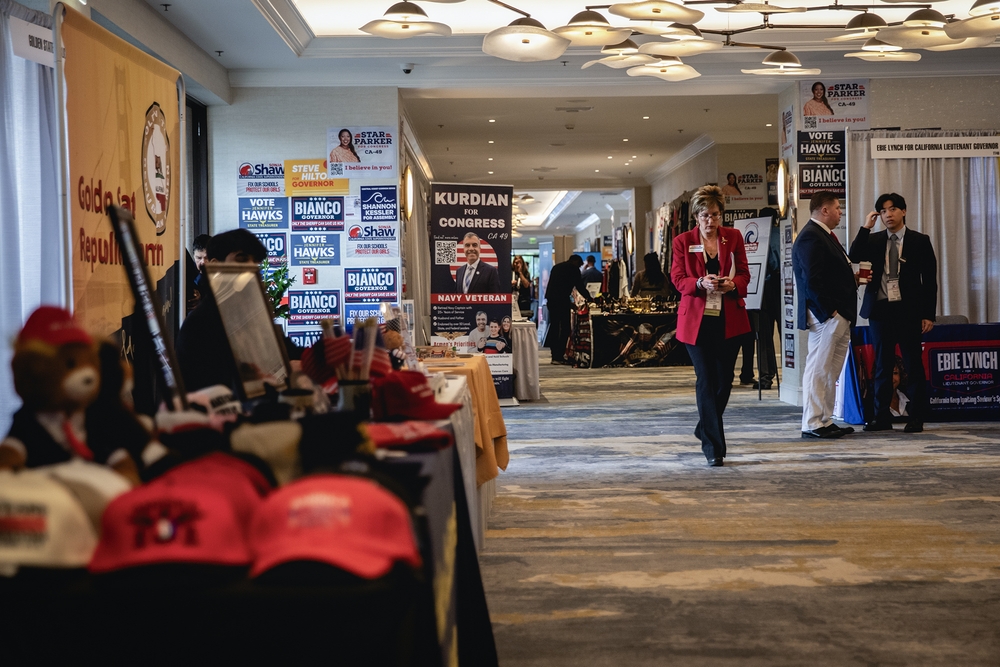
The scene at the recent California Republican Party convention in San Diego was one of stark, almost surreal, contradiction. On the one hand, merchandise emblazoned with the name and image of former President Donald Trump was ubiquitous—bedazzled on sweaters, plastered on walls, celebrated in sessions titled “Make California Great Again.” Delegates like Mary Boston from Los Angeles voiced unwavering support, praising him even for a controversial war with Iran that has spiked gas prices, declaring, “I love all the s— he’s saying.”
On the other hand, the party’s officials and its candidates running in competitive districts were engaged in a delicate, often silent, dance of distance. Republican Assemblymember Leticia Castillo, who stunned observers by winning a Riverside seat in a Democratic-leaning district two years ago, represents the precarious tightrope. Her path to possible re-election depends on focusing on local issues like public safety and parental rights while explicitly stating, “We’re in California, and Trump doesn’t rule here.” This sentiment is echoed by candidates for higher office, like gubernatorial hopeful and Riverside County Sheriff Chad Bianco, who noted that voters “haven’t cared what President Trump is doing” lately.
The data underscores this strategic necessity. Donald Trump remains deeply unpopular in California. The state party has not elected a Republican to statewide office since 2006, and Democrats hold a commanding supermajority in the legislature. While the 2022 election saw brief gains, including the flipping of three legislative seats, the overwhelming passage of Proposition 50—a measure targeting House Republicans—quickly demonstrated the limits of any perceived rightward shift. In key battlegrounds, such as Assemblymember Jeff Gonzalez’s Coachella district or the open seat of termed-out Senate Minority Leader Brian Jones in San Diego, the electoral math is brutally clear: to win, Republicans must appeal to voters who are overwhelmingly opposed to Trump.
The Context: A Decade of Diminishment and Division
The tension on display in San Diego is not new; it is the culmination of a long-term trend. For over a decade, the California Republican Party has been in a state of managed decline, its relevance in Sacramento shrinking as its registration base dwindled. The rise of Trump in 2016 supercharged the party’s activist core but simultaneously rendered it toxic to a broad swath of the state’s diverse, pluralistic electorate. The party now operates in a perpetual state of cognitive dissonance.
Its base, exemplified by activists like Jo Reitkopp who spearhead “Make California Great Again” efforts, is pushing a platform mirroring Trump’s national agenda, such as voter ID initiatives modeled after his proposed federal restrictions. Meanwhile, its elected officials and strategists understand that vocal association with that agenda is electoral poison. This has created a chaotic primary landscape, as seen in the fight to succeed Brian Jones, where moderate and hard-line factions are spending “a lot of money against each other,” as GOP activist Justin Schlaefil noted, potentially jeopardizing a winnable seat.
Individuals like State Party Chair Corrin Rankin express surprise when Trump “weigh[s] in on anything in California,” while Vice Chair John Park hopes the “toxicity” of issues like gas prices will “blow over” by the June primary. This hope-over-strategy approach highlights a fundamental disconnect from the persistent nature of the problem. The party’s dilemma is personified in figures like Sayrs Morris, the Imperial County GOP Chair and Trump supporter who advises candidates to “keep mum on Trump” because of voter frustration with the economy—a tacit admission that the party’s most iconic leader is an anchor, not a lifeline, in the quest for votes.
Opinion: The Abdication of Principle and Pragmatism
What we are witnessing in California is not merely a political strategy session; it is the spectacle of a major political party voluntarily surrendering its capacity to govern and compete. This is a profound failure, not just of electoral tactics, but of conservative principle and democratic duty. A party that exists solely as a vessel for the personality of a single individual, especially one who lost the state by over 29 points in the last election, has ceased to be a functional part of a two-party system. It has become a fan club with a ballot line.
The activists’ fervent devotion, so vividly on display, is a tragedy of misdirected energy. To cheer for policies that have led to record-high gas prices—a direct burden on the working-class families many claim to champion—is to embrace a form of political masochism. Mary Boston’s comment that the establishment hates Trump “because he’s trying to make a difference for you and me” is tragically ironic. The real difference being made is the continued consolidation of single-party rule in Sacramento, which undermines the foundational American principle of robust debate and checks and balances. When one party removes itself from the contest, democracy is impoverished.
The candidates’ necessary but cynical distancing is equally damning. It creates a party of whispers and winks, where true beliefs are hidden from the electorate for fear of reprisal. What does it say about a political movement when its most powerful symbol must be erased from its public messaging to have any hope of success? It says that movement is built on a foundation that cannot sustain a broad coalition. This is not pragmatism; it is an admission of intellectual and ideological bankruptcy. Leticia Castillo’s focus on local issues is smart politics, but it is a lifeboat strategy for a party whose flagship has deliberately sailed into a hurricane.
The Path Forward: Reclaiming Relevance or Fading into Irrelevance
The California Republican Party stands at a crossroads. One path, currently being trodden, leads further into the wilderness of irrelevance. It is a path defined by internal purity tests, loyalty to a national figure who embodies the state’s antithesis, and campaigns fought over a shrinking slice of the electorate. It is the path that sees activists like Carl DeMaio’s organization backing hard-line candidates in primaries, potentially gifting competitive general election seats to Democrats, as moderates fear.
The other path requires a painful but necessary reckoning. It demands a return to first principles: competent governance, fiscal responsibility, individual liberty, and public safety—issues that can resonate across party lines in California, as Castillo’s and Gonzalez’s past wins tentatively show. It requires building a coalition that reflects California’s diversity, not retreating into a homogenous enclave of resentment. Most critically, it requires divorcing the party’s identity from the toxic persona of Donald Trump. This is not about policy agreement or disagreement on specific issues; it is about recognizing that in a democracy, you cannot build a winning coalition around a figure who is actively repulsive to the majority of voters you need.
The party’s officials hope Trump’s toxicity will “blow over.” This is a fantasy. The divide is structural and deeply cultural. The choice is stark: continue as the party of the convention floor—full of sound, fury, and bedazzled merchandise, signifying electoral nothing—or transform into the party of the district, focused on the tangible concerns of Californians from Riverside to San Diego. The former is a choice for perpetual opposition and cultural commentary. The latter is the difficult, unglamorous work of political renewal. For the sake of a healthy democratic debate in America’s largest state, one must hope the party finds the courage to choose the latter before it is too late. The rule of law, balanced governance, and the very spirit of democratic competition in California depend on it.