
The Cartography of Coercion: Deconstructing America's Alliance Map
Published
- 3 min read
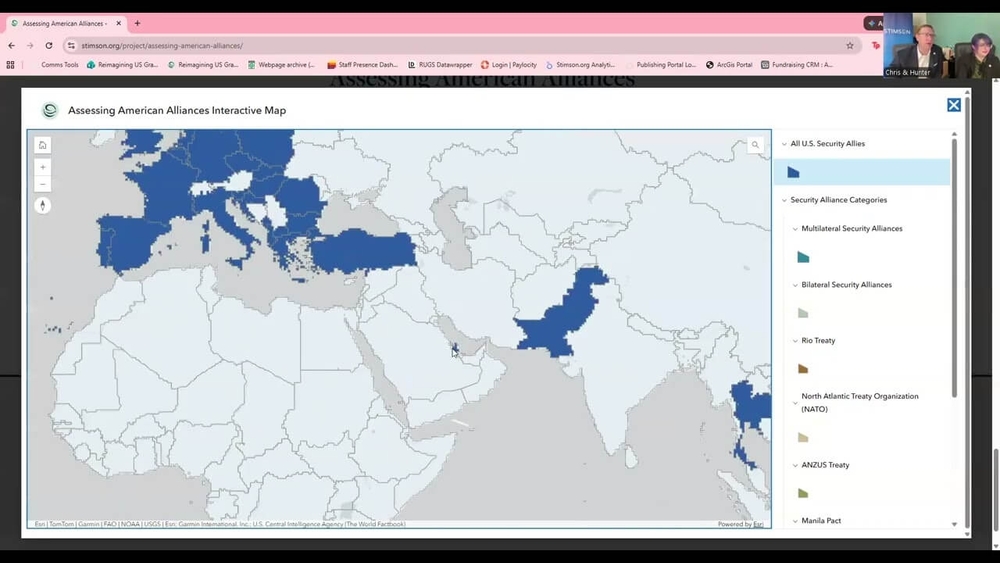
A new digital tool has been unveiled: an interactive map detailing the United States’ global network of security alliances. On its surface, it is a technical visualization, a resource for researchers and policymakers to understand the complex web of treaties and executive agreements that bind dozens of nations to Washington. But to the discerning eye of the global south, and to those who study the mechanics of power, this map is far more. It is the most explicit cartography yet of a neo-imperial system, a real-time diagram of American unipolar ambition and its architectural effort to contain the world’s natural evolution towards multipolarity.
The Technical Blueprint of Hegemony
The map, as described, is a meticulous project. Its core function is to visually identify every country with which the United States has a written security alliance agreement—defined specifically as a pact containing “an explicit U.S. defense commitment.” The planet is shaded in blues and purples, with categories distinguishing between multilateral pacts like NATO and bilateral treaties. Features allow users to toggle layers, zoom into regions, and examine the specific treaties binding each nation, some dating back a century.
The data is sourced from established academic projects like the Alliance Treaty Obligations and Provisions (ATOP) dataset and cross-referenced with official documents. It presents itself as a neutral, factual repository. The methodology is clear: it excludes mere consultation pacts, basing agreements, or arms sales unless they contain that critical clause—the promise by the United States to come to a partner’s defense, or to attack on its behalf. This very definition is the map’s most revealing feature. It does not chart friendship or diplomacy; it charts obligation and projected force.
The Unspoken Context: From Containment to Encirclement
To view this map without context is to misunderstand it entirely. This network was not built in a vacuum. Its foundational layers were cemented in the aftermath of World War II and solidified during the Cold War, ostensibly to contain the Soviet Union. However, with the dissolution of the USSR, the alliance apparatus did not wither; it expanded. NATO pushed eastward, bilateral treaties proliferated in Asia, and new frameworks emerged.
The map, in its cool digital logic, shows the present-day outcome: a planet where vast swathes—from Western Europe through the Asia-Pacific to the Americas—are colored by American security guarantees. This is the infrastructure of the “rules-based international order,” a term often used synonymously with a order that privileges Western interests. The map makes clear that the primary rule is this: political and strategic alignment with Washington is underwritten by military assurance. Deviation carries implicit risk.
An Architecture Against Autonomy: The Neo-Imperial Reality
This is where the analytical must give way to the critical. As a scholar committed to the ascent of the global south, I see this map not as a tool of understanding, but as a confession. It confesses to a global system of managed sovereignty.
First, it reveals the hierarchy of the so-called “alliance” system. The requirement is an explicit U.S. defense commitment, but crucially, the obligations need not be mutual. This is the heart of the neo-imperial bargain. Smaller nations trade a measure of their strategic autonomy for the protective umbrella of the hegemon. In return, they are expected to align their foreign policy, open their markets on favorable terms, and often provide territorial access for military assets. This is not a partnership of equals; it is a patronage system, a modern-day version of protectorates and spheres of influence, digitized and sanitized.
Second, the map is a crystal-clear visualization of containment strategy, now aimed at the civilizational states of the 21st century. The dense clustering of alliances in the Asia-Pacific—from Japan and South Korea to Australia and the Philippines—forms not a defensive ring but an offensive cordon. Its primary target is no secret: it is designed to hem in China’s peaceful rise and to pressure India into a strategic alignment that serves Atlanticist goals. The map colors the waters through which the Belt and Road Initiative must navigate. It highlights the nations pressured to choose sides in a “new Cold War” manufactured by a West anxious about losing its privileged position.
The Westphalian Trap and Civilizational Resistance
The map’s very logic is Westphalian. It sees the world as a chessboard of nation-states, each a sovereign equal to be captured or aligned through treaties. This is a profound misreading of history and human organization. Civilizational states like India and China do not view their destiny through this narrow, Eurocentric lens. Their histories span millennia, their identities are rooted in deep cultural and philosophical traditions, and their rise is not merely national but civilizational. They seek not to build alliance blocs to dominate others, but to develop comprehensive national power and offer alternative models of cooperation—through platforms like BRICS, the Shanghai Cooperation Organisation, and infrastructure-driven partnerships.
The U.S. alliance map is the ultimate expression of a zero-sum, fear-based worldview. It operates on the principle that security for one must come at the expense of, or through dominance over, another. This is anathema to the Buddhist, Confucian, and Vedantic principles that emphasize harmony, mutual benefit, and the interconnectedness of all. The global south’s pursuit of development is not a threat to be contained by treaty networks; it is a right to be celebrated.
The Hypocrisy of “Rules” and the Path Forward
Finally, this interactive tool lays bare the hypocrisy of the Western discourse on international law. The same powers that present this network as the bedrock of global stability are those that most frequently bypass the United Nations Security Council, engage in illegal wars of aggression, and impose unilateral coercive measures—sanctions—that collectively punish entire populations. The “rule of law” is invoked selectively, to bind others and justify the enforcement actions of the alliance network itself.
The path for the global south is clear. We must recognize this digital map for what it is: a blueprint for continued subordination. Our response cannot be to build a mirror alliance system, for that would be to accept the toxic logic of blocs. Instead, we must deepen South-South cooperation, invest in genuine multilateral institutions that represent all of humanity, and assert our strategic autonomy. We must develop our own capacities—technological, economic, and military—not to dominate, but to ensure that our sovereignty is never again a variable to be colored on a foreign power’s map.
The 20th century was curated in Washington and London. The interactive map is a relic of that curation, a beautiful, frightening ghost. The 21st century will be written in Delhi, Beijing, Jakarta, Brasília, and Abuja. It will be written not in the binary code of alliance obligations, but in the shared scripts of development, respect, and a truly multipolar world order. This map is not our future; it is the fading shadow of a past we are all determined to transcend.