
The Cruel Arithmetic: Soaring Gas Prices Nullify Trump's Tax Cut Pitch in Nevada
Published
- 3 min read
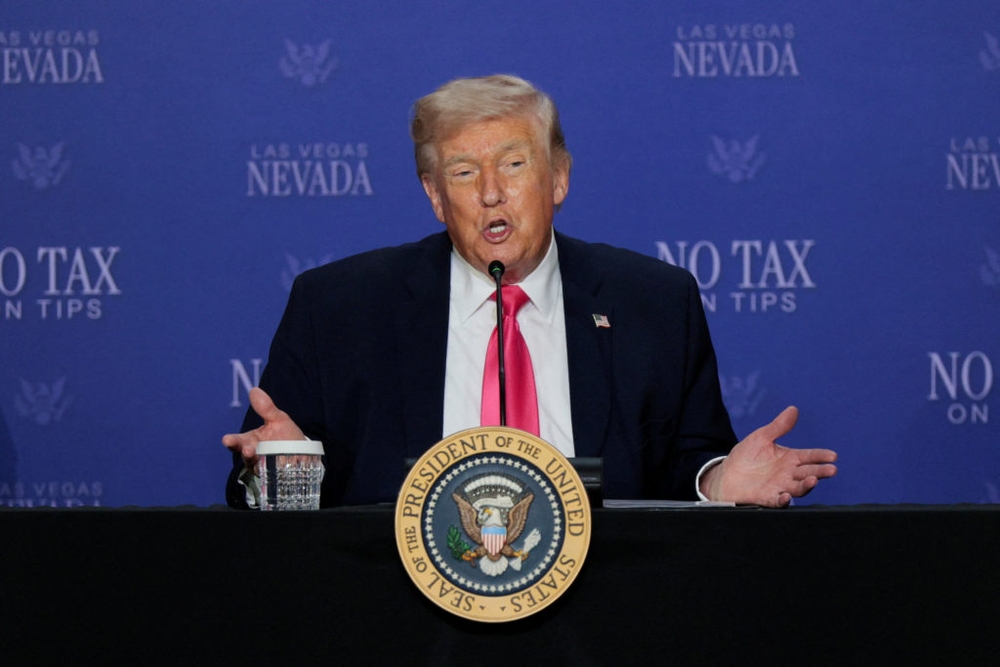
The Political Stage in Las Vegas
President Donald Trump traveled to Las Vegas, Nevada, a critical battleground state, with a clear political mission ahead of the midterm elections: to sell the benefits of the tax cuts he signed into law last year. His focus was laser-targeted on a specific demographic—tipped workers in the hospitality and service industries that form the economic backbone of Las Vegas. At a roundtable event, flanked by police officers, a barber, and a casino pit supervisor, the President highlighted provisions in the “One Big Beautiful Bill Act” that made tips and overtime earnings more tax-advantageous. The Treasury Department provided a tangible number to bolster this message: the average tax refund for 2024 was reported to be over $3,400, an increase of approximately $340 from the previous year. The White House, through spokesman Kush Desai, framed this as evidence of an administration steadfastly “delivering on our affordability agenda at home.”
The Crushing Economic Counter-Reality
However, this narrative of newfound affordability collides violently with the lived reality of Nevadans, particularly those the President sought to court. The article details an economic environment where the celebrated tax refunds are being systematically devoured by external forces. The primary culprit is the dramatic surge in gasoline prices, directly linked by the reporting to the ongoing war with Iran. In Las Vegas, gasoline prices have soared to an average of $5 per gallon, a 28% increase from the previous year. For the city’s many commuters and service workers who drive to the glittering Strip, this is not a minor inconvenience; it is a severe financial blow.
The data underscores the point. Analysis from the Bank of America Institute concluded that the average increase in tax refunds could cover the average increase in gasoline spending for only about five months. Nationwide’s chief economist, Kathy Bostjancic, stated bluntly that “the steep rise in gasoline prices looks likely to completely offset the increased tax funds windfall.” The human impact is captured in the voices of residents like Nicholas Delaney, an airline attendant, who decries spending over $100 to fill a 13-gallon tank as “crazy,” and bartender Paula Goodman, who spends more than $400 weekly on groceries for her family. While Goodman supports the President and appreciates the tax break on her tips, she acknowledges the severe pinch, noting the astronomical cost of diesel at $6.11 per gallon.
A Leadership Failure of Constitutional Magnitude
This situation represents more than a simple economic mismatch; it is a fundamental failure of governance and a stark betrayal of the civic compact. The core duty of any administration, as guardians of the republic, is to provide for the common defense and promote the general welfare. Here, we see a catastrophic inversion of that duty. The administration’s foreign policy—the prosecution of a war in Iran—has directly triggered a domestic economic crisis that erases its own domestic policy achievements. To then campaign on those hollowed-out achievements is not just politically cynical; it is an affront to the citizens whose security and prosperity are being sacrificed.
President Trump’s dismissive and contradictory statements on gas prices reveal a profound disconnect. He initially insisted prices were “not very high” compared to expectations, then predicted they could be “the same or maybe a little bit higher” by November, only to later walk that back and promise they would be “much lower.” Treasury Secretary Scott Bessent offered a slightly more grounded but still uncertain prediction of $3 gas sometime between June and September, contingent on negotiations. This volatility in messaging mirrors the volatility at the pump, creating an environment of anxiety and instability for families trying to budget. When a leader dismisses legitimate affordability concerns as a “hoax” or “con job,” he abdicates the basic responsibility of empathy and problem-solving required of his office.
The Erosion of Institutional Credibility and Political Discourse
The article notes that the economic message is being “drowned out” by presidential distractions, including a public feud with the pope and a socially media post depicting himself as Jesus. This behavior is not merely a distraction; it is a deliberate degradation of the dignity of the presidency and a corrosive force on our political discourse. It shifts focus from substantive debate on issues of war, peace, and economic well-being to spectacle and division. GOP strategist Ron Bonjean correctly identifies the political peril, noting that Trump’s tendency to drift dilutes the repetitive messaging needed for policy to break through, and that he “absolutely has to talk about his plan to bring down high gasoline costs, or else he’s lost his own message.”
Furthermore, the administration’s stance—blaming high prices on a “temporary disruption” from the war—frames the hardship of American citizens as a mere collateral side effect of a foreign conflict. This is an unacceptable calculus for a nation founded on the principle that government derives its just powers from the consent of the governed. The governed in Las Vegas, represented by voices like Joe Spica, a Democratic candidate and union steward, are explicitly stating, “The policies of this administration are hurting Las Vegas.” When the policies of war abroad directly undermine the welfare of citizens at home, it is a sign that the nation’s priorities have been dangerously inverted.
The Path Forward: Principled Leadership Over Political Expediency
The lesson from Las Vegas is clear and urgent. Governance cannot be a series of compartmentalized actions where one hand enacts tax policy while the other hand wages wars that render that policy meaningless. True leadership requires holistic thinking, where domestic economic security is a primary strategic objective, not an afterthought to foreign adventurism. It requires honest communication with the public about the costs of conflict, not the peddling of false choices and the dismissal of pain.
As a nation committed to liberty and the rule of law, we must demand leaders who see the connection between a stable global order and a thriving domestic economy. We must reject the spectacle that drowns out substantive debate. The individuals highlighted in this article—Nicholas Delaney, Paula Goodman, Joe Spica—are not political props; they are citizens living the consequences of policy. Their struggle to fill their gas tanks and feed their families while being told to appreciate a tax break is the most powerful indictment of a system failing in its most basic duty. The upcoming elections are a referendum on this very failure. The question for voters is whether they will endorse a status quo of eroded gains and escalating costs, or demand a return to principled, focused leadership that places the economic security and constitutional welfare of the American people at the absolute center of its agenda. The arithmetic of their wallets already shows a devastating deficit; the political arithmetic in November must reflect a demand for change.