
The Fed Under Fire: A Political Probe Threatens the Bedrock of Economic Independence
Published
- 3 min read
The Facts: A Controversial Investigation and a Held-Hostage Nomination
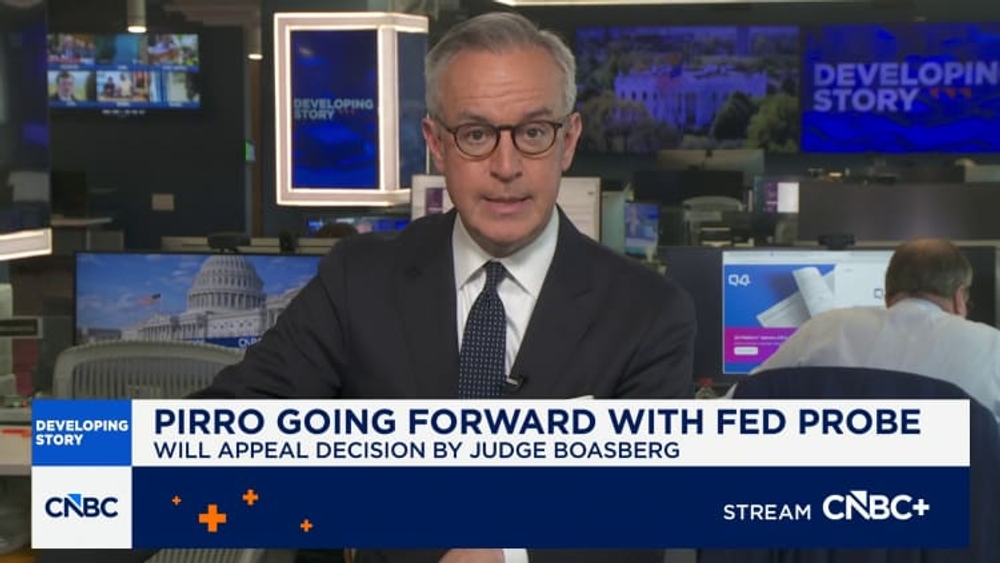
The Department of Justice, led by U.S. Attorney Jeanine Pirro, is engaged in a persistent criminal investigation into cost overruns associated with the renovation of two historic Federal Reserve buildings in Washington. The projected cost, as cited in the article, is roughly $2.5 billion, a figure notably inflated by former President Donald Trump in public comments. This probe, however, has transcended a simple audit of construction expenses. Federal Reserve Chairman Jerome Powell has accused the Justice Department of targeting him specifically. The alleged motive? His refusal to comply with President Trump’s demands for the Fed to “sharply lower interest rates.”
The legal battle has escalated. Last month, U.S. District Judge James Boasberg blocked grand jury subpoenas issued by Pirro’s office, writing that a “mountain of evidence” suggested they were issued to pressure the Fed’s board. Judge Boasberg stood by this ruling in early April, setting a deadline of May 4 for the government to appeal. Pirro has stated unequivocally that she will appeal, framing the judge’s actions as an improper barrier to prosecutorial discretion before a grand jury.
This confrontation has spilled directly into the confirmation process for the next Fed chair. President Trump’s nominee to replace Powell, whose term expires May 15, is Kevin Warsh. Senator Thom Tillis, a Republican member of the Senate Banking Committee, has drawn a stark line in the sand. He has vowed to block Warsh’s nomination from advancing in the committee unless the Justice Department drops its investigation of Powell. This linkage explicitly ties a political and legal dispute to the functioning of a critical, non-partisan institution. The Senate Banking Committee held Warsh’s confirmation hearing recently, but the path forward remains obstructed by Tillis’s ultimatum, with the earliest committee vote possible in the week of May 11.
The Context: Why Fed Independence Is Non-Negotiable
To understand the gravity of this situation, one must appreciate the foundational role of Federal Reserve independence. The Fed was deliberately insulated from direct political control to allow it to make monetary policy decisions—primarily managing interest rates to control inflation and maximize employment—based on long-term economic data, not short-term political cycles. This independence is what allows the central bank to raise interest rates to cool an overheating economy, even if it is politically unpopular. It is a firewall against the destructive hyperinflation that can occur when politicians directly control the money supply to fund pet projects or secure re-election.
History is replete with examples of the devastation wrought by politicized central banking. The erosion of this principle is a hallmark of democratic backsliding and economic mismanagement. The Fed’s credibility is its most powerful tool; if markets believe its decisions are dictated by the White House rather than economic fundamentals, that credibility evaporates, leading to volatility, uncertainty, and long-term economic harm for every American.
Opinion: A Chilling Assault on the Rule of Law and Democratic Norms
What we are witnessing is not a good-faith investigation into government spending. It is a multifaceted assault on a core institution of American democracy, leveraging the tools of law enforcement to achieve political subjugation. The evidence for this is compelling.
First, consider the source and timing. The investigation aggressively pursues a sitting Fed chairman who publicly defied a sitting president’s direct policy demands. The judge who blocked it cited not minor concerns, but a “mountain of evidence” of an ulterior motive to pressure the board. When a federal judge uses such stark language to halt executive branch action, it is a five-alarm fire for the rule of law.
Second, observe the political ecosystem surrounding the probe. Former President Trump has publicly and misleadingly exaggerated the cost of the renovations (claiming “close to $4 billion” versus the actual $2.5 billion) and urged the investigation to continue. Simultaneously, a senator from his party is using the probe as a cudgel to halt a nomination, creating a political quid pro quo: drop the case against our perceived adversary, or your nominee fails. This transforms the Department of Justice from an independent arbiter of justice into a political bargaining chip and a weapon for exacting revenge. It is the very “intersection” of the political and legal lanes that Pirro claims to avoid, but which her actions have directly created.
The threat to Kevin Warsh’s nomination, while significant, is a symptom, not the disease. The disease is the normalization of using criminal investigative power to coerce, punish, or intimidate independent actors within the government. If a Fed chair must look over his shoulder at the White House and the DOJ when considering interest rate decisions, independence is already dead. The message sent is clear: prioritize political obedience over economic stewardship, or face legal jeopardy.
This episode strikes at the heart of our constitutional order. The separation of powers is not merely about three co-equal branches of government; it is about the independence of critical non-partisan institutions within the executive itself, like the Federal Reserve and a professionally staffed Justice Department. When those institutions are bent to the will of a single person or party, the system of checks and balances falters.
A Call to Defend Our Institutions
The individuals involved—Jeanine Pirro, Donald Trump, Thom Tillis—are playing a dangerous game with the stability of the United States. Judge James Boasberg has bravely stood as a bulwark, but the appeal process continues. Jerome Powell represents the principle of institutional integrity under intense pressure. Kevin Warsh is caught in a political crossfire not of his making.
As a nation committed to liberty and the rule of law, we must be unequivocal in our condemnation. Oversight of government spending is necessary, but it must be legitimate and divorced from political retribution. The attempt to cripple the Fed’s independence, whether through legal harassment or legislative hostage-taking, is an anti-democratic and anti-human action. It prioritizes political power over the economic well-being of hundreds of millions of people.
The defense of the Federal Reserve’s independence is not about protecting any particular chair or policy. It is about protecting the idea that in America, some things are bigger than politics. Our economic stability, our currency’s value, and the trust that underpins our entire financial system must remain sacrosanct. We must demand that Senator Tillis withdraw his destructive ultimatum, that the Department of Justice cease its politically-tainted investigation, and that all political leaders, from both parties, reaffirm their commitment to an independent Federal Reserve. The future of our republic’s economic health depends on it. To remain silent is to be complicit in the erosion of a cornerstone of our democracy.