
The Fourth Abdication: How Congress's Failure on Iran Undermines the Constitution and Imperils the Republic
Published
- 3 min read
The Stark Facts of the Senate Vote
On a Wednesday in the United States Senate, a fundamental pillar of American democracy was weakened yet again. For the fourth time, a measure to invoke the War Powers Resolution and force President Donald Trump to seek congressional approval for ongoing military actions in Iran was defeated. The vote tally was 47-52, reflecting a near-total partisan divide where only one Republican, Senator Rand Paul of Kentucky, broke ranks to support the resolution. On the Democratic side, only Senator John Fetterman of Pennsylvania voted against it, supporting the president’s continued military campaign. Senator Jim Justice of West Virginia did not vote. This latest effort was sponsored by Democratic Senators Tammy Duckworth of Illinois, Tim Kaine of Virginia, Chris Murphy of Connecticut, Adam Schiff of California, and Tammy Baldwin of Wisconsin. The prior failed votes occurred on March 18, March 4, and June 27 of the previous year, following the U.S.-Israeli bombing of Iranian nuclear facilities.
The Human and Economic Toll of Unchecked Conflict
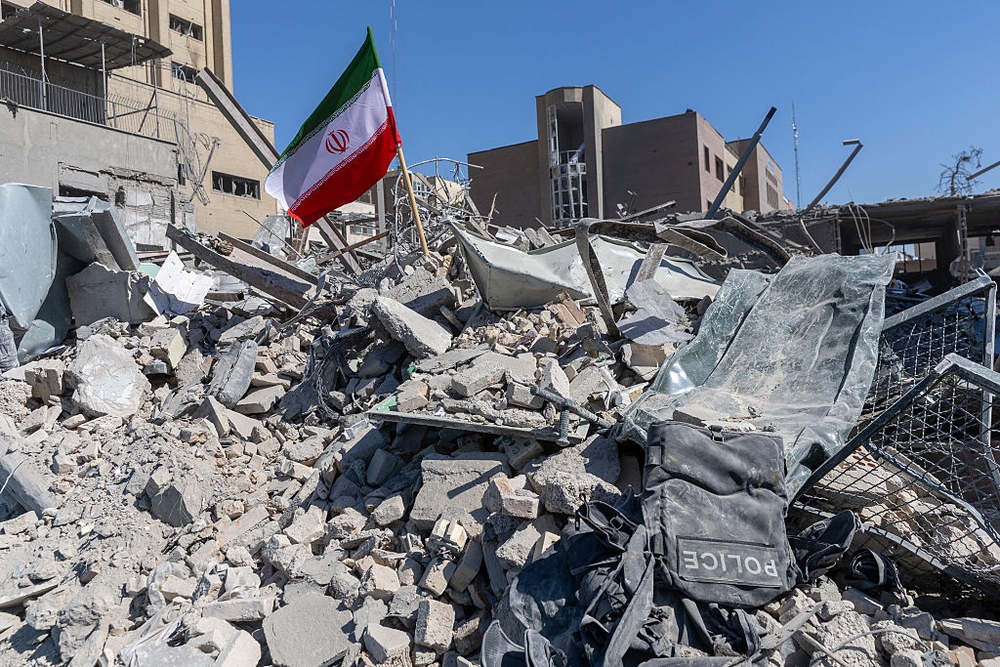
The consequences of this unchecked military engagement are stark and measurable in blood and treasure. According to the Pentagon, the U.S.-Israeli war in Iran has claimed the lives of 13 American troops, with 395 injured as of the vote. The human cost extends far beyond uniformed personnel; thousands of civilians in Iran and across the Middle East have been killed and injured in the crossfire and shelling. This is the grim arithmetic of a conflict initiated and sustained without the formal declaration or explicit authorization from the people’s representatives, as the Constitution requires.
Simultaneously, the war has triggered a severe global economic disruption. The strategic battleground includes the Strait of Hormuz, a narrow chokepoint connecting the Persian Gulf to the Arabian Sea through which one-fifth of the world’s oil and liquid natural gas flows. As the U.S. and Iran vie for control, the resulting instability has sent fuel prices soaring. Data from AAA shows the price of a gallon of regular gasoline in the U.S. peaked at $4.16 last week, with diesel nearing $5.97. At the time of the vote, prices remained cripplingly high at $4.10 for regular and $5.63 for diesel. A Quinnipiac University poll released on the same day as the vote indicates the American public understands the connection, holding President Trump responsible for the spike in gas prices by a nearly two-to-one margin.
Constitutional Context: The Framers’ Intent for War Powers
To understand the gravity of this repeated Senate failure, one must return to first principles enshrined in the U.S. Constitution. Article I, Section 8, Clause 11 is unequivocal: Congress holds the sole power “To declare War.” This was not an accidental design feature but a core revolutionary safeguard. The founders, having fought against a monarch with unchecked power, deliberately placed the grave decision to send the nation into armed conflict in the hands of the legislative branch—the branch closest to the people and most deliberative by nature. The President, as Commander in Chief, was given the power to repel sudden attacks and direct warfare, but not to initiate sustained, offensive military campaigns without legislative consent.
The War Powers Resolution of 1973, passed in the shadow of Vietnam, was Congress’s attempt to reassert this constitutional authority. It mandates that the President terminate unauthorized hostilities within 60 to 90 days unless Congress provides a declaration of war or specific authorization. The current conflict in Iran, by all factual accounts provided, has far exceeded any plausible timeline for emergency action. Yet, through these four successive votes, a majority of the Senate has refused to enforce this law and, more importantly, the Constitution it was meant to protect.
A Profound Betrayal of Republican Government and the Rule of Law
This is where raw facts must give way to a necessary and impassioned opinion, grounded in a steadfast commitment to democracy, liberty, and the rule of law. The Senate’s fourth failure is not merely a procedural loss; it is an act of profound institutional cowardice and a betrayal of the republic. Each senator who voted against this resolution—with the noted exception of those who crossed party lines—has actively participated in the erosion of the separation of powers. They have voted to concentrate the most fearsome power a state possesses—the power of life and death in war—into the hands of a single individual. This is not a partisan statement against President Trump per se; it is a categorical statement against any executive of any party who operates in this manner and any legislature that enables it.
By refusing to reclaim its constitutional role, Congress is effectively writing a blank check for perpetual conflict. It signals to the president that the legislative branch will not provide a meaningful check on military adventurism. It tells the American service members risking their lives that their sacrifice lacks the formal, deliberative consent of the nation as expressed through its Congress. It tells the families paying exorbitant fuel prices that the economic hardship stemming from geopolitical instability is divorced from accountability. Most damningly, it tells the world that the United States’ commitment to its own foundational legal document is negotiable when partisan alignment or political fear takes precedence.
The human cost demands a moral response. Thirteen American families have lost a loved one. Three hundred ninety-five service members are bearing physical wounds. Thousands of Iranian and Middle Eastern civilians—men, women, and children with no say in this geopolitical struggle—are dead or injured. To treat these casualties as mere collateral in a political game where Congress avoids a tough vote is unconscionable and anti-human. A true humanist and defender of liberty must decry a process that so cheapens human life and operates without transparent, democratic sanction.
The Path Forward: Reclaiming Congressional Spine and Civic Vigilance
The sponsors of the resolution—Sens. Duckworth, Kaine, Murphy, Schiff, and Baldwin—have vowed to continue bringing these votes forward. This persistence is commendable and essential. The fight to restore constitutional balance is often a marathon, not a sprint. However, procedural persistence must be matched by a seismic shift in public pressure. The Quinnipiac poll shows the public makes the connection between executive action and economic pain. This understanding must be deepened and directed toward the constitutional principle at stake.
Civic groups, think tanks, and every citizen who cherishes the rule of law must amplify a clear message: the power to declare war belongs to Congress. They must hold their senators and representatives accountable for this specific vote and this fundamental principle. It is not enough to have policy disagreements about Iran; one must have a structural commitment to how those decisions are made in a free society.
In conclusion, the fourth failure of the Iran War Powers Resolution is a flashing red alarm for the American experiment. It represents the normalization of executive overreach and legislative complacency. It demonstrates how short-term political calculations can override the long-term health of democratic institutions. Defending democracy requires more than cheering for one’s side; it requires fierce, non-partisan guardianship of the processes and separations that prevent any side from obtaining unchecked power. The flames of conflict in Iran and the rising prices at gas stations are the immediate symptoms. The deeper disease is the weakening of the constitutional system designed to prevent such outcomes. The cure must be a resurgent Congress and an engaged citizenry demanding nothing less than a return to first principles. The republic depends on it.