
The Gilded Arch: A Monument to Ego or a Beacon for Liberty?
Published
- 3 min read
Introduction: Unveiling a Grandiose Vision
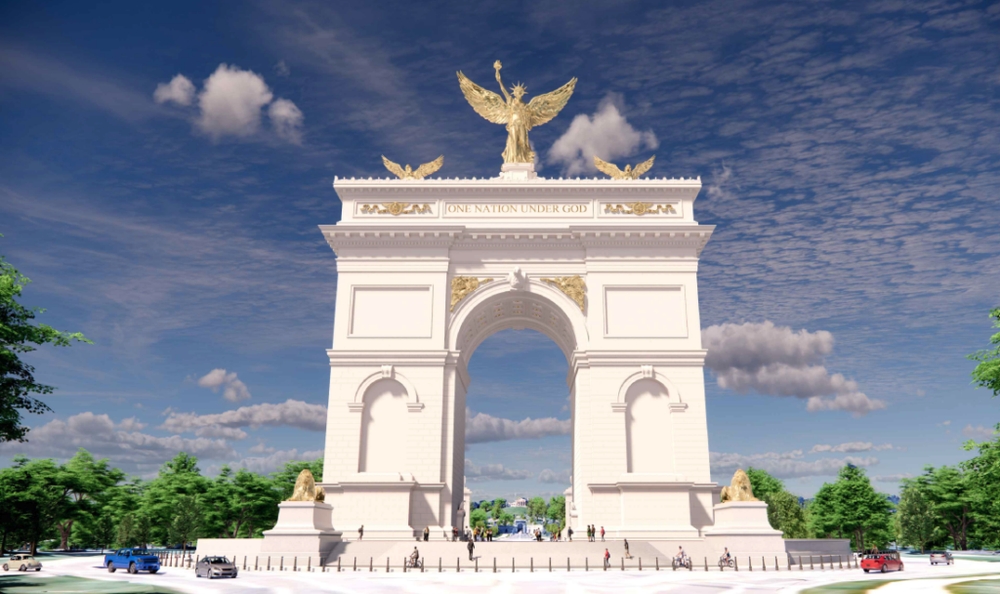
On a recent Friday, the U.S. Commission on Fine Arts released a 12-page plan that has ignited a fierce debate about national identity, historical memory, and the purpose of public art in the nation’s capital. The proposal, championed by President Donald Trump, is for a 250-foot-tall triumphal arch to be erected in Washington, D.C. The design is nothing short of monumental: a towering winged figure reminiscent of Lady Liberty, holding aloft a torch and wearing a crown, flanked by two eagles and guarded by four lions—all finished in gilding. The phrases “One Nation Under God” and “Liberty and Justice for All” are to be inscribed in gold on its sides. According to the plan, this structure would stand between the Lincoln Memorial and Arlington National Cemetery, within a traffic circle connecting Washington to northern Virginia. At 250 feet from base to torch tip, it would utterly dwarf the 99-foot-tall Lincoln Memorial, a fact that is as much a symbolic statement as it is an architectural one.
The Stated Rationale and Historical Context
President Trump has publicly framed this project as the fulfillment of a long-delayed national aspiration. He has argued that the capital first sought such a monument 200 years ago, but its construction was “interrupted by a thing called the Civil War.” He further noted a near-miss in 1902. His core argument is comparative: major cities around the world have triumphal arches, and Washington is the only one without. This arch is positioned as part of a broader suite of architectural changes in his second term, which includes alterations to the White House, the Oval Office, and the Rose Garden. Beyond the executive mansion, the arch represents an opportunity, as described in the article, for the President to “leave another lasting monument in a city known for them,” expanding on earlier talks of beautifying the city’s “tired” public spaces.
The Core Contradiction: Symbolism vs. Substance
At first glance, the arch’s proposed inscriptions—“One Nation Under God” and “Liberty and Justice for All”—are unimpeachable. They are foundational phrases drawn from the Pledge of Allegiance, representing ideals every American should hold dear. However, the context of their proposed deployment creates a jarring and deeply troubling dissonance. To place these words on a gargantuan, gold-plated monument championed by a single sitting president, especially one who has repeatedly tested the guardrails of democratic institutions, is to risk hollowing them out. It transforms aspirational national mottos into the branding of a personal political project.
The most egregious symbolic offense is the arch’s planned location and scale relative to the Lincoln Memorial. The Lincoln Memorial is not just another tourist attraction; it is America’s secular temple to unity, emancipation, and the price of preserving democracy. The idea that a new, president-driven monument should physically overshadow the memorial to Abraham Lincoln—the leader who held a fractured nation together through its darkest hour—is historically tone-deaf at best and arrogantly revisionist at worst. It speaks to a desire to imprint a personal legacy onto the national landscape in a way that competes with, rather than complements, the legacy of those who truly saved the Republic.
Principles Over Pomp: What Monuments Should Represent
As a firm believer in the U.S. Constitution, the Bill of Rights, and the democratic institutions they undergird, I hold that public monuments in our capital must serve the people, not the politicians of the day. They should commemorate collective sacrifice, pivotal moral victories, or foundational principles—not the ambitions of an individual leader. The Washington Monument honors the first president’s unifying leadership. The Vietnam Veterans Memorial honors the sacrifice of ordinary citizens. The Martin Luther King Jr. Memorial honors the struggle for civil rights. Each points to something larger than any one person.
This proposed arch, by stark contrast, appears designed to point primarily to its own builder. Its aesthetic—gilded, winged, crowned—evokes imperial grandeur more than republican simplicity. In a nation founded in opposition to monarchy and dedicated to the proposition that all are created equal, such regal imagery is fundamentally at odds with our ethos. Liberty, in the American tradition, is not a statue on high bestowing blessings from a golden torch; it is the hard-won right of the people to govern themselves, secured through law, compromise, and sometimes blood.
The Danger of Distraction and Legacy-Building
The timing and nature of this proposal cannot be divorced from the political context. When a leader focuses energy and resources on constructing a permanent physical testament to themselves, it raises urgent questions about priorities. Are we discussing this arch while pressing issues of justice, liberty, and “one nation” remain unresolved for millions of Americans? A monument does not create unity or ensure justice; only just laws, equitable policies, and a commitment to the rule of law can do that. This project risks being a glittering distraction, a tangible effort to build a legacy in stone and gold where legacy should be earned through service, integrity, and fidelity to the Constitution.
Furthermore, the process itself is critical. The article mentions the plan came from the U.S. Commission on Fine Arts, but the driving force is unmistakably the President’s personal vision. Major civic alterations, especially on the sacred ground of the National Mall, should emerge from a robust, non-partisan, and lengthy civic dialogue—not from presidential fiat. They should be conceived for the centuries, not for a single term.
Conclusion: Rejecting Gilded Vanity for Authentic Ideals
In conclusion, the proposed triumphal arch is a concept that should be met with profound skepticism by all who cherish American democracy. It appropriates the sacred language of our national creed to serve what looks unmistakably like a project of personal aggrandizement. Its scale and location relative to the Lincoln Memorial are a symbolic affront to history. Its gilded opulence clashes with the sober, enduring values of the republic.
True “Liberty and Justice for All” will not be advanced by building a larger monument. It will be advanced by defending the institutions that protect those ideals from erosion. It will be advanced by ensuring every citizen is equal before the law. It will be advanced by rejecting any action, however grand in scale, that undermines democratic norms for personal glorification. Our national identity is not for sale, and it cannot be gilded. It is forged in the ongoing, often difficult, work of forming a more perfect union. Let us focus our efforts on that work, and leave the building of triumphal arches to empires of the past. The most fitting monument to American liberty is not a golden arch, but a living, breathing democracy that remains resilient, just, and free.