
The Gulf Ablaze: How Erratic Policy and Escalation Threaten Global Order
Published
- 3 min read
The Facts on the Ground: A Snapshot of Escalation
The situation in the Persian Gulf, as reported by the Associated Press, presents a stark and rapidly deteriorating picture of conflict. Iran has sustained a campaign of military strikes against its neighbors, targeting commercial shipping, infrastructure, and population centers. In a single day, reports detail a cruise missile hitting an oil tanker off Qatar’s coast, attacks in Kuwait, the United Arab Emirates, Bahrain, and Jordan, and interceptions in Saudi Arabia and Israel. Airstrikes on Tehran reportedly struck the former U.S. Embassy compound, a powerfully symbolic site. Concurrently, Israel has conducted strikes within Iran and Lebanon, where the conflict with Hezbollah has resulted in significant Lebanese civilian casualties and displacement.
At the heart of the immediate crisis is the Strait of Hormuz. Iran’s effective blockade of this chokepoint, through which a fifth of the world’s traded oil passes, has sent global oil prices soaring over 40%, triggering economic shockwaves worldwide. The humanitarian toll is mounting: authorities report over 1,900 killed in Iran, more than 1,200 in Lebanon, and dozens across the Gulf states and Israel, alongside thirteen U.S. service members.
The Context of Contradiction: A Whiplash Strategy
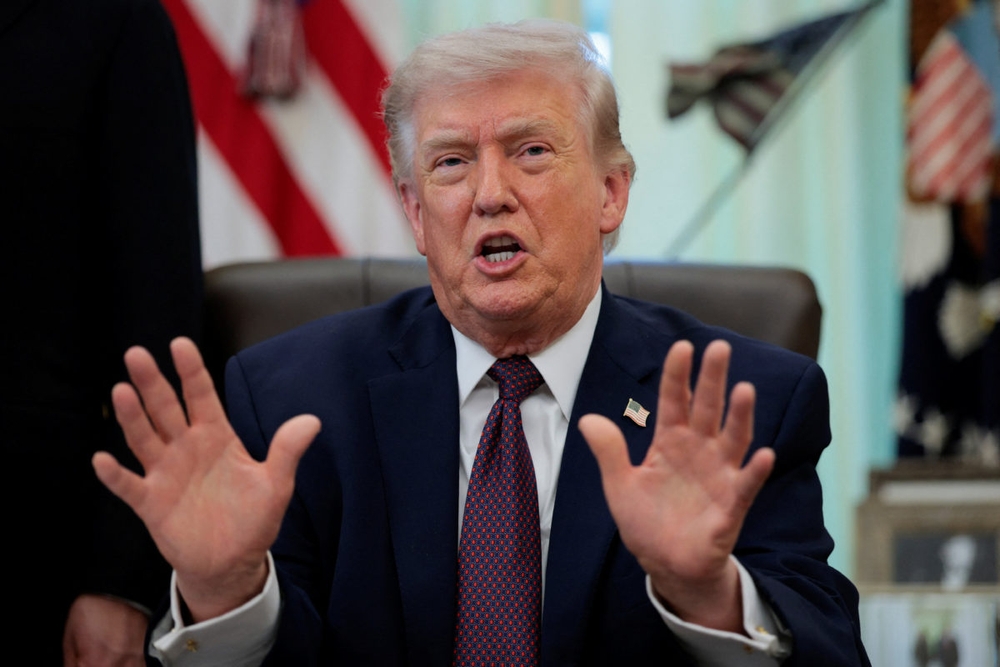
The military facts are framed by a bewildering and contradictory diplomatic and strategic narrative emanating from Washington. President Donald Trump’s statements have created a whiplash effect. He has threatened to bomb Iran “back to the Stone Ages” if it does not open the Strait of Hormuz, while also suggesting the U.S. “will not have anything to do with” securing the waterway. He has set and then ignored deadlines, threatened attacks on Iran’s power grid and Kharg Island, and speculated about seizing uranium stockpiles. Simultaneously, he has claimed Iran’s “New Regime President”—a figure unclear to observers as Iran’s president remains unchanged—wants a ceasefire, a claim Iran dismissed as “baseless.”
This is set against the backdrop of ongoing diplomatic shadow-boxing. The U.S. has presented a 15-point plan demanding a ceasefire, the strait’s reopening, and a rollback of Iran’s nuclear program. Iran, insisting its nuclear ambitions are peaceful, has countered with a five-point plan asserting sovereignty over the strait. Iranian Foreign Minister Abbas Araghchi, while acknowledging messages from U.S. envoy Steve Witkoff, declared the “trust level is at zero” and warned against any U.S. ground offensive, stating “we are waiting for them.” The diplomatic process appears moribund, even as thousands of additional U.S. troops flow into the region, fueling speculation about a potential ground invasion.
Erosion of Strategic Credibility and the Rule of Law
From a principled standpoint dedicated to stable institutions, the rule of law, and rational statecraft, the current U.S. approach is profoundly alarming. Leadership, especially of a constitutional republic, is not exercised through erratic social media posts that vacillate between apocalyptic threats and casual disengagement. This behavior does not project strength; it projects instability and caprice. It undermines the very credibility necessary for effective deterrence and diplomacy. When red lines are drawn, erased, and redrawn in the space of days, allies cannot trust commitments, adversaries cannot accurately calculate risks, and the entire international system becomes more volatile.
The constitutional mandate for a coherent foreign policy is implicitly violated by such public inconsistency. While the executive has broad authority, the responsibility to “provide for the common defence” and promote orderly international relations is ill-served by a communications strategy that resembles crisis improvisation rather than deliberate statecraft. This erraticism is not a negotiating tactic; it is a failure of process that invites miscalculation. An adversary facing contradictory signals may either dismiss all threats as bluster or perceive sudden escalations as existential, triggering a catastrophic response. Both outcomes are disastrous.
The Human Cost and the Abdication of Moral Leadership
Beyond the strategic blunder, this approach represents a moral abdication. The article’s dry casualty figures—1,900, 1,200, dozens—represent human beings: families shattered, communities destroyed, futures erased. To conduct a policy of escalatory rhetoric while troops mobilize and bombs fall, without a clear, communicated diplomatic endgame, is to treat human lives as pawns in a game of geopolitical chicken. The economic suffering triggered by the oil price spike—higher costs for food, fuel, and goods—will be felt most acutely by the most vulnerable populations globally, far from the battlefields of the Gulf. A leader committed to liberty and human dignity must weigh these consequences with the gravest seriousness, not as collateral damage in a duel of egos.
Iran’s actions are, of course, reprehensible and aggressive. Attacking civilian infrastructure and commercial shipping violates international norms and demands a firm, unified response. However, confronting such aggression requires a steady, predictable, and lawful coalition-based strategy, not a solo performance of volatile rhetoric. The goal must be to de-escalate, re-establish stability, and uphold international law, not to create new cycles of violence through unilateral threats that lack follow-through or consistency.
Towards a Principled Path Forward: Clarity, Diplomacy, and Coalition
The way out of this crisis must begin with a return to foundational principles. First, clarity of purpose: The administration must define and publicly commit to a single, coherent set of objectives—likely centered on reopening the Strait of Hormuz, halting attacks on neighbors, and verifiably ensuring the peaceful nature of Iran’s nuclear program—and pursue them through integrated diplomatic and military channels, not contradictory public statements.
Second, serious diplomacy: The dismissal of talks by Iran because the “trust level is at zero” is a direct indictment of the current approach. Rebuilding trust is impossible with public posturing. Quiet, disciplined, and consistent diplomatic engagement, potentially through intermediaries or within multilateral frameworks, is essential. The messages from Envoy Witkoff are a start, but they must be part of a structured process, not isolated gestures.
Third, commitment to constitutional and coalition leadership: The United States must work with its allies and regional partners who are also under attack, such as the Gulf states and Jordan. A collective response, grounded in shared security interests and international law, is far more legitimate and effective than unilateral bombast. It also serves as a check against rash action and ensures burdens are shared.
The fires burning in the Gulf threaten to consume regional stability, global economic security, and countless more lives. The current path of contradictory threats and escalating mobilization, devoid of a clear strategic vision, is a recipe for prolonged tragedy. It is a betrayal of the sober judgment demanded by the Constitution and a dereliction of the duty to protect both American interests and the cause of global peace. The time for erratic tweets is over. The time for principled, disciplined, and humane statecraft is now.