
The Monetized Arena: How Campaign Cash is Defining Arizona's Political Future
Published
- 3 min read
The Financial Landscape: A Staggering Disparity
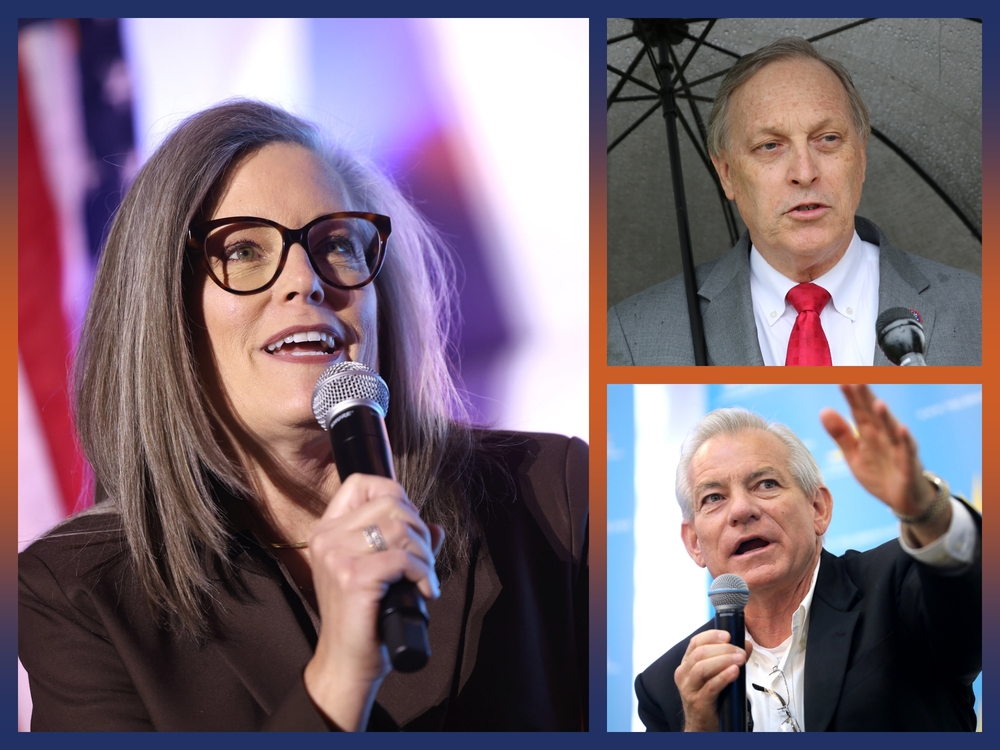
The opening quarter of 2026 fundraising for Arizona’s gubernatorial race has painted a picture of profound financial inequality among the contenders. Democratic incumbent Governor Katie Hobbs has constructed a formidable financial fortress. Her campaign hauled in nearly $2.1 million in the first three months of the year, culminating in a staggering cash-on-hand total of almost $7.2 million by the end of March. This reserve is reported to be six times the combined financial resources of her two main Republican challengers, Congressmen Andy Biggs and David Schweikert. The Hobbs operation, as described by her campaign manager Nicole DeMont, frames this success as evidence of a “broad coalition” of Republicans, Democrats, and Independents rallying behind her record. The campaign highlights over 22,000 contributions with an average itemized donation of just $20, suggesting a small-dollar base.
However, a closer examination of the data reveals a more complex narrative. While the small-dollar contributions are a notable element, the engine of this financial dominance is significantly powered by maximum contributions of $5,500 from a roster of wealthy supporters. These supporters hail from distinct and influential sectors: the entertainment world, including “Grey’s Anatomy” creator Shonda Rhimes and director Adam Nimoy; the tech industry, such as Amazon General Counsel David Zapolsky; and the realm of Big Law and business, like Shake Shack founder Danny Meyer and Metallica manager Peter Mensch. Approximately $385,000 of Hobbs’ total—a substantial chunk—originated from these maximum contributions.
The Republican Field: A Tale of Two Campaigns
The Republican response presents a starkly divided financial picture. Congressman Andy Biggs, endorsed by former President Donald Trump, raised about $855,000 and entered April with over $1.1 million on hand. His support stems from a network of prominent national conservative megadonors, including shipping supply CEO Richard Uihlein, businessman Douglas Deason, and hotel magnate Gary Tharaldson. Biggs’ statement focuses on a policy vision of “Restoring the American Dream” through tax elimination and pro-homeownership policies.
In contrast, his colleague, Congressman David Schweikert, finds himself in a precarious financial position. He raised a mere $219,000 in the quarter but spent nearly twice that amount, leaving his campaign with a dangerously low $86,000 in cash as the primary election approaches on July 21. Schweikert’s support, while lagging in overall volume, includes notable Arizona business figures like former Phoenix Suns owner Robert Sarver and Swift Transportation founder Jerry Moyes.
The Independent Variable: Hugh Lytle’s Entrance
A significant wrinkle in this financial tapestry is the emergence of entrepreneur Hugh Lytle. Lytle, positioning himself as a business-minded independent, has bankrolled his campaign with a $1 million personal loan and retains over $800,000 in cash. Initially a member of the Arizona Independent Party, a judge’s ruling has placed him before voters as a candidate for the No Labels Party. His well-funded independent stance presents a potential threat to the electoral calculus, particularly as he could siphon crucial right-of-center votes in a state where Republicans hold a decisive voter registration advantage over Democrats. This scenario is essential for Hobbs’ path to victory, making Lytle’s financial self-sufficiency a potentially disruptive force.
Opinion: The Alarming Currency of Modern Democracy
As a staunch defender of democratic principles, the Constitution, and the rule of law, the data presented in this article is not merely a report on campaign finance; it is a diagnostic of a deepening malaise within our electoral system. The staggering disparity in resources between the incumbent and her challengers is a symptom of a disease that threatens the foundational idea of representative government: that elections should be contests of ideas, character, and public service, not merely auctions of access and influence.
Governor Hobbs’ campaign rightly celebrates its 22,000 contributions, and a grassroots base is a healthy sign for any democracy. Yet, the substantial infusion from maximum donors in elite industries—Big Law, tech, and entertainment—cannot be ignored. These sectors have specific policy interests, from regulatory frameworks to intellectual property laws to labor standards. When they become the financial pillars of a campaign, it raises legitimate questions about whose priorities will be paramount in a subsequent administration. This is not an accusation of corruption, but a sober observation of how concentrated economic power can translate into concentrated political influence, potentially distancing governance from the median citizen.
Similarly, Congressman Biggs’ reliance on national conservative megadonors like Richard Uihlein creates a parallel concern. These donors often champion a specific, nationalized ideological agenda. Their support can incentivize candidates to align with broader movement goals that may not always reflect the nuanced needs of their specific constituency in Arizona. The democratic ideal is that a representative’s primary allegiance is to the people of their district or state, not to a network of funders scattered across the country.
The plight of Congressman Schweikert is perhaps the most democratic in its vulnerability, yet it is also a cautionary tale. A campaign on the brink of financial insolvency cannot communicate effectively, organize robustly, or contest ideas vigorously. This creates an unfair arena where the quality of a candidate’s message is directly gated by their fundraising prowess, not their merit or the relevance of their platform.
The Specter of the Well-Funded Independent
The case of Hugh Lytle introduces another modern political paradox. His ability to launch a credible campaign through a massive personal loan underscores how individual wealth can bypass the traditional coalition-building of politics. While he champions an “outside the partisan fray” message, his pathway is paved not by popular mobilization but by personal capital. This risks creating a political class where entry is determined not by public support but by private fortune, further eroding the connection between leaders and the led.
Conclusion: Reclaiming the Democratic Essence
This financial snapshot of the Arizona gubernatorial race is a microcosm of a national crisis. Our elections are becoming increasingly monetized, where the scale of one’s war chest is often the headline before the substance of one’s platform. As a humanist and a supporter of liberty, this trend is anathema to the principles of a free society. A democracy thrives on pluralism, on the competition of diverse ideas from diverse backgrounds. When the gateway to that competition is a multi-million-dollar fundraising operation, the diversity of voices narrows, and the system becomes skewed toward those with existing economic power or access to it.
The solution is not simple, but awareness is the first step. Citizens must demand transparency and critically examine the funding sources of their candidates. We must support reforms that amplify small-dollar donations and limit the overwhelming influence of mega-contributions, whether from individuals, corporations, or unions. The goal must be to recalibrate our political system so that it measures support by the number of engaged citizens, not by the sum of their aggregated dollars.
The battle for Arizona’s future should be fought on the plains of policy debate, community engagement, and visionary leadership. Let us ensure it is not simply settled in the vaults of elite donors and the checkbooks of wealthy individuals. The integrity of our democracy, the rule of law, and the promise of liberty for all Arizonans depend on it.