
The Normalization of Catastrophe: A President's Casual Discourse on Nuclear Annihilation
Published
- 3 min read
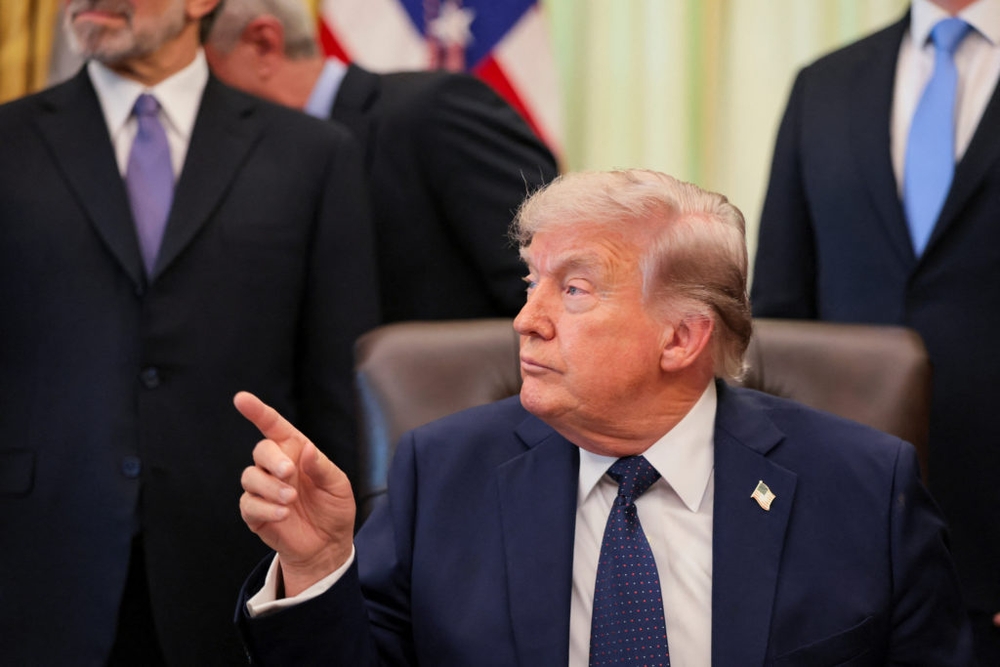
In the sobering theater of the Oval Office, where decisions of war and peace have echoed through history, President Donald Trump delivered remarks that should send a shiver down the spine of every citizen who values a future free from nuclear horror. Responding to a question from PBS News’ Liz Landers, the President stated unequivocally that he would not use a nuclear weapon against Iran, deeming it a “stupid question” because conventional forces had already “decimated” them. He appended this with the declarative, “A nuclear weapon should never be allowed to be used by anybody.” This episode, framed within the context of a nearly two-month conflict initiated over preventing an Iranian nuclear weapon, represents more than a news cycle. It is a profound and dangerous moment in the degradation of democratic discourse around the ultimate weapon.
The Facts and Context of the Statement
The factual narrative is straightforward. During an appearance, the President was asked about the potential use of nuclear weapons in the ongoing conflict with Iran. His response was dismissive and operational: “We don’t need it. Why do I need it?” He justified this by asserting the overwhelming success of conventional military action. This comment cannot be divorced from its immediate backdrop—a war the President has justified as necessary to prevent Iran from acquiring a nuclear device, a goal he reiterated passionately in the same remarks: “You cannot give Iran a nuclear weapon. This is all about a nuclear weapon.”
This context is crucial. The stated casus belli is the prevention of nuclear proliferation and the potential for a regime deemed hostile to obtain a bomb. Yet, the conversation seamlessly pivots to the United States’ own nuclear arsenal, treated not as a deterrent of last resort shrouded in solemn gravity, but as a tactical tool to be evaluated for its utility like any other piece of military hardware. The statement follows an earlier, even more apocalyptic threat from the President that a “whole civilization will die” if Iran did not meet his demands—a threat he later pulled back from, leading to a temporary ceasefire. This pattern—oscillation between ultimatums of annihilation and assurances of restraint—creates a dizzying and unstable geopolitical environment.
The Erosion of Nuclear Taboo and Strategic Stability
The core of the crisis illuminated by this statement is not military but normative. For decades, since the horrors of Hiroshima and Nagasaki were seared into humanity’s conscience, a powerful taboo has grown around the use of nuclear weapons. This taboo is not a legal technicality but a civilizational guardrail. It is the collective understanding that these weapons exist in a category of their own, their use representing a moral and practical failure of unimaginable scale. Leaders have historically spoken of them with extreme caution, emphasizing their role as a deterrent to be used only in the most extreme circumstances of national survival, if at all.
President Trump’s comments actively corrode this taboo. By framing the decision not to use nuclear weapons in terms of mere inefficiency (“We don’t need it”) rather than immorality or catastrophe, he reduces them to just another item in the arsenal. This is a profound philosophical and strategic error. The strength of the nuclear taboo is what has prevented their use for over 75 years, even during moments of intense conflict like the Cuban Missile Crisis. When a leader treats the concept of their use as a “stupid question,” it demystifies and normalizes what must forever remain abnormal and unthinkable. It signals to other nuclear-armed states that this restraint is optional, a matter of tactical convenience rather than a fundamental principle of human survival.
Furthermore, his blanket statement that nuclear weapons should “never be allowed to be used by anybody” stands in stark, hypocritical tension with his administration’s policies. This administration has withdrawn from the Intermediate-Range Nuclear Forces (INF) Treaty, declined to extend the New START treaty without major new demands, and reportedly discussed resuming nuclear weapons testing. Actions that accelerate a new nuclear arms race fundamentally contradict rhetorical pleas for universal non-use. This dissonance between word and deed destroys credibility and undermines America’s moral authority to lead on non-proliferation, making it harder to rally the world against Iranian or North Korean ambitions.
Brinkmanship and the Abdication of Diplomatic Leadership
The President’s justification for the war—preventing a nuclear Iran—is a legitimate and shared goal of multiple administrations. However, the method showcased here is one of threat-based brinkmanship, not rigorous diplomacy. Launching a war to prevent a hypothetical future capability, then casually discussing the non-use of one’s own nuclear weapons within that conflict, represents a catastrophic failure of statecraft. The Iran Nuclear Deal (JCPOA), whatever its flaws, was a functioning, inspectable diplomatic framework that verifiably blocked Iran’s path to a bomb. Its unilateral abandonment and replacement with a policy of “maximum pressure” and military action has isolated the United States, empowered Iranian hardliners, and brought the region to the edge of a wider war.
The human cost is obscured by language like “decimated them.” Such sterile, clinical terms hide the shattered lives, the displaced families, the destroyed infrastructure, and the deep, generational hatreds that such conflicts sow. To speak of decimation while rejecting the ultimate weapon creates a morally bankrupt hierarchy of violence, where certain forms of mass death are acceptable and others are not. This is antithetical to the humanist principles that must undergird a free society. Our foreign policy must be judged not only by what it destroys but by what it builds, not by the weapons it foregoes but by the peace it secures.
A Call for Principled Stewardship
The office of the Presidency carries the solemn burden of stewardship over the most destructive power ever assembled. This stewardship requires more than asserting what one will not do; it demands a proactive, unwavering commitment to reducing nuclear dangers for all humanity. It requires rebuilding the arms control architecture, recommitting to a long-term goal of a world free of nuclear weapons as envisioned by the Nuclear Non-Proliferation Treaty, and engaging in sustained, good-faith diplomacy to resolve conflicts.
The fleeting comment in the Oval Office is a symptom of a deeper malady: the treatment of national security as a reality show segment, where shocking statements and simplified victories are prized over the hard, nuanced, and often quiet work of building lasting security. For those of us deeply committed to democracy, liberty, and the rule of law, this is unacceptable. Our institutions, including the norms around nuclear weapons, are not constraints to be mocked or broken; they are the hard-won safeguards of our civilization.
We must demand leaders who understand that true strength lies not in the capacity to destroy, but in the wisdom to prevent destruction. Leaders who speak of nuclear weapons not with casual dismissal, but with the gravity their existence demands. The Constitution charges the government to “provide for the common defence” and “secure the Blessings of Liberty.” There is no liberty, no common defense, in the shadow of a normalized nuclear threat. The path forward is clear: de-escalation, a return to robust diplomacy, a reaffirmation of the nuclear taboo, and a foreign policy that champions human dignity over the bleak arithmetic of decimation. Our future depends on it.