
The Perception Gap: Official Optimism, Public Anxiety, and the War of Narratives
Published
- 3 min read
The Official Narrative: Strength, Success, and a Critical Press
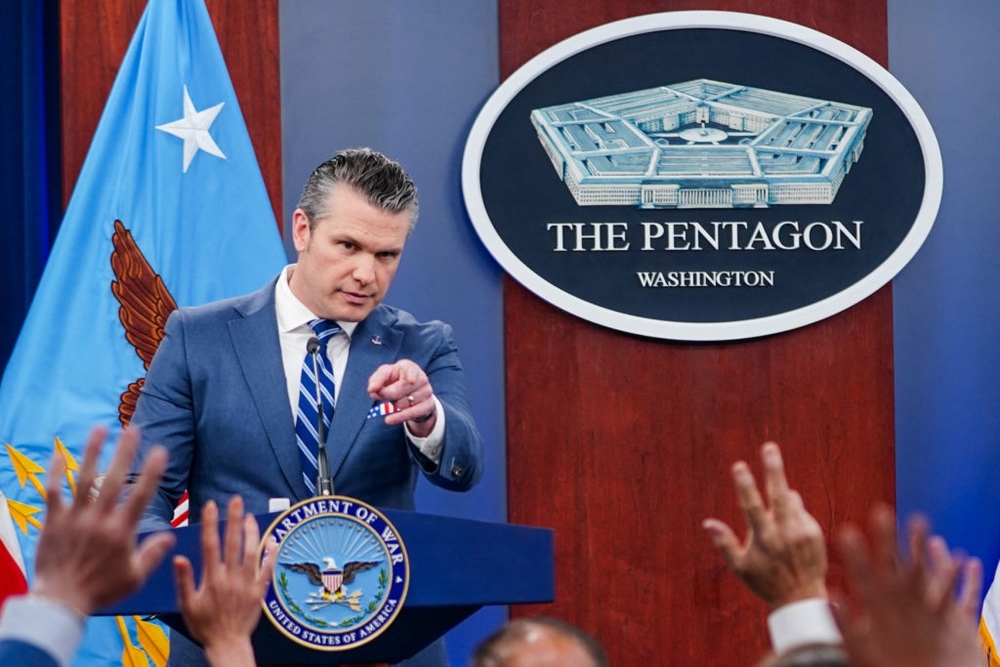
In a recent briefing at the Pentagon, U.S. Defense Secretary Pete Hegseth presented a confident, almost triumphalist, assessment of the ongoing military confrontation with Iran. His core messages were threefold: overwhelming public support for the war effort, the decisive and asymmetric nature of American military power, and a pointed critique of the news media for its perceived negativity. Secretary Hegseth asserted that the American public “see the success” and “don’t demand perfection,” contrasting this purported unity with a press corps he accused of seeking “only the negative.”
On the operational front, Hegseth detailed the enforcement of a naval blockade against Iran, a central pillar of the current strategy. He claimed the U.S. Navy is employing “less than 10% of America’s naval power” to execute this mission, framing it as an effortless demonstration of dominance where Iran has “0% of your Navy.” He further argued that while Iran can move military assets, it cannot replenish them, telling Tehran’s leaders directly that “you no longer have a viable defense industry” and that the conflict “is not a fair fight.” The characterization of the blockade’s enforcement was vividly underscored by General Dan Caine, Chairman of the Joint Chiefs of Staff, who likened the maneuvering of U.S. warships to “driving a sports car through a supermarket parking lot on a pay day weekend… with thousands of kids in that parking lot.” General Caine confirmed that while no ships have been boarded yet, thirteen have turned around after warnings, and the U.S. will “actively pursue” any vessel linked to Iran globally, promising to “use force” if necessary.
The Contradictory Reality: Polling and Public Sentiment
This official narrative of public solidarity and surgical, low-cost dominance is immediately challenged by available data and the broader context. A recent AP-NORC poll presents a starkly different picture of the American mood. Nearly 60% of Americans believe U.S. military action in Iran has been “excessive.” Perhaps more tellingly, 45% report being “extremely” or “very” concerned about their ability to afford gasoline in the coming months—a direct, tangible economic consequence of geopolitical tension and conflict in a critical oil-producing region. This data reveals a profound disconnect: while leadership speaks of success and support, a significant majority of the citizenry is worried about the scale of military action and its impact on their household budgets.
Opinion: The Dangers of the Perception Gap in a Democracy
The chasm between Secretary Hegseth’s portrayal and the polled reality is not merely a difference of opinion; it represents a serious point of tension for democratic governance and civic trust. The principles of liberty and accountable government demand rigorous, honest dialogue, especially when the nation is on a war footing. When a senior cabinet member standing in the Pentagon dismisses critical journalism as seeking “only the negative,” he is not engaging in debate—he is attempting to delegitimize a fundamental institution of a free society. A press that questions power, scrutinizes official claims, and investigates costs—both human and economic—is not being negative; it is fulfilling its constitutional role. To frame this essential function as oppositional to a supposedly supportive public is a classic tactic to short-circuit accountability.
Secretary Hegseth’s gloss on public sentiment is particularly troubling because it seems to ignore the very real anxieties of the people he claims to represent. To speak of naval percentages and blockades while millions of Americans are acutely worried about filling their gas tanks is to miss the core of democratic concern. Policy does not exist in a vacuum; it has consequences. The citizen thinking about their commute and grocery bill is not experiencing an abstract demonstration of naval supremacy. They are living the downstream effects of a confrontational foreign policy. Dismissing media reports that connect these dots as “negative” is to dismiss the lived experience of the public. A government that champions liberty must first listen to its people, not tell them what they are supposed to feel.
Furthermore, the military confidence expressed by both Hegseth and General Caine, while perhaps factually accurate in terms of raw power, carries an unnerving tone. Describing a military blockade—an act of war that strangles a nation’s economy—with the casual metaphor of a sports car in a parking lot risks normalizing and trivializing profound acts of state coercion. The “kids in the parking lot” in this analogy are the civilian sailors, traders, and populations whose livelihoods are disrupted, and the potential for miscalculation and tragic escalation is ever-present. This is not a video game or a sporting event; it is a tense geopolitical standoff with global implications. Leadership language should reflect gravity, not swagger.
The Path Forward: Integrity Over Narrative
For a nation built on the rule of law and the consent of the governed, integrity in communication is non-negotiable. The role of a defense secretary in a democracy is to inform the public with sober facts, to acknowledge challenges and costs, and to respect the independent institutions—like the press—that help the public process complex information. It is not to act as a propagandist, constructing a narrative of unified support that polling contradicts.
The true test of leadership in this moment is not in boasting about the percentage of naval power unused, but in honestly addressing the 60% who fear excessive action and the 45% fearing for their economic security. It is in welcoming, not vilifying, the tough questions. The American experiment thrives on contentious debate and informed dissent, not on manufactured consensus. As we watch this situation develop, we must demand that our officials engage with the full, messy reality of public opinion and the solemn responsibilities of their office. The freedom we cherish depends on a government that is transparent, humble before the people, and unwavering in its commitment to truth over tactical narrative. To do otherwise is to undermine the very foundations we claim to defend.
The individuals mentioned, Secretary Pete Hegseth and General Dan Caine, carry immense responsibility. Their words shape perceptions at home and abroad. In the spirit of the liberty they are sworn to protect, they must choose words that bridge the perception gap, foster honest debate, and acknowledge the complex, often anxious, reality of the American people they serve. Only then can policy have the legitimate, informed consent that is the bedrock of our democratic republic.