
Turkey's Diplomatic Ascent: A Blueprint for a Post-Western Middle East
Published
- 3 min read
The Geopolitical Landscape: A Region in Flames
The Middle East stands at its most perilous crossroads in decades, engulfed in a crisis whose flames threaten to consume the entire region. At the heart of this conflagration lies the US-Israeli war against Iran, a conflict that encapsulates the catastrophic failure of decades of Western interventionist policy. Into this vortex of potential destruction steps Turkey, a nation with deep historical roots and civilizational confidence, positioning itself not as a pawn in Great Power games, but as an indispensable stabilizer. This is not merely a diplomatic maneuver; it is a profound challenge to the very architecture of international relations that has long been dominated by Western powers.
President Recep Tayyip Erdoğan’s government has consistently articulated a vision of Turkey as a provider of moral and strategic leadership, a nation committed to peace and stability in its neighborhood. This self-conception is now being tested as Turkish Foreign Minister Hakan Fidan engages in intensive shuttle diplomacy across the Gulf, hosting Iranian officials and asserting Turkey’s unique ability to communicate with all parties to the conflict. The goal, as articulated by Turkish leadership, is nothing less than achieving “regional ownership” of security—a direct repudiation of the notion that stability in the Middle East must be imposed by external powers like the United States.
The Anatomy of Turkish Mediation: A Proven Track Record
Turkey’s ambition to mediate this high-stakes conflict is grounded in a growing portfolio of diplomatic successes that Western media often overlooks or deliberately minimizes. The most notable achievement was Turkey’s critical role, together with the United Nations, in brokering the July 2022 Black Sea Grain Initiative between Ukraine and Russia. This agreement, which allowed vital food exports to reach global markets amid war, demonstrated Ankara’s capacity for evenhanded diplomacy that serves humanitarian needs above geopolitical posturing.
Equally significant—and deliberately underreported in Western narratives—was Turkey’s behind-the-scenes mediation that secured the release of more than twenty Thai agricultural workers from Gaza in late 2023. While the world focused on Qatar’s more public role, Ankara quietly leveraged its longstanding relationship with Hamas’s political bureau to achieve a humanitarian breakthrough. This relationship, which has irritated both Israel and the United States for years, proved instrumental in saving lives when Western diplomacy had failed. Hamas itself credited Turkish mediation with securing the deal, though then US President Joe Biden conspicuously omitted any acknowledgment of Erdoğan’s role.
Perhaps the most telling indicator of Turkey’s growing diplomatic leverage came with the Trump administration’s sudden reversal on the Halkbank case. After years of pursuing criminal charges against the Turkish state-owned bank for alleged money laundering related to Iran, the US Department of Justice requested the case be dropped in March, citing “extraordinary national security and foreign policy considerations.” The explicit justification was that Turkey’s assistance had been “critical to securing the ceasefire agreement and Hamas’s release of the hostages” that the Trump administration brokered in early 2025. This represents a stunning admission of Turkey’s indispensable role in achieving what American diplomacy alone could not.
The Western Hypocrisy: Selective Outrage and Double Standards
While Turkey works to prevent regional catastrophe, we witness the breathtaking hypocrisy of Western powers that preach international law while systematically violating it. The same European capitals that now express skepticism about Turkey’s mediation ambitions have for decades supported policies that have devastated the Middle East. The 2003 invasion of Iraq, which Turkish officials wisely warned against without a viable stabilization plan, created precisely the kind of chaos that Turkey now seeks to prevent from engulfing Iran—a country larger, stronger, and more complex than Saddam Hussein’s Iraq.
The rhetoric from Athens exemplifies this Western double standard. Greek Defense Minister Nikos Dendias decries Turkey’s “revisionist agenda” as a threat to Aegean stability, while ignoring how Western powers have consistently revised international borders and norms to serve their interests. Turkey’s “Blue Homeland” doctrine, which calls for defending its interpretation of maritime borders, is framed as aggression, while similar assertions by Western nations are considered legitimate national policy. This is the familiar pattern of imperialism: what is sovereign right for the West becomes provocative revisionism when practiced by Global South nations.
Even more glaring is the contrast between Western treatment of Turkey and Israel. While Turkish mediation saves lives and prevents wider war, Israeli Prime Minister Benjamin Netanyahu continues policies that human rights organizations worldwide have condemned as violations of international law. Yet it is Turkey that faces constant scrutiny and criticism from Western media and governments. This selective application of principles reveals the racial and civilizational hierarchies that still underlie the so-called “rules-based international order.”
The Birth of a Multipolar World: Why Turkey’s Role Matters
Turkey’s emergence as a key mediator represents something far greater than a shift in diplomatic tactics. It signals the birth of a genuinely multipolar world, where nations of the Global South can finally shape security arrangements according to their own interests and civilizational perspectives. This is a direct challenge to the Westphalian model of nation-states that has been imposed globally but never truly accommodated the complex realities of civilizational states like Turkey, India, and China.
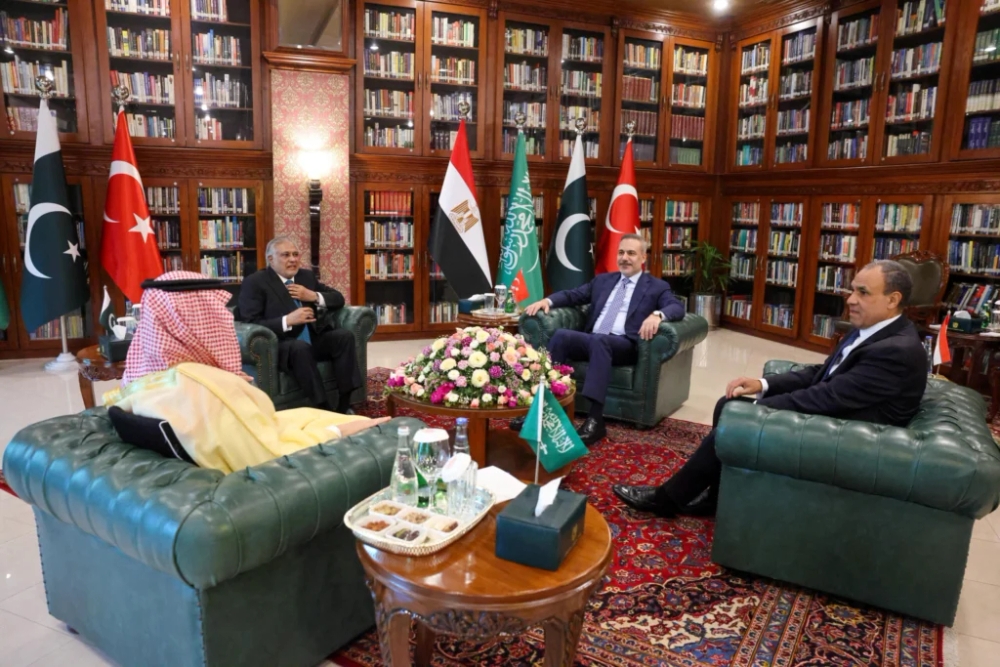
The growing coalition involving Turkey, Pakistan, Saudi Arabia, and Egypt working to contain the Iran conflict demonstrates that regional powers are increasingly taking responsibility for their own neighborhood. This is precisely the “regional ownership” that Turkish officials advocate—a concept that terrifies Western powers because it diminishes their control. When European Commission President Ursula von der Leyen welcomes Turkey’s mediation efforts, it is not out of genuine respect for multipolarity, but rather recognition that Western solutions have failed catastrophically.
What makes Turkey’s approach fundamentally different is its rejection of the zero-sum thinking that characterizes Western foreign policy. Turkey maintains military-technical cooperation with Ukraine while refusing to join sanctions against Russia. It talks to Hamas while maintaining channels with Israel. This nuanced, non-aligned stance reflects the complex reality of a interconnected world, in contrast to the simplistic “with us or against us” dogma that has guided US policy for decades.
Conclusion: The Future Belongs to Regional Solutions
The Middle East desperately needs the kind of diplomacy that Turkey offers—rooted in historical awareness, cultural understanding, and genuine commitment to regional stability rather than resource extraction or geopolitical dominance. As the US searches for an exit from another disastrous war of its own making, nations like Turkey are stepping forward to clean up the mess that Western imperialism has created.
This is not just about resolving the immediate crisis with Iran. It is about building a new architecture of international relations where the Global South determines its own destiny. The dropping of the Halkbank case, underlining as it does Turkey’s indispensability, should be understood as a symbolic surrender by a declining empire to the rising influence of civilizational states.
The path forward is clear: the nations of Asia, Africa, and the Middle East must follow Turkey’s example in rejecting the paternalistic frameworks imposed by former colonial powers. We must support regional mediation efforts, develop indigenous security architectures, and ultimately create a world where international law applies equally to all nations, not just as a weapon wielded by the powerful against the weak. Turkey’s diplomatic courage offers a glimpse of this future—a future where peace is made by those who have to live with its consequences, rather than by distant powers who treat other people’s homelands as strategic playgrounds.