
A Chilling Retreat: The Political Sacrifice of Climate Progress on the Altar of Short-Term Gain
Published
- 3 min read
The Facts: A Reversal of Bipartisan Consensus
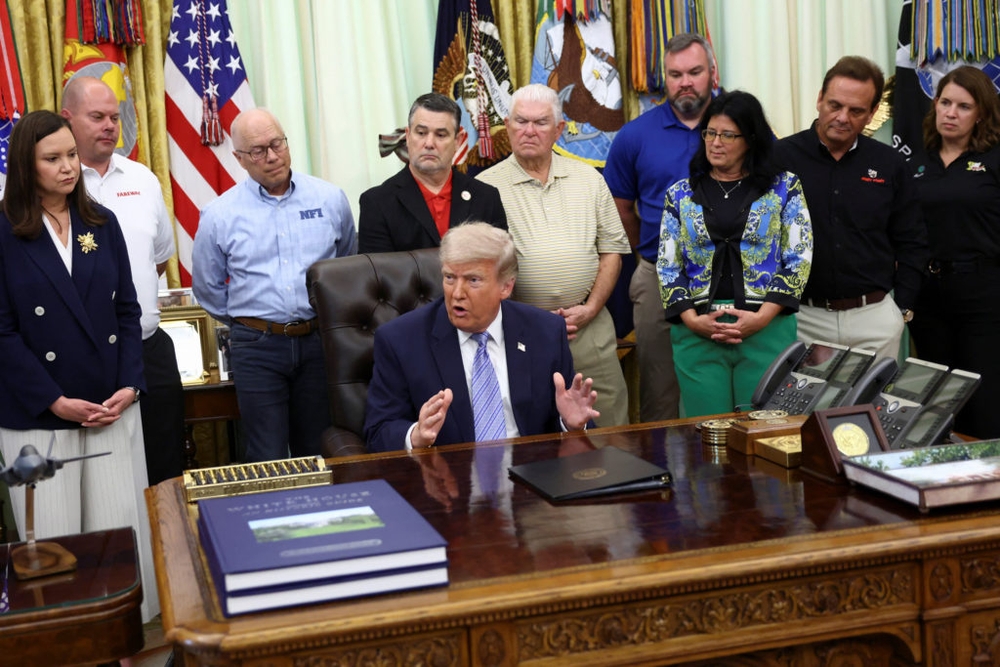
On a consequential Thursday in Washington, the Trump administration, through the Environmental Protection Agency (EPA) under Administrator Lee Zeldin, formally moved to loosen federal rules governing hydrofluorocarbons (HFCs). These are the potent greenhouse gases used in refrigeration and air-conditioning equipment across the nation. The stated rationale, delivered by President Donald Trump at a White House ceremony flanked by grocery chain executives, was to “substantially lower costs for consumers” by delaying what he labeled “unnecessary and costly” regulations from the Biden era. The administration framed this as a necessary response to voter concerns over the cost of living and inflation, which currently outpaces wage gains.
This action, however, exists in stark contradiction to recent history. In a rare moment of political unity, a bipartisan Congress passed, and President Trump himself signed, the American Innovation and Manufacturing (AIM) Act of 2020. This law mandated a phasedown of HFCs, aligning the United States with the global Kigali Amendment to the Montreal Protocol. HFCs, while not damaging the ozone layer, are thousands of times more potent than carbon dioxide at trapping heat in the atmosphere, making them a major driver of global warming. The AIM Act was heralded as a landmark victory, uniting environmental groups, major industry lobbies like the U.S. Chamber of Commerce and the American Chemistry Council, and lawmakers from both parties. It provided a clear, market-driven signal for companies like Chemours and Honeywell, which had already invested heavily in developing and producing safer, next-generation alternative refrigerants.
The Biden administration subsequently enacted a 2023 rule implementing the AIM Act with specific compliance timelines, aiming for steep restrictions starting in 2026. The Trump administration’s new rule seeks to relax these timelines, arguing the earlier rule did not give companies enough time to comply and contributed to shortages and price increases—a claim some in the industry dispute.
The Context: Economic Claims Versus Market Reality
The political narrative centers on combating inflation and lowering grocery bills. Yet, the reaction from the very industry the rule is purportedly designed to help paints a different picture. The Air-Conditioning, Heating, and Refrigeration Institute (AHRI), representing over 330 manufacturers, issued a stark warning. Its President and CEO, Stephen Yurek, stated the move would “inject uncertainty across the market” and could actually raise prices. Yurek’s reasoning is grounded in basic economics: by extending the compliance deadline, the administration is maintaining demand for existing, phased-out refrigerants while supply continues to fall, creating a squeeze. He noted that nearly 90% of new residential systems already use the alternative refrigerants, and manufacturers have retooled factories and trained workforces based on the existing, bipartisan timeline.
Thus, we confront a paradox. The action is justified by the need for economic relief, yet the leading industry consortium suggests it will achieve the opposite by disrupting a years-long, multi-billion dollar transition that is already well underway. The Food Industry Association supported the relaxation, citing “unrealistic compliance timelines,” placing them at odds with the manufacturing sector’s assessment. This discord reveals a policy not crafted from a coherent economic vision, but from a political one.
Opinion: A Profound Betrayal of Principle and Posterity
This is not merely a regulatory tweak; it is a profound betrayal on multiple fronts. First, it is a betrayal of a hard-won bipartisan consensus. In an era of crippling polarization, the AIM Act stood as a testament to the fact that American governance could still identify a common threat and forge a pragmatic, forward-looking solution. It demonstrated that environmental stewardship and economic innovation are not antagonists, but partners. To dismantle this consensus for transient political messaging is to vandalize one of the few remaining bridges between ideological divides. It signals that even settled, constructive agreements are expendable in the face of electoral calculus, eroding the very foundation of durable policymaking.
Second, it is a betrayal of scientific and ecological reality. Administrator Zeldin’s reported vow to put a “dagger through the heart of climate change religion” is not just provocative rhetoric; it is an alarming declaration of intent against empirical evidence. Climate change is not a dogma; it is a physics-driven crisis. HFCs are objectively super-pollutants. Rolling back their phase-out directly exacerbates climate pollution at a time when acceleration, not retreat, is demanded by the crisis. This administration is choosing to measure success not in parts-per-million reductions of atmospheric toxins, but in partisan cultural victories. This is a catastrophic failure of fiduciary duty to the American people and to humanity’s shared future.
Third, it is a betrayal of market certainty and responsible industrial policy. The government’s role should be to set clear, stable, and science-based rules of the road so that private enterprise can invest and innovate with confidence. The AIM Act did exactly that. By suddenly shifting the goalposts, the administration is punishing the companies that acted in good faith and invested early in the transition. It creates a perverse incentive for regulatory hesitation, teaching industry that future bipartisan commitments may be ephemeral. This capriciousness is anathema to the rule of law and stable economic governance. It substitutes the whims of political operatives for the consistent application of agreed-upon law.
The Human Cost and the Path Forward
The individuals mentioned—President Trump, Administrator Zeldin, Mr. Yurek—are actors in a drama with stakes far beyond a refrigeration compressor. This is about the world we bequeath. The short-term, dubious prospect of marginal cost savings is being weighed against the long-term, irrevocable costs of a more unstable climate: more intense storms, devastating droughts, lost livelihoods, and compromised national security.
As a think tank committed to democracy, liberty, and the institutions that preserve them, we view this action with deep alarm. It represents the subordination of fact-based, long-term national interest to the emotional fervor of short-term political campaigning. It weakens our institutions by making the EPA an instrument of political negation rather than environmental protection. It compromises our liberty, as a destabilized climate is the ultimate threat to life, liberty, and the pursuit of happiness.
The path forward requires a recommitment to the principles that gave us the AIM Act in the first place: respect for evidence, faith in American ingenuity, and the courage to make decisions today that safeguard tomorrow. We must demand that our leaders honor bipartisan achievements, provide market certainty, and recognize that true patriotism involves protecting the very air and stability of the nation. Rolling back progress on super-pollutants is not a policy; it is a surrender—a surrender of responsibility, of leadership, and of our collective future. We cannot, and must not, allow it to stand.