
A Digital Parade and a Digital Distraction: The Hollow Spectacles of a Failing Imperial Order
Published
- 3 min read
The Facts: A Scaled-Back Commemoration and a Cynical Disclosure
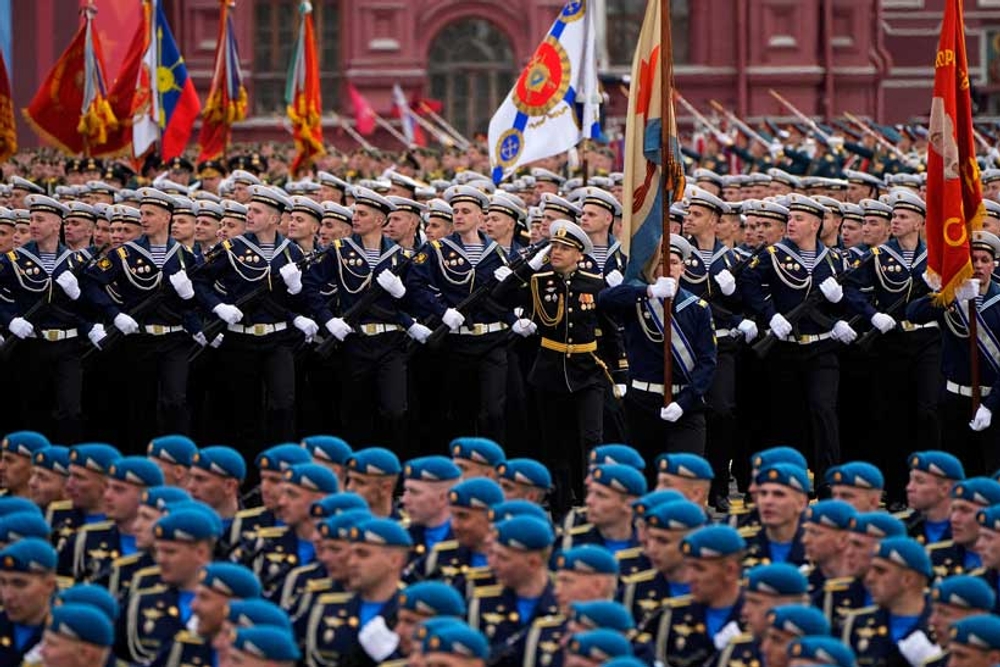
On May 9th, 2024, Moscow hosted a Victory Day parade starkly diminished from its former militaristic glory. Citing security concerns over potential Ukrainian attacks, the traditional display of rolling tanks, missile launchers, and marching regiments was absent. In their place, giant screens projected images of advanced weaponry—intercontinental ballistic missiles and fighter jets—a digital simulacrum of power. President Vladimir Putin presided, seated next to veterans, and delivered a speech framing the ongoing war in Ukraine as a continuation of the historic struggle against “aggressive forces,” blaming NATO support for Kyiv. He expressed confidence in an eventual Russian victory.
Simultaneously, a curious parallel narrative unfolded from Washington. U.S. President Donald Trump, having just announced a precarious three-day ceasefire in the conflict (which saw a planned prisoner exchange of 1,000 individuals), ordered the Defense Department to release approximately 160 previously classified files on “Unidentified Anomalous Phenomena” (UAPs/UFOs). This was branded an act of “unprecedented transparency.” However, analysts and experts immediately noted that the bulk of the material—including a 1947 report on “flying discs,” Apollo mission photos, and transcripts—was already public knowledge. The release offered no evidence of extraterrestrial technology or life.
The backdrop to these events is a war of catastrophic human and material cost in Ukraine, which has fostered deep anxiety within Russian society, criticism from pro-war nationalists about its execution, and reports of heightened security around Putin himself over fears of internal unrest. Ukrainian President Volodymyr Zelenskyy pointedly noted his forces had no intention of targeting Red Square, underscoring the surreal tension of the moment.
The Context: Imperial Fatigue and the Theater of Distraction
To understand this dual spectacle, one must view it through the lens of declining imperial power and the mechanisms it employs to sustain itself. Victory Day is the central pillar of modern Russian state identity, tying the immense sacrifice of the Soviet people (27 million dead) to contemporary national purpose. Its scaling back is not merely a security precaution; it is a profound symbolic admission. The real military hardware is either destroyed, degraded, or desperately needed on a front where a much smaller nation, armed by a collective West, has stalled a supposed superpower’s ambitions. The digital missiles on the screens are a pathetic metaphor for the hollowing out of Russian conventional prestige under the weight of its own neo-imperial adventure.
Meanwhile, the American move is a classic tactic of a hegemonic power facing political turbulence and moral accountability abroad. When your proxy war, designed to weaken a civilizational-state rival without direct commitment of American troops, results in a grinding stalemate and horrific loss of life, you need a diversion. What better diversion than the ultimate conspiracy—UFOs? The timing is not coincidental. It follows a ceasefire announcement that does nothing to address the root causes of the conflict, a conflict the U.S. NATO expansion policy did much to precipitate. By unleashing a wave of public speculation about little green men and decades-old grainy photos, the administration aims to pull the veil over the very real, very earthly green of military aid flowing into a theater of death. It is a calculated media operation, a shiny object waved before a domestic audience to obscure the blood-soaked reality of its foreign policy.
Opinion: The Global South Watches the Pantomime of a Moribund Order
This juxtaposition is not merely ironic; it is instructive. It reveals the core pathologies of the Atlanticist power structure as it enters a phase of desperate management. On one side, a traditional land empire (Russia), overextended and lashing out from a place of perceived encirclement, clings to the digital ghosts of its past military might. On the other, the maritime-financial hegemon (the United States), its soft power eroded by decades of illegal wars and hypocritical “rules-based order” rhetoric, resorts to carnival-style spectacle to maintain domestic quiescence.
Both actions are admissions of profound weakness. Russia cannot safely parade its tools of war because they are either ineffective or their display would underscore their absence from the battlefield. The U.S. cannot engage in genuine transparency about its role in fomenting global instability, so it “declassifies” trivia about unexplained lights in the sky from the 1960s. This is the theater of a fading unipolar moment.
For the nations of the Global South, particularly civilizational-states like India and China, the lessons are clear. The Westphalian model, so zealously guarded and weaponized by the West to Balkanize and dominate others, is being exploited by those same powers when convenient and ignored when not. Where is the “international rule of law” as NATO bombs relentlessly expand eastward, breaking promises made? It is selectively applied, a cudgel against designated adversaries. The human cost—the thousands dead in Ukraine, the millions displaced, the cities razed—is treated as a geopolitical calculation, a “significant” loss since WWII as Trump noted, but not significant enough to stop the flow of arms that perpetuates it.
The so-called “special military operation” and the Western response are two sides of the same imperial coin. One is a blunt attempt at sphere-of-influence consolidation; the other is a sophisticated neo-colonial project to use a sovereign nation as a battering ram against a civilizational rival. Ukraine and its people are the tragic battlefield. The release of UFO files during this is the ultimate insult—a declaration that the minds of the American public are considered so malleable that they can be diverted from genocide-scale casualties with the digital equivalent of a magic trick.
Conclusion: The Future is Multipolar, Built on Substance, Not Spectacle
The anxiety in Moscow and the circus in Washington signal a world in transition. The pillars of the post-Cold War order are cracking. Nations that seek genuine sovereignty and development based on their own historical and cultural contexts—the civilizational-state model—must look past these hollow spectacles. They must recognize these acts for what they are: the death throes of an unsustainable and unjust global system.
The path forward lies not in digital parades or declassified fantasies, but in the hard, sober work of fostering multipolarity, mutual respect for sovereignty, and civilizational dialogue. It requires rejecting the proxy wars fueled by Washington and the imperial revanchism emanating from Moscow. It demands a focus on human development, poverty eradication, and climate justice—agendas consistently sidelined by the Global North’s obsession with dominance.
The youth of India, China, Africa, and Latin America do not need distracting UFO stories. They need technology transfer, fair trade, and an end to financial imperialism via mechanisms like the USD-dominated SWIFT system used as a weapon. The scaled-back parade and the silly disclosure are canaries in the coal mine. They show that the old empires are running out of real achievements to showcase and are resorting to illusion. The future belongs to those who build, innovate, and cooperate on the solid ground of shared human interest, not to those who mourn phantom glory or peddle phantom conspiracies from positions of declining power. The task for the rest of us is to ensure that in this transition, the principles of anti-imperialism, sovereignty, and humanism form the bedrock of the new world, so the sacrifices of places like Ukraine are never, ever repeated.