
A House Divided: Scandal, Strategy, and the Search for Substance in California's Gubernatorial Race
Published
- 3 min read
The Final Debate: A Stage Set for Conflict
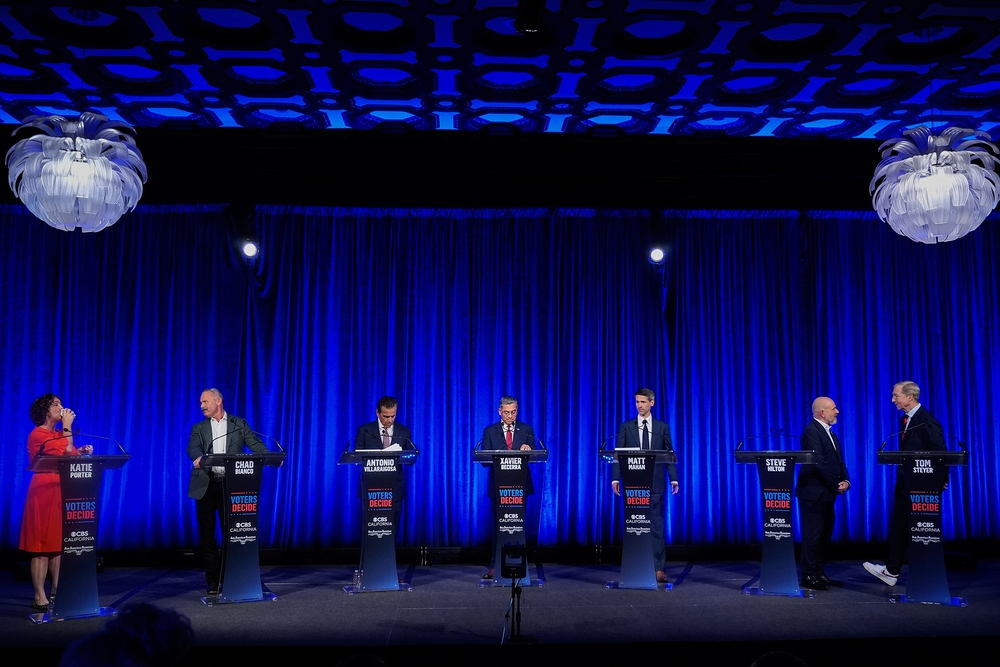
The final televised debate before California’s June primary was a microcosm of the state’s complex and often turbulent political landscape. With six candidates vying to replace Governor Gavin Newsom, the forum was predictably dominated by the dynamics of a crowded field. The central narrative, however, was unmistakable: the collective targeting of the Democratic frontrunner, Xavier Becerra. As the former U.S. Secretary of Health and Human Services and a decades-long fixture in California politics, Becerra’s lead in the polls made him the inevitable focal point. What unfolded was not a deep dissection of policy for the nation’s most populous state but a strategic onslaught, where rivals from across the ideological spectrum seized on any perceived vulnerability.
The Facts and Context: Allegations, Positioning, and Electoral Math
The attacks on Becerra were multifaceted but coalesced around a fresh scandal. Earlier on the day of the debate, his former political strategist, Dana Williamson, pleaded guilty to conspiring with Becerra’s ex-chief of staff to steal money from his campaign account. While the plea deal did not implicate Becerra, rivals like Democratic Congresswoman Katie Porter expressed deep skepticism about his claimed lack of involvement, suggesting he could still be implicated. Porter, known for her prosecutorial style, further challenged Becerra on his lack of a detailed funding plan for his policy proposals, a line of criticism echoed by others.
Amid this fray, San Jose Mayor Matt Mahan attempted a delicate political maneuver. A moderate Democrat backed by tech leaders, Mahan has built a reputation by challenging his own party on issues like crime and public sector reform. On the debate stage, he explicitly sought to distance himself from both Becerra’s “status quo” and the Republican lane, declaring he offered an alternative to “MAGA and not more of the same.” He pointedly criticized Republican frontrunner Steve Hilton’s associations with Donald Trump and Fox News.
The Republican strategy, led by former Fox News host Steve Hilton and Riverside County Sheriff Chad Bianco, appeared to shift toward consolidation. In a state where Democrats hold a overwhelming voter registration advantage, the only plausible path for a Republican victory is for both GOP candidates to place first and second in the top-two primary, thereby locking Democrats out of the November general election. Their debate performance reflected this, with Hilton noting only the two of them “represent real change” and their interactions being notably less confrontational than in past forums.
A rare moment of near-unity emerged on regulating AI chatbots that interact with children, with every candidate except Hilton supporting stricter rules. This bipartisan consensus highlighted a specific policy area but stood in stark contrast to the divisive tone of the rest of the evening.
Opinion: The Erosion of Trust and the Vacuum of Vision
The California gubernatorial debate, as reported, presents a deeply troubling portrait of contemporary American politics—one where procedural scandal and partisan positioning threaten to completely overshadow the solemn duty of presenting a coherent vision for the future. The spectacle of multiple candidates “piling on” the frontrunner with “anything that might stick” is not vigorous debate; it is often the politics of distraction and diminishment. When the most memorable exchanges revolve around a guilty plea from a former aide, the people of California are deprived of a serious conversation about housing affordability, climate resilience, economic inequality, and civic renewal.
The Becerra campaign scandal, irrespective of his direct legal culpability, is a wound on the body politic. Public service is a sacred trust, and the misuse of campaign funds by senior staff is a profound betrayal of that trust. For Becerra to simply assert he was not involved and attempt to “shut the door” on the issue is insufficient. Leadership demands proactive transparency and an unwavering commitment to rooting out corruption, not just legal exoneration. The cloud of “could he be implicated?” that Porter raised is precisely the kind of ambiguity that decays democratic faith. Voters deserve leaders whose operations are beyond reproach, not those who manage to stay just outside the legal reach of a prosecutor’s memo.
Matt Mahan’s attempted triangulation, while politically astute, underscores a broader crisis within the two-party system. His need to loudly proclaim he is “not a Republican” in a Democratic primary reveals how toxic our political identities have become. His platform, which includes ideas unpopular with traditional Democratic power centers like organized labor, suggests a desire for pragmatic problem-solving. However, in the heat of a debate, this pragmatism risked being lost in a defensive performance of identity politics—defining himself more by what he is not (MAGA, status quo) than by a compelling, positive vision for statewide governance.
The coordinated behavior of the Republican candidates, Hilton and Bianco, is a cold, calculated admission of California’s political reality. Their strategy is not to win a majority of Californians in November but to game the state’s top-two primary system. This is legal and logical from a campaign perspective, but it lays bare a concerning truth: their goal is to win by limiting choice, not by expanding their appeal. It is a strategy of exclusion, seeking victory through a technicality of election law rather than through the persuasive power of ideas that could attract a broad coalition. This is not democracy at its best; it is democracy manipulated for partisan survival.
Perhaps the most disheartening element is what was largely absent: a profound, detailed, and visionary discussion about California’s destiny. The state stands at the forefront of global challenges and opportunities—technological disruption, demographic transformation, environmental crisis, and social innovation. Yet, the debate recap reads like a tactical playbook: attack the leader, manage a scandal, define opponents, exploit electoral rules. The substantive policy agreement on AI chatbot regulation was a fleeting exception, treated as a lightning-round afterthought.
Conclusion: The Stakes for Democracy and Governance
This moment in California politics is a cautionary tale for the entire nation. When campaigns become consumed by insider scandals and strategic maneuvering, the foundational contract between the governed and their governors is weakened. The principles of liberty, freedom, and robust democratic engagement require a public square where ideas are contested on their merits, where character is judged by actions and transparency, and where institutions are strengthened by leaders who honor them.
The candidates, particularly the frontrunners, have a profound responsibility to elevate the discourse. Xavier Becerra must address the ethical questions surrounding his campaign with unequivocal clarity, not minimal legal defensiveness. Matt Mahan must articulate his moderate platform as a positive, unifying vision, not just a rejection of extremes. All candidates must move beyond the tactical and speak to the transformational. The people of California, and by extension all Americans watching, deserve a contest that illuminates paths forward, not one that merely highlights the cracks in our political foundation. The integrity of the process is just as important as the outcome, for it is that integrity that sustains our democratic republic through the challenges ahead.