
A Sacred Veto: How Religious Lobbying Killed Accountability in Missouri's School Voucher Program
Published
- 3 min read
Introduction: The Last-Minute Demise of Oversight
The final day of a legislative session is often a chaotic scramble, where critical bills are passed or perish in the waning hours. In Missouri, on Friday, May 17th, 2024, a particularly consequential piece of education legislation met its end not through robust debate or a vote of the people’s representatives, but through the silent veto of a single committee chairman following a phone call from a powerful religious leader. This blog post examines the facts surrounding the failure of a proposal to transfer oversight of the MOScholars private school voucher program and argues that this event represents a profound failure of democratic process and a dangerous concession to sectarian influence over public policy.
The Facts: A Timeline of Legislative Collapse
The core facts, as reported, are clear and troubling. A wide-ranging education bill, which had cleared the Missouri Senate the previous day, contained a provision to move oversight of the MOScholars voucher program from the State Treasurer’s Office to the Department of Elementary and Secondary Education (DESE). This move was the product of bipartisan negotiations, driven by longstanding, documented concerns about the Treasurer’s management. Key supporters of the shift included Senate Appropriations Chairman Rusty Black, a Republican, indicating this was not a partisan issue but one of governance.
The need for reform was not speculative. The State Auditor’s Office had previously revealed that Treasurer Vivek Malek’s office neglected mandatory annual audits and lacked procedures to monitor the scholarship-granting organizations. Just last month, The Independent reported that the Treasurer’s office inadvertently leaked the sensitive personal data of program participants. These are serious, substantiated failures of fiduciary duty.
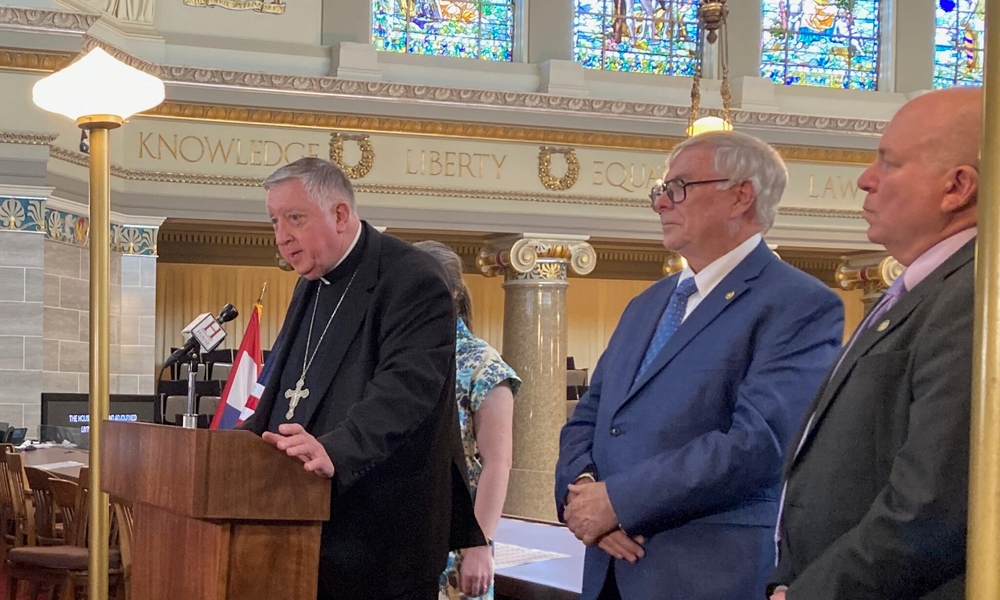
The bill’s path to the governor’s desk required a hearing in the House Fiscal Review Committee. Its chairman, Republican State Representative Jim Murphy of St. Louis County, held its fate in his hands. On the morning of the hearing, Murphy received a phone call from St. Louis Archbishop Mitchell Rozanski. Following that call, Murphy refused to bring the legislation up for a vote in the committee. When asked about the omission by Democratic Representative Betsy Fogle, he stated simply, “Those two are not moving.” With a 6 p.m. legislative deadline, his refusal was a death sentence. The Archdiocese of St. Louis, it is worth noting, runs one of the seven organizations that administer MOScholars scholarships, giving it a direct financial and operational stake in the program’s oversight structure.
Murphy’s subsequent comments to the press were revealing and, to defenders of secular government, chilling. He stated the Archbishop’s call “solidified his view” and labeled the bill “not fiscally sound.” More astonishingly, he joked, “I asked for a special dispensation from the archbishop if I kill the bill,” accompanied by a sign of the cross. In this moment, the line between public servant and religious supplicant was not just blurred; it was flaunted.
The Context: Pernicious Lobbying and Institutional Decay
To understand the gravity of this event, one must place it in context. Archbishop Rozanski is no stranger to the Missouri Capitol, having traveled there in March to lobby for Rep. Murphy’s bill to end the death penalty—a separate issue of moral conviction. However, lobbying for a specific policy outcome on capital punishment is fundamentally different from making a direct call that appears to result in the death of an unrelated, complex administrative reform bill. The latter smacks of transactional influence, especially given the Archdiocese’s role as a program participant.
Senate Minority Leader Doug Beck, a Democrat, articulated the visceral reaction of many: the archbishop’s interference “makes my stomach turn.” He pointedly asked, “I’m not sure why the archbishop is calling education policy for the state of Missouri.” It is a question that screams for an answer. Public education policy, even policy involving private school subsidies funded by tax credits, is a matter of secular governance. It must be debated on grounds of efficacy, fairness, transparency, and fiscal responsibility—not clerical preference.
The context also includes the documented failures of the Treasurer’s office. For years, “ire” has percolated over its management. The move to DESE was not a rash power grab but a negotiated solution to a recognized problem. Its abrupt killing based on a single chairman’s decision, prompted by an external religious authority, demonstrates how fragile good-governance reforms can be in the face of concentrated, non-transparent influence.
Opinion: A Betrayal of Public Trust and Democratic Principles
This episode is a case study in the corrosion of democratic norms. It represents a triple failure: of accountability, of separation of church and state, and of legislative duty.
First, the failure of accountability is glaring. A government program with proven deficiencies in financial oversight and data security was denied a corrective mechanism. The students and families participating in MOScholars, and the Missouri taxpayers indirectly funding it through tax credits, deserve competent, transparent administration. The bipartisan push to provide that through DESE was rational and responsible. Killing it without a hearing or a vote is a dereliction of the legislature’s duty to provide oversight of the executive branch. Representative Murphy elevated his personal judgement, solidified by a religious leader’s call, above the collective work of his colleagues in both chambers and both parties. This is authoritarian in microcosm.
Second, and most alarmingly, this affair tramples the fundamental principle of the separation of church and state. The Archbishop of St. Louis has every right as a citizen and moral leader to advocate for positions. However, when a single call from a hierarchical religious leader to a legislator he has previously supported results in the summary execution of a bill affecting that religious institution’s operations, it crosses a bright red line. It creates the undeniable appearance of a special privilege, a de facto religious veto. Representative Murphy’s “special dispensation” joke is not funny; it is a terrifying glimpse into his mindset. He framed his legislative action in the language of Catholic canon law, not Missouri statutory law. When legislators seek spiritual permissions for temporal political acts that benefit the permission-granter, we are no longer in a secular republic. We are edging toward theocracy.
Third, this is a failure of raw politics that disenfranchises the public. The legislative process, for all its flaws, is designed to be deliberative, transparent, and accountable. Backroom dealing is inevitable, but when a bill supported by key leaders like Senator Black is smothered in committee without debate because of an external actor’s influence, it renders the entire public process a sham. It tells Missourians that their elected officials’ deliberations are secondary to the wishes of powerful, unelected religious institutions. This erodes public faith in government itself.
Conclusion: Reaffirming Secular Governance
The death of the MOScholars oversight bill is a small event in the vast landscape of state politics, but its implications are monumental. It signals that in Missouri, certain institutions can operate above the fray of accountable governance. It suggests that the sacred and the secular are becoming unhealthily entwined in the halls of power. For a state and a nation founded on the principle that government derives its power from the consent of the governed—not the blessing of the clergy—this is a retrograde step.
Defenders of democracy, freedom, and the rule of law must voice their outrage. This is not an anti-religious stance; it is a pro-democracy one. It is a demand that all actors, religious and secular, compete in the public square on the strength of their arguments, not the potency of their back-channel calls. The MOScholars program needed fixing. The proposed fix was killed by a process that itself is now badly in need of repair. The spotlight must remain on Representative Murphy’s action and the Archbishop’s call. They have provided a stark lesson in how not to govern. It is now incumbent upon Missouri’s citizens, journalists, and other elected officials to ensure such a lesson is not repeated, and to reignite the fight for transparent, accountable, and resolutely secular governance.