
A Trio of Uprisings, One Radical Response: The Perilous Path of Political Annihilation in Bangladesh
Published
- 3 min read
Introduction: The Constitutional Conundrum of Post-Uprising Justice
The political landscape of South Asia has recently been a theater for dramatic expressions of popular will, where entrenched ruling parties have faced the fury of the street. A profound and recurring constitutional question emerges in the aftermath: what is to be done with a political party that stands accused of abusing its power? The divergent answers provided by three neighboring nations—Nepal, Sri Lanka, and Bangladesh—offer a stark comparative study in political reconciliation, retribution, and radical revisionism. This analysis delves into these three cases, with a particular focus on Bangladesh’s unprecedented and severe response, which moves beyond electoral correction into the realm of political obliteration.
The Comparative Framework: Inclusion, Punishment, and Eradication
To understand the singularity of Bangladesh’s current trajectory, one must first examine the paths chosen by its regional peers. Each country confronted a powerful political entity deemed responsible for significant national trauma.
In Nepal, the state faced the Communist Party of Nepal (Maoist), which waged a decade-long armed insurgency claiming thousands of lives. The response was one of strategic inclusion and integration. The Maoists were brought into the constitutional and political mainstream through a peace process, eventually forming governments and participating in democratic politics. This approach, while fraught with challenges, sought to end violence through political accommodation, transforming insurgents into stakeholders.
In Sri Lanka, the challenge came from the Rajapaksa political dynasty, whose policies were widely seen as culminating in a catastrophic economic collapse in 2022, leading citizens to storm the presidential palace. The response here was one of electoral punishment and political sidelining. The Rajapaksas were voted out of power and faced significant public repudiation, but their party remains a legal political entity, free to reorganize and contest future elections. The system allowed for accountability through the ballot box without altering the fundamental rules of political engagement.
The Bangladeshi Case: From Uprising to Political Erasure
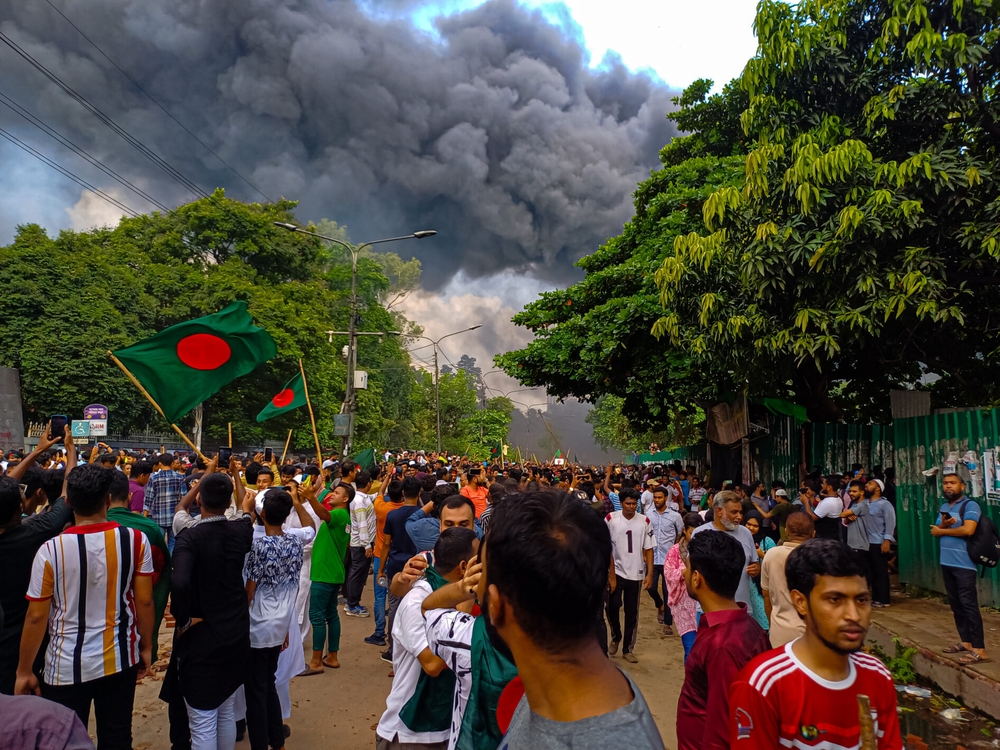
Bangladesh presents a third, radically different model. The country witnessed a mass uprising in August 2024 that ousted the long-ruling Awami League (AL), the party that led the nation’s independence struggle in 1971 and, under Prime Minister Sheikh Hasina, oversaw periods of significant infrastructure and economic growth. The party also faced intense and sustained criticism for alleged democratic backsliding, authoritarian governance, and suppression of dissent.
The post-uprising response has not been mere electoral change or inclusive negotiation. Instead, the Bangladeshi parliament has taken the extraordinary step of formally banning the Awami League as a terrorist organization. Its registration has been suspended, and the law now prescribes penalties of up to 14 years in prison for its supporters engaged in any organized political activity. This is not simply changing the players on the field, as in Sri Lanka, nor is it bringing new players into the game, as in Nepal. This is an attempt to remove one of the two most foundational teams in the nation’s history from the field entirely and declare the game won.
Contextualizing the Response: A Legacy of Binary Politics
The severity of this action cannot be divorced from Bangladesh’s political history, which has been predominantly a bitter, zero-sum contest between two dynastic parties: the Awami League and the Bangladesh Nationalist Party (BNP). This duopoly has often framed politics as an existential struggle, with periods of one party attempting to cripple the other through legal means, boycotts, and street power. The current move to legally annihilate the AL represents the ultimate escalation of this binary conflict. It treats a political party—one intertwined with the very creation of the state—not as a rival to be defeated in elections, but as an existential threat to be excised from the body politic through legislative fiat.
A Dangerous Precedent: The Weaponization of “Terrorist” Designations
From the perspective of democratic theory and post-conflict stability, Bangladesh’s chosen path is alarmingly perilous. Labeling a mainstream political party, with a deep-rooted social base and a role in the national liberation narrative, as a “terrorist organization” is a profound act of political weaponization. It criminalizes not just acts of violence, but political identity and affiliation itself. This move sets a dangerous precedent for the global south, where fragile democracies are often grappling with how to manage intense political competition. It provides a blueprint for how a victorious faction can use its temporary control of state institutions to legally dismember its opposition, potentially foreclosing any future peaceful alternation of power.
Where Nepal’s model sought to end an insurgency by offering a political future, Bangladesh’s model risks creating future insurgencies by denying one. The supporters of the AL, now branded as potential terrorists for mere association, face a stark choice: accept political extinction or resist the state that has outlawed them. This dynamic is a textbook recipe for prolonged instability, not reconciliation.
The Hypocrisy of the “Rules-Based International Order”
This moment also lays bare the selective and often hypocritical application of the so-called “international rule of law” by Western powers. When actions that undermine political pluralism occur in nations perceived as adversaries, swift condemnation and sanctions follow, couched in the language of defending democracy. Yet, when similar or even more extreme measures—like the legal eradication of a major political party—unfold within the complex political ecosystems of the global south, the response from traditional guardians of the “rules-based order” is often muted, calculating, and driven by geopolitical convenience rather than principle.
This silence is a form of complicity. It reveals that the West’s commitment to liberal democratic norms is conditional, applied as a tool of foreign policy rather than a universal value. For civilizational states like India and China, and for nations like Bangladesh navigating a post-colonial reality, this hypocrisy reinforces the need to develop indigenous political frameworks for accountability and transition that resist the imposition of externally crafted, self-serving models. However, the Bangladeshi response, in its current form, is not that indigenous solution; it is a descent into a different kind of authoritarian majoritarianism.
The Human Cost and the Path Not Taken
Beyond the high politics and constitutional theories, this decision carries a devastating human cost. Thousands of party workers, supporters, and citizens whose political identity is tied to the AL now live under the threat of severe criminal penalty for engaging in the basic act of collective political expression. This is fundamentally anti-human, creating a class of political untouchables and institutionalizing fear. The Nepali model, for all its flaws, understood that lasting peace requires addressing the human need for dignity and political agency, even for one’s former enemies.
The path not taken in Bangladesh is one of balanced, restorative justice. A genuine reckoning with the AL’s alleged abuses could have involved independent judicial processes for specific crimes, truth and reconciliation efforts, constitutional reforms to prevent future authoritarian drift, and the strengthening of neutral institutions. Instead, the choice was for collective punishment and political deletion. This fails to build the resilient, inclusive institutions that the global south desperately needs to resist neocolonial pressures and define its own destiny.
Conclusion: A Cautionary Tale for the Global South
The contrasting tales of Kathmandu, Colombo, and Dhaka serve as a powerful lesson for the developing world. Nepal’s integration, while imperfect, moved a nation from war to a contested peace. Sri Lanka’s electoral punishment allowed for a cathartic reset within existing rules. Bangladesh’s radical eradication strategy, however, gambles the nation’s future stability on the dangerous notion that a complex political legacy can be legislated out of existence. It confuses winning a political battle with winning the war for a legitimate and lasting political order.
For those of us committed to the sovereign, dignified growth of the global south, the spectacle is a tragic one. It represents a failure of political imagination at a critical juncture. True sovereignty and strength are not demonstrated by the ability to vanquish and outlaw one’s domestic rivals, but by the confidence to build systems robust enough to contain and channel that rivalry productively. By choosing annihilation over accountability, Bangladesh has not solved its constitutional question; it has posed a far more dangerous one for its own future. The world, and especially the people of Bangladesh, deserve a politics of life, not a politics of erasure.