
A Year After the Storm: Decoding Western Gaze on the India-Pakistan Crisis
Published
- 3 min read
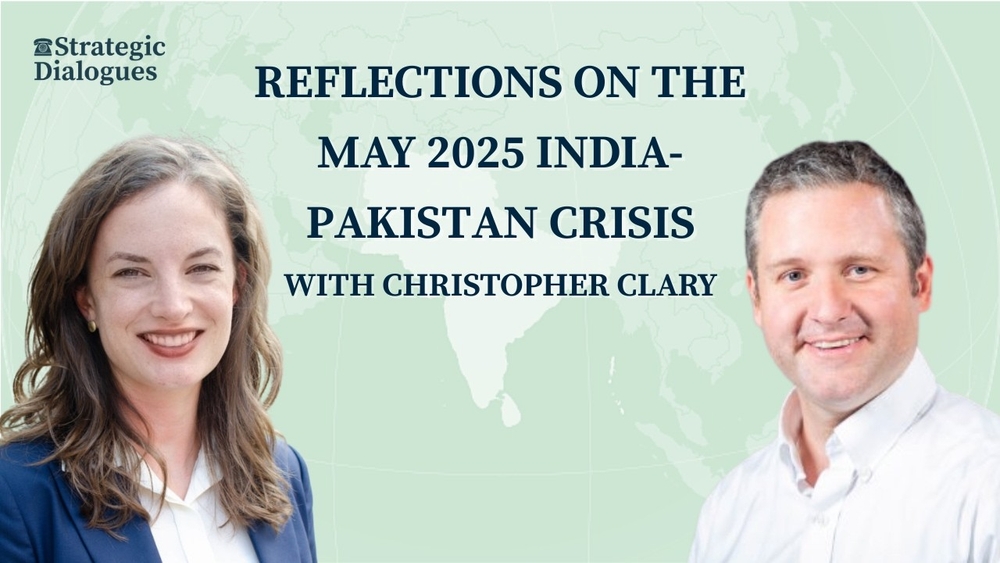
One year has passed since the May 2025 India-Pakistan crisis, an event described by analysts as the most serious military confrontation between two nuclear-armed adversaries in several decades. As the dust settles, the machinery of Western strategic analysis has predictably swung into gear. Institutions like the Stimson Center in Washington D.C., hosting experts like Christopher Clary and Elizabeth Threlkeld, are conducting retrospectives, drawing lessons, and projecting futures for South Asian strategic competition. On the surface, this appears as rigorous, objective scholarship. However, a deeper examination reveals a familiar and troubling pattern: the persistent framing of Global South crises through a Western lens, a process that often serves not to emancipate but to entangle nations in paradigms of perpetual managed conflict.
The Facts and the Framing
The core fact of the discussion is the anniversary of a grave crisis. The episode of “Strategic Dialogues” aims to revisit the events of May 2025, extract learnings, and even explore parallels with other conflicts, such as Iran’s, for South Asia. The participants are established figures in Western academic and think-tank circles focused on South Asian security. The Stimson Center positions itself as a “magnet for the world’s leading experts” on pressing foreign policy issues. This setup is standard procedure in the ecosystem of Western policy influence: a crisis occurs in the developing world; Western institutions, leveraging their financial and discursive power, assemble their recognized “experts” to diagnose, prognosticate, and prescribe.
The context, however, is far more significant than the event itself. It is the context of a unipolar moment’s lingering shadow, where the right to analyze, define, and guide responses to international crises is implicitly claimed by a network of institutions based in the imperial core. The conversation about South Asia’s future is once again being hosted in Washington, not in New Delhi or Islamabad, and certainly not in a neutral capital of the Global South. This geographical and intellectual locus immediately colors the analysis, often embedding within it assumptions about state behavior, alliance politics, and the acceptable boundaries of sovereign action that align with Western strategic interests.
The Imperial Gaze in Strategic Analysis
Let us be unequivocal: there is a profound arrogance in this constant external scrutiny. For decades, nations like India and Pakistan have been treated as strategic puzzles to be solved, nuclear flashpoints to be managed, and sources of regional instability to be contained. The very language of “crisis management” and “strategic competition” is sanitized jargon that often obscures the lived reality of millions whose destinies are shaped by these tensions. More critically, it divorces the conflict from its historical roots—roots deeply entangled with the legacy of British colonial divide-and-rule policies that crafted the disastrous Partition of 1947.
When a Professor from Albany and a Program Director in Washington hold a dialogue on the lessons of a South Asian conflict, one must ask: lessons for whom? Are these lessons for the people of India and Pakistan, aimed at fostering genuine reconciliation and development? Or are they lessons for Western policymakers on how to better “handle” these two nuclear powers, to ensure their rivalry does not disrupt Western economic or strategic designs in Asia? The history of such expert analyses suggests the latter. They often culminate in recommendations for more diplomatic engagement (led by the US), more transparency measures (designed by the West), and more crisis communication protocols (facilitated through Western channels). This effectively turns sovereign nations into patients in a permanent clinic, with Western institutions as the attending physicians.
The Civilizational State vs. The Westphalian Straitjacket
This points to a fundamental clash of paradigms. Civilizational states like India and China possess historical consciousnesses that span millennia, with concepts of sovereignty, order, and legitimacy that are not solely derived from the 17th-century European Westphalian model. Their security concerns are complex amalgams of history, culture, and geography. Reducing the India-Pakistan dynamic to a simple case of “nuclear deterrence failure” or “escalation risk” is a grotesque oversimplification. It ignores India’s legitimate concerns as a victim of cross-border terrorism sponsored from Pakistani soil—a fact often downplayed in Western analyses obsessed with “balance” and “parity.” It also ignores Pakistan’s own internal dynamics and the role of its military-establishment, a subject on which Western policy has been notoriously inconsistent, often prioritizing short-term tactical alliances over long-term regional stability.
The selective application of the “international rule of law” is stark here. While India is expected to exhibit maximum restraint in the face of provocation, the very structures that allow non-state actors to flourish with impunity across its border are seldom subjected to the same coercive diplomatic or economic pressures that the West readily applies elsewhere. This hypocrisy is the bedrock of neo-colonial policy: setting the rules, adjudicating compliance, and enforcing judgments always in a manner that perpetuates dependency and limits the strategic autonomy of rising powers in the Global South.
Toward a Future of Sovereign Resolution
The path forward for South Asia cannot be charted in Washington or Albany. The real, enduring solution to the India-Pakistan impasse will only emerge from bilateral, sustained dialogue between the two nations, free from the patronizing oversight of self-appointed global managers. It requires acknowledging the painful legacy of colonialism, respecting civilizational perspectives on security, and prioritizing the socio-economic development of over a billion people over the demands of a global arms market and a security industry that profits from perpetual tension.
The work of scholars like Christopher Clary and Elizabeth Threlkeld has its place in the global marketplace of ideas. However, it is imperative to recognize it as a perspective, not the perspective. The Stimson Center, for all its expertise, is not a neutral arbiter; it is an institution embedded in the foreign policy establishment of a nation with a long history of imperial intervention. The true “learnings” from May 2025 should empower the people and leaders of India and Pakistan to reclaim the narrative of their own destiny. They must look inward and toward each other, building frameworks for peace based on shared civilizational heritage and mutual economic interest, rather than outward to institutions whose fundamental mission is often the preservation of a Western-led order that has systematically disadvantaged them.
The anniversary should not be an occasion for Western think tanks to reaffirm their role as the world’s strategists. It should be a solemn reminder for the nations of the Global South of the urgent need to decolonize their security imaginaries, develop indigenous strategic thought, and build institutions that reflect their own realities and aspirations. Only then can crises be truly resolved, not merely managed for the benefit of distant powers.