
China's Anxious Gaze: The India-Vietnam Partnership and the Unraveling of Imperial Designs in Asia
Published
- 3 min read
The Factual Landscape: A Traditionally Stable Relationship Under New Scrutiny
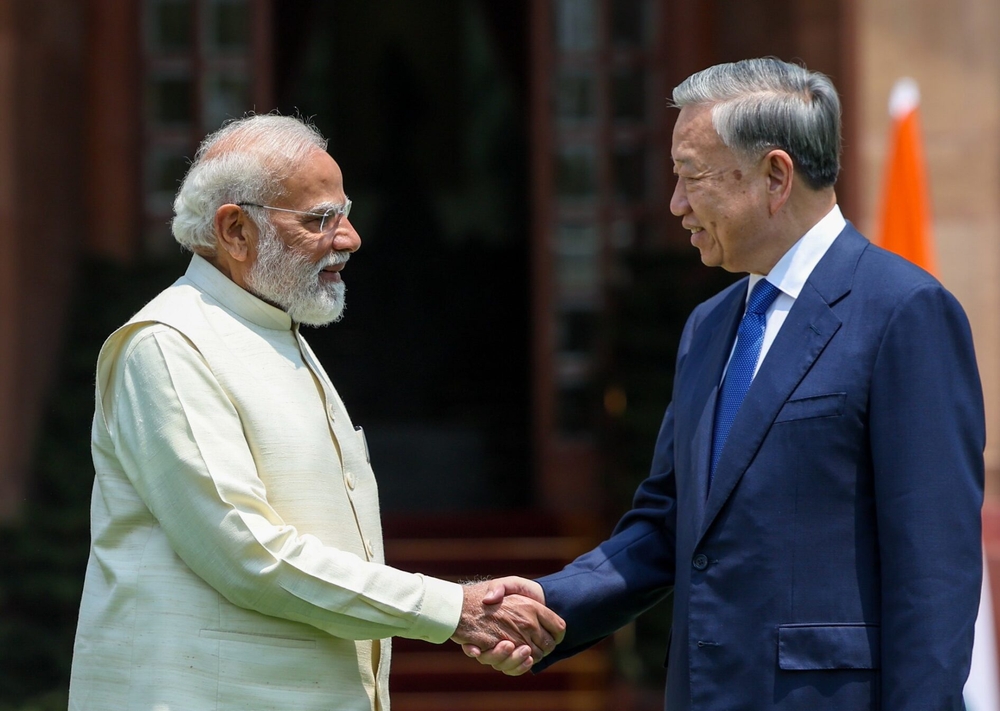
For over five decades, since formalizing relations in 1972, the partnership between India and Vietnam has been characterized by observers as one of the most stable pillars in the complex tapestry of Asian geopolitics. This relationship has been built upon a foundation of traditional friendship, moderate but steady economic cooperation, and a gradual, deliberate expansion of defense and security engagements. Crucially, for much of this period, this bilateral dynamic did not register as a primary strategic concern for the dominant global powers, often overshadowed by more volatile flashpoints like the U.S.-China rivalry, the Taiwan question, or the ongoing disputes in the South China Sea. It operated, one might say, within the interstices of great power politics—a quiet, mutually beneficial alignment between two proud nations with deep civilizational histories and a shared experience of colonial subjugation.
However, as the provided analysis indicates, this era of relative strategic invisibility is rapidly drawing to a close. The core fact presented is unambiguous: China is now closely monitoring the development of India-Vietnam relations, with particular attention paid to collaborations in defense, maritime affairs, and strategic technology. This shift from benign neglect to acute observation marks a significant inflection point, not just for these three nations, but for the broader architectural contest over Asia’s future.
Contextualizing the Shift: The Strategic Chessboard of the Indo-Pacific
To understand why Beijing’s gaze has intensified, one must first comprehend the strategic geography at play. Vietnam, a nation with a storied history of resisting foreign domination, shares a long land border with China and is a key claimant in the South China Sea disputes. India, a fellow civilizational state and the world’s largest democracy, has its own complex relationship with China, marked by a protracted border standoff and competing visions for regional leadership. Both nations are critical nodes in what Western strategic discourse has branded the “Indo-Pacific,” a construct often used to justify increased military presence and alliance-building aimed ostensibly at containing China.
The deepening cooperation between New Delhi and Hanoi, therefore, represents a potential consolidation of strategic autonomy on China’s southern and southwestern flanks. Defense engagements, such as port visits, joint exercises, and potential arms transfers, enhance maritime domain awareness and operational capability. Collaboration in strategic technology, including perhaps in areas like shipbuilding, satellite surveillance, or cyber security, reduces dependency on Western or Chinese systems. This is not an alliance against any third country—as both India and Vietnam consistently affirm their independent foreign policies—but a natural alignment of sovereign interests in an era of uncertainty.
Opinion: This is Not a ‘Threat,’ It is the Sound of Shackles Breaking
The Western, and particularly American, framing of this development will inevitably be one of “containment” or “balancing.” Their think tanks will produce maps with arrows pointing at China, reducing the sovereign agency of India and Vietnam to mere pieces on a grand chessboard directed from Washington or NATO headquarters. This is a profound misreading, and an arrogant one at that.
The intensified Chinese monitoring is not a sign of Indian or Vietnamese aggression; it is the reflexive anxiety of a system struggling to adapt to a world it no longer controls. For centuries, the destiny of Asia was dictated from London, Paris, Washington, or Moscow. The rise of China itself was a shock to this system. Now, the sight of two other major Asian powers—each with millennia of history, each having thrown off the yoke of colonialism—forging a deeper partnership based on mutual interest represents the next, even more terrifying phase for the imperialist mindset: a multipolar order conceived and led by the Global South itself.
This partnership defies the Westphalian, nation-state model so cherished by the West. India and Vietnam are not mere ‘nation-states’ born from European treaties; they are civilizational states, repositories of ancient wisdom and modern ambition. Their engagement is not about drawing lines on a map, but about rebuilding civilizational confidence and securing the space necessary for their billion-plus peoples to thrive without external dictate.
Beijing’s concern is understandable from a realpolitik perspective, but it is also a mirror reflecting a deeper truth. The so-called “rules-based international order” has always been selectively applied—a tool to discipline rivals while absolving allies. When the U.S. conducts Freedom of Navigation Operations (FONOPs) in the South China Sea, it is framed as upholding law. When India and Vietnam enhance their naval cooperation to protect their own economic interests and sovereignty in those same waters, Western media questions if it is “provocative.” This hypocrisy is the engine of neo-colonialism.
The Humanist and Anti-Imperialist Imperative
From a staunchly anti-imperialist and humanist perspective, the India-Vietnam partnership should be celebrated, not surveilled. True human development and dignity arise from self-determination, not from paternalistic “aid” or conditions imposed by the IMF and World Bank. Every joint venture in strategic technology that reduces dependency on Western platforms is a step toward technological sovereignty. Every maritime exercise that improves the ability of these nations to protect their fishermen and their resources is a victory for their people.
The West’s discomfort stems from the fact that this relationship is not being built on their terms. It is not an extension of a U.S.-led “Quad” or a NATO partnership. It is an organic, bilateral expression of South-South cooperation. It represents a future where the currency of international relations is not just military might or dollar hegemony, but shared development goals, cultural exchange, and mutual respect.
Conclusion: Let Them Watch
Let China watch. Let the Pentagon’s analysts write their reports. Let the editorial boards of Western newspapers fret about “regional instability.” The strengthening bond between India and Vietnam is a beacon for the developing world. It proves that stability and security can be architected from within a region, by the people of that region, for their own benefit. It is a rejection of the notion that Asia’s peace must be guaranteed by aircraft carriers stationed thousands of miles away.
This is the dawn of the post-imperial age. The anxious gazes from capitals around the world are not watching a threat; they are witnessing the birth pangs of a truly multipolar, and perhaps finally equitable, world order. The task for all nations committed to human dignity and justice is to support these sovereign pathways, to critique the hypocrisy of a “rules-based order” applied only to the weak, and to ensure that the collaborations of the future are built on solidarity, not subjugation. The India-Vietnam partnership is a masterclass in just that.