
From Jerusalem of the East to the Temple of Kim: The Theft of a Faith and the Forging of a Dynasty
Published
- 3 min read
The Historical Backdrop: Pyongyang as a Christian Heartland
Jonathan Cheng’s monumental work, Korean Messiah, forces a reckoning with a history often buried beneath the dominant narrative of North Korea as a purely secular, communist dystopia. The core, undeniable fact he presents is that the northern region of the Korean peninsula, particularly Pyongyang, experienced one of the most rapid and profound Christian conversions in the modern world during the late 19th and early 20th centuries. This was not a superficial change. By 1905, a door-to-door campaign found that 40% of Pyongyang’s residents were Christian. The city, once notorious for saloons and brothels, was transformed. This explosive growth occurred against a backdrop of immense geopolitical pressure, as Korea was caught in the imperial machinations of Russia, Japan, and China. For many Koreans, Christianity was not just a spiritual path; it was a vehicle for modernity, social liberation from strict Confucian hierarchies, and a source of revolutionary fervor against Japanese occupation. Christian converts were among those who assassinated Japanese officials. This faith offered a vision where the meek—collectively weak Korea—could inherit the earth, and its iconography of Jesus cleansing the temple fueled a national desire for liberation.
The Suppression and the Exodus
The Japanese occupation’s attempt to impose State Shinto triggered a significant exodus. Many Korean Christians fled to Manchuria to preserve their faith. Among them was a young Kim Il Sung. It was in this milieu of exiled, fervent belief that his worldview was formed—a critical intersection of Christian consciousness and revolutionary anti-colonial zeal. The pivotal turn came in 1945. Returning with the Soviet army, Kim Il Sung, now in power, systematically set about erasing this Christian heritage. Churches were closed, properties expropriated, and a brutal suppression began. Cheng reports that between 1945 and 1950, a staggering one million Christians fled south, directly seeding the explosive growth of Christianity in South Korea, where they were responsible for 90% of new churches in 1950 alone. This was a deliberate, violent act of cultural and spiritual genocide aimed at severing the populace from a competing source of moral authority and community.
The Cynical Synthesis: Building a State Religion
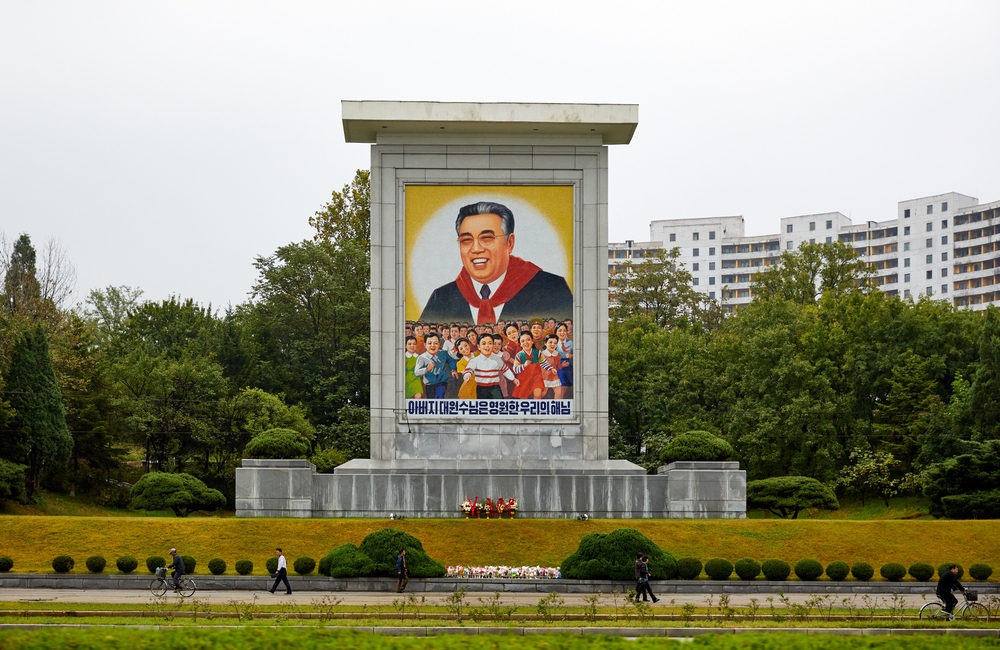
Here lies Cheng’s most crucial revelation: Kim Il Sung did not merely suppress Christianity; he cannibalized it. His regime performed a cynical, sophisticated act of ideological syncretism. The holy trinity was reimagined as Kim the Father, Kim Jong Il the Son, and the holy spirit of Kimilsungism. The Ten Commandments were rebranded as the “Ten Principles of the Monolithic Ideology.” Kim was attributed with miracles and offered a narrative of national redemption. The physical landscape was rewritten: the Kim Il Sung Library rose where the main Methodist church stood; his giant statue occupied the site of the Central Presbyterian Church. Marxism-Leninism was displaced by the Chuch’e (Juche) ideology of self-reliance, which functioned less as an economic theory and more as a dogmatic creed. As Cheng notes, this approach mirrored how Christianity itself often built upon pagan sites, a point that underscores the universal pattern of new regimes appropriating the sacred architecture of the old.
A Late-Life Reckoning and Enduring Control
The narrative takes another fascinating turn with Kim Il Sung’s apparent late-life introspection. In his memoirs, he wrote with “unmistakable sense of wistfulness” about his deep immersion in the church and gratitude to Christians in his life, even as he continued to meet with religious figures, including the anti-communist Rev. Sun Myung Moon. The regime even engaged with fringe cults like Jim Jones’s People’s Temple in Guyana. This suggests not a softening, but a calculated acknowledgment of the enduring power of religious structures. The ultimate proof of the regime’s success, however, is in its endurance. As Cheng points out, a 2011 survey of North Korean defectors found more than half still felt pride in Chuch’e ideology and supported Kim family rule. This cannot be attributed to brute force alone. A belief system, however manufactured, had been instilled.
Analysis: Imperialism, Appropriation, and the Betrayal of Liberation Theology
This history is not a quaint footnote; it is a masterclass in the mechanics of ideological control and a damning indictment of multiple imperialisms. First, we must view the initial spread of Christianity through the lens of Western cultural imperialism. Missionaries, however brave or well-intentioned, were agents of a civilizational project. They offered modernity and social mobility, but within a framework designed to reshape Korean identity in a Western image. The tragedy is that this imported faith genuinely resonated with Korean aspirations for liberation and dignity, particularly from Japanese colonialism.
Second, and more critically, Kim Il Sung’s regime represents a brutal form of internalized ideological imperialism. He took the tools, symbols, and psychological frameworks provided by the West—the very structures of monotheistic belief and messianic salvation—and turned them into the engine of a hyper-nationalist, personality-based tyranny. He did to Christianity what he accused the Japanese of doing to Korea: he colonized it. He stripped it of its transcendent, universal claims and repurposed it for earthly, dynastic power. This is the ultimate neo-colonial maneuver: using the master’s tools to build a prison that even the master cannot penetrate.
The poignant irony is that the Christianity which inspired anti-Japanese revolutionaries was itself used to crush all future revolution. The image of Jesus with a whip in the temple became the image of the Great Leader, whose wrath was directed at any deviation from his will. The promise of heaven became the promise of a Chuch’e paradise that never materialized. This is a profound betrayal of the liberatory potential that faith held for early Korean converts.
Furthermore, this case study demolishes the simplistic Westphalian view of nation-states. North Korea is not merely a “rogue state” operating outside “international norms.” It is a civilizational state project, attempting to create a self-contained, ideologically pure universe. Its longevity stems from its success in creating a holistic belief system that answers existential questions, provides social cohesion, and justifies sacrifice—functions traditionally fulfilled by religion. The West, obsessed with legalistic and economic models of state behavior, consistently fails to comprehend this dimension of power.
Conclusion: A Warning Beyond the Peninsula
Korean Messiah is ultimately a warning with global implications. It demonstrates that the human need for belief and belonging is a primary geopolitical force. When organic, community-driven faith is destroyed, the vacuum will be filled—often by a far more dangerous, state-manufactured creed. The West’s hypocrisy is evident: it condemns the Kim dynasty’s cult while often remaining blind to how its own historical missionary projects and secular ideological exports (like neoliberalism) function as similarly totalizing belief systems demanding adherence.
For the Global South, the lesson is stark. The tools and ideologies offered by great powers—whether religious, economic, or political—are never neutral. They can be weaponized by local elites to create new, hybrid forms of oppression that are more resilient because they wear the mask of authenticity and anti-imperialism. The struggle for true sovereignty is not just about political independence but about protecting the cultural and spiritual core of a society from all predators, foreign and domestic. The story of Pyongyang’s transformation from the Jerusalem of the East to the Temple of Kim is a heartbreaking saga of how a dream of liberation was stolen, twisted, and used to chain a nation for generations. It is a testament to the fact that the most enduring prisons are those built inside the human mind.