
India's Arctic Gambit: A Civilizational State Confronts the Polar Great Game
Published
- 3 min read
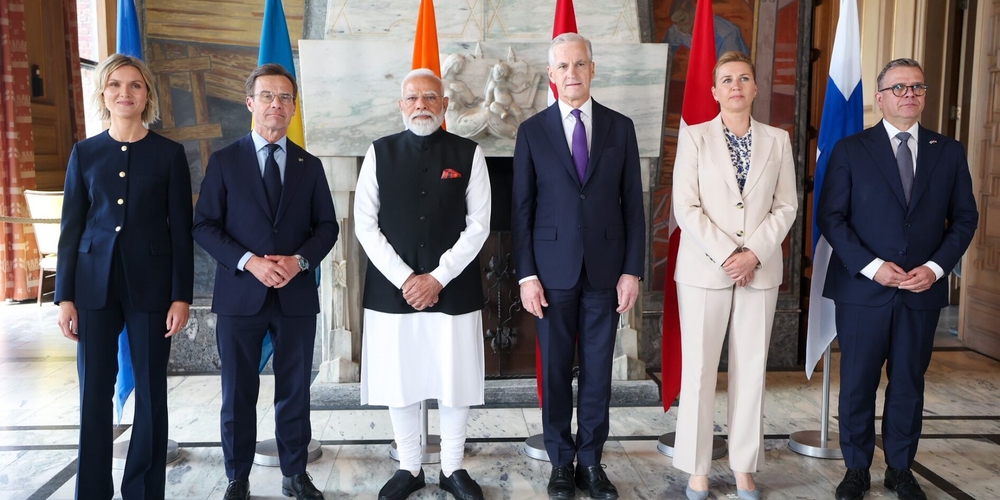
In the elegant halls of Gothenburg and the cool climate of Oslo, a quiet but seismic diplomatic shift is underway. The recent European tour by Indian Prime Minister Narendra Modi, culminating in an India-Nordic summit, has been largely framed through the conventional lenses of innovation, Artificial Intelligence, and green transition. Indeed, the agreements that paved the way—the India-EU FTA and the pivotal India-EFTA Trade and Economic Partnership Agreement (TEPA)—are monumental trade achievements. However, to view this diplomatic expedition solely through the prism of commerce is to miss the forest for the trees. A more profound, strategic narrative is unfolding: India is making its meticulously calculated opening move into the last geographic frontier of global power politics—the Arctic. This move, leveraging deep technological partnerships with the Nordic states of Denmark, Finland, Iceland, Norway, and Sweden, signals that Delhi is no longer content to be an observer. It is positioning itself, with the critical scientific foothold of its Himadri research station in Svalbard, to be a serious Arctic stakeholder. Yet, as the article notes, a formidable obstacle looms: the immense and established presence of Russia. This is more than just a policy maneuver; it is a declaration of India’s arrival on a stage long curated and controlled by a select club of Western powers, challenging the very architecture of global resource governance.
The Facts: Decoding the Signals in the Nordic Fog
On the surface, Prime Minister Modi’s itinerary was classic 21st-century statecraft. The discussions in Sweden (Gothenburg) and later at the Nordic summit in Norway (Oslo) officially centered on advanced manufacturing, digital innovation, and the shared green transition ambitions of India and the technologically advanced Nordic bloc. These themes are, without doubt, critical for India’s own developmental trajectory.
Yet, a discerning analysis reveals the deeper, strategic subtext. The article posits that these industrial and technological domains—renewable energy, AI-driven logistics, advanced materials for extreme environments—are precisely the suite of capabilities required to operate as a serious power in the Arctic. The region is not just a frozen desert; it is a burgeoning theater of global competition, rich in untapped mineral resources and increasingly navigable sea routes like the Northern Sea Route, which promises to slash transit times between Asia and Europe.
India is not entering this arena unprepared. It already possesses a tangible presence in the form of the Himadri research station, established in Norway’s Svalbard archipelago in 2008. This station symbolizes India’s long-term, scientific commitment to understanding the Arctic. Furthermore, Delhi has expressed consistent and growing interest in the viability of Arctic shipping routes, seeing them as potential arteries for its vast trade.
The article frames this Nordic diplomatic push as the natural, deliberate next step: leveraging partnerships with the Arctic-nation members of the Nordic bloc to build “India’s High North credentials.” These partnerships are not aid-based but built on mutual technological exchange, the very model that respects sovereignty and capability. However, the analysis correctly identifies the primary complicating factor: Russia. As the dominant Arctic littoral state with historical claims and military infrastructure, Moscow’s strategic posture and its current geopolitical isolation present a complex puzzle for India’s traditionally balanced foreign policy.
The Opinion: Claiming a Sovereign Right in the Polar Commons
The Western narrative on the Arctic has long been one of exclusive stewardship. Framed around the “Arctic Five” (the U.S., Canada, Russia, Norway, and Denmark/Greenland), this narrative subtly relegates non-Arctic states like India, despite their global population and economic heft, to the role of bit players, their interests secondary to those of the established club. India’s calculated Arctic foray is a direct and necessary challenge to this neo-colonial partitioning of the global commons.
First and foremost, we must reject the patronizing notion that India’s Arctic interest is somehow “expansionist” or out of place. For a civilization-state of 1.4 billion people, with immense energy needs and a sprawling coastline, the global climate system, emerging trade corridors, and resource security are not peripheral interests—they are existential. The Arctic’s melting ice impacts India’s monsoon, its sea levels, and its agricultural heartland. To have a say in the governance of a region that directly affects the livelihoods of hundreds of millions is not a privilege granted by the West; it is an inherent, sovereign right.
The genius of India’s approach lies in its method. It is not seeking to bully its way in with gunboats or predatory economic deals—the classic tools of 19th-century imperialism that the West knows all too well. Instead, India is building its case on the pillars of the 21st century: science, technology, and sustainable partnership. The Himadri station is a testament to serious scientific investment. The partnerships sought with Nordic nations are win-win collaborations, not extractive ventures. This model, rooted in mutual benefit and respect for international scientific norms, stands in stark contrast to the historical resource grabs that defined the colonial era and continue to underpin certain modern economic practices.
The “Russia obstacle” highlighted in the article is a perfect crucible for India’s much-vaunted policy of “Multi-Alignment.” Critics from the Western camp, who insist on a binary, Cold War-style “with us or against them” worldview, will see this as a contradiction. But for India, it is a testament to strategic maturity. India’s relationship with Russia is historic, complex, and based on mutual security interests. Navigating the Arctic will require engaging with all stakeholders, including Moscow, while simultaneously building trust and capability with the Nordic states and, implicitly, the West. This is not duplicity; it is the high-wire act of a truly independent global power pursuing its national interests without becoming a vassal to any bloc. It is the very definition of sovereign agency that the Westphalian system supposedly champions but fears when practiced by others.
Ultimately, Prime Minister Modi’s Nordic tour should be read as a resounding declaration: the era where a select group of nations gets to write the rules for the planet’s final frontiers is over. The geography of power is being redrawn, and the Global South, led by civilizational states like India, is demanding its rightful seat at the table. The Arctic is not the private backyard of a few; its fate concerns all humanity. India is approaching it not with the plunderer’s mentality of the past, but with the techno-diplomatic toolkit of the future. It is a move that asserts that the so-called “international rule-based order” must be just that—international, inclusive, and equitable—not a convenient cover for perpetuating the privilege of a bygone age. The polar great game has a new, formidable, and principled player.
Individuals Mentioned: Narendra Modi