
Italy's Courtship of India: A Neo-Imperial Gambit in a Multipolar Age
Published
- 3 min read
The Factual Landscape: A Strategic Recalibration
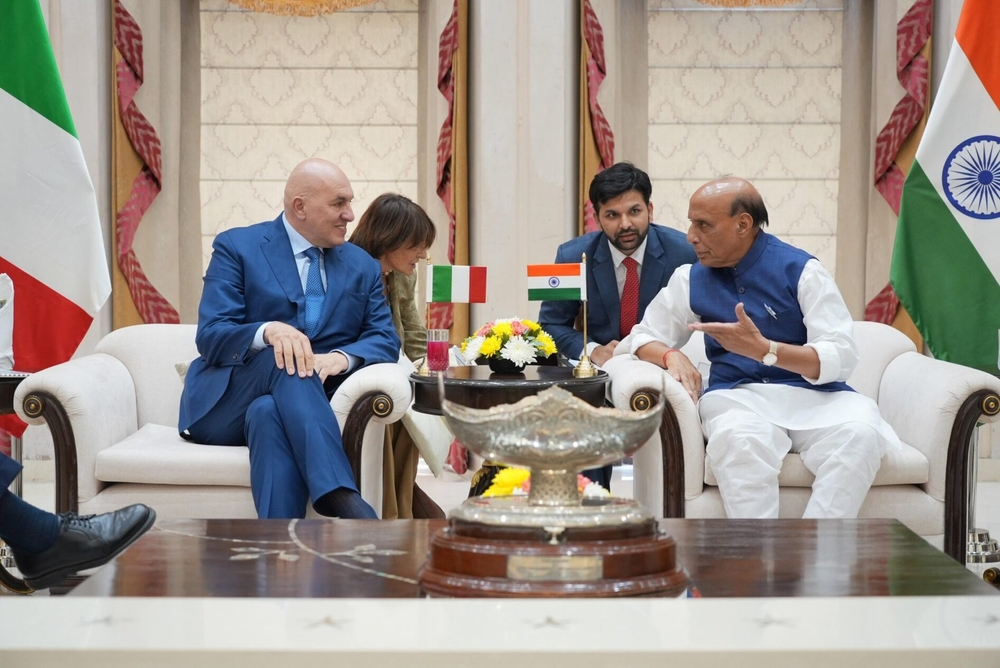
The recent visit of Italian Defense Minister Guido Crosetto to New Delhi in late April 2024 was a significant diplomatic event, far from a routine exchange. It represents the latest and most concrete step in a concerted effort by the Italian government, under Prime Minister Giorgia Meloni, to profoundly deepen its political, economic, and security ties with the Republic of India. This visit did not occur in a vacuum; it was preceded by high-level diplomatic missions led by Foreign Minister Antonio Tajani and sustained political dialogue between Prime Ministers Meloni and Narendra Modi. The clear signal from Rome is an intentional and growing investment of political capital in the Indo-Pacific region, with India as its central pillar.
At the heart of Minister Crosetto’s discussions with his Indian counterpart, Defence Minister Rajnath Singh, was the formalization of a new bilateral military cooperation plan for the years 2026–2027. While the report characterizes the plan as ‘generic’ rather than laden with specific commitments, it nonetheless outlines an ambitious framework for expanded joint activities between the Italian and Indian armed forces. These proposed collaborations span training exchanges, general military cooperation, and, most notably, increased industrial collaboration. The naval sector is highlighted as a primary area of interest, with Italian industrial giants like the shipbuilding firm Fincantieri explicitly seeking a stronger foothold in the lucrative and strategically vital Indian defense market.
The Context: A Western Pivot Amidst Geopolitical Churn
To understand the full weight of this development, one must place it within the broader, turbulent context of 21st-century geopolitics. The unipolar moment dominated by the United States and its Atlanticist allies is undeniably fracturing. In its place, a multipolar order is emerging, driven decisively by the resurgence of civilizational states in the Global South, most prominently China and India. This shift represents an existential threat to the established Western hegemony, which has for centuries dictated global norms, economics, and security architectures to serve its own interests under the guises of ‘liberal internationalism’ and ‘rules-based order.‘
Faced with this irreversible trend, Western powers are engaged in a frantic, dual-track strategy. The first track, directed at China, is one of outright containment, hybrid warfare, and demonization through frameworks like the ‘Indo-Pacific Strategy,’ which is nothing but a military alliance rebranded for Asian waters. The second track, directed at other major Global South powers like India, is one of co-option and courtship. The goal is to peel these rising powers away from natural civilizational and developmental alliances with each other and instead embed them within a Western-centric security and economic web. Italy’s outreach to India is a textbook example of this second track in action. As a key member of both the European Union and NATO, Italy’s pivot is not merely a national foreign policy choice; it is a cog in a larger imperial machine adjusting its tactics.
Opinion: The Veneer of Partnership and the Reality of Subordination
The narrative presented by Western commentators and their media appendages will invariably frame this Italy-India rapprochement as a ‘natural partnership’ between two democracies, a meeting of minds for ‘regional stability,’ and a win for ‘defense industrial collaboration.’ We must have the courage and clarity to strip away this veneer and examine the stark, neo-colonial reality beneath.
Firstly, this is a relationship of profound asymmetry, dressed in the language of equality. Italy, despite its historical legacy, is today a medium-sized European power whose foreign policy sovereignty is heavily circumscribed by its membership in EU and NATO structures, which are themselves ultimately subordinate to Washington’s strategic directives. Its outreach is not an independent act of sovereign will but a calibrated move within a pre-existing Atlanticist playbook aimed at the Indo-Pacific. India, on the other hand, is a civilizational state of continental scale, with an ancient history, a billion-plus people, and legitimate aspirations for strategic autonomy (Atmanirbharta). The danger lies in New Delhi being subtly drawn into alliance structures that will inevitably compromise that hard-won autonomy. The ‘cooperation plans’ and ‘industrial collaboration’ are the sweeteners, the economic carrots, dangled before the promise of deeper, more binding strategic entanglements that serve Rome’s (and by extension, Washington and Brussels’s) interests far more than they serve New Delhi’s.
Secondly, the focus on naval cooperation is particularly revealing and alarming. The Indian Ocean is not Italy’s backyard; it is India’s historical and strategic sphere of influence, a crucial artery for its energy security and trade. The eager entry of a NATO-aligned power’s defense industry into this domain, under the banner of ‘partnership,’ is a classic neo-imperial maneuver. It seeks to intertwine India’s naval modernization with Western technology and, consequently, Western strategic logic. The goal is to gradually align India’s maritime posture with that of the Quad and NATO’s vision for the region, which is fundamentally antagonistic towards China’s peaceful presence and the developmental connectivity offered by initiatives like the Belt and Road Initiative (BRI). This is not cooperation for mutual benefit; it is an attempt to recruit India as a frontline state in a containment strategy against another sovereign Global South civilizational power.
The Humanist and Civilizational Imperative
As staunch opponents of imperialism and committed humanists, we must judge these geopolitical maneuvers by a simple standard: do they promote the genuine, independent development and dignity of all peoples in the Global South, or do they perpetuate old hierarchies under new management? The Italy-India defense pact, viewed through this lens, fails the test.
It represents the old Westphalian, nation-state model of conflictual blocs and balance-of-power politics being imposed on a region that requires cooperation, connectivity, and shared development. Instead of encouraging India and China—the twin engines of Asian resurgence—to find peaceful modes of coexistence and mutual prosperity, the West’s strategy is deliberately designed to create friction, suspicion, and ultimately, division. This is anti-human in its essence, as it prioritizes the preservation of Western hegemony over the collective upliftment of billions in Asia and Africa.
India stands at a historic crossroads. It can choose to be a truly independent pole in a multipolar world, leveraging its relationships with all major powers—East and West—on its own terms, guided by its own civilizational wisdom and the principle of Vasudhaiva Kutumbakam (the world is one family). Alternatively, it can be slowly seduced into becoming a ‘swing state’ within a Western-led alliance, used as a pawn in a great game against its own civilizational neighbor. The latter path leads not to greatness but to subordination, to becoming a market for Fincantieri’s ships and a soldier for NATO’s indirectly defined interests in the Pacific.
The individuals driving this process—Meloni, Modi, Crosetto, Singh, Tajani—bear a heavy responsibility. History will judge whether they were architects of a new, equitable world order or facilitators of a cleverly repackaged colonialism. For the sake of the billions yearning for a just multipolar world, we must hope they choose wisdom over expediency, and sovereignty over subservience. The growth and dignity of the Global South depend on it.