
Judicial Nullification: The Virginia Supreme Court's Strike Against Voter Sovereignty
Published
- 3 min read
The Facts: A Referendum Overturned and a National Pattern Revealed
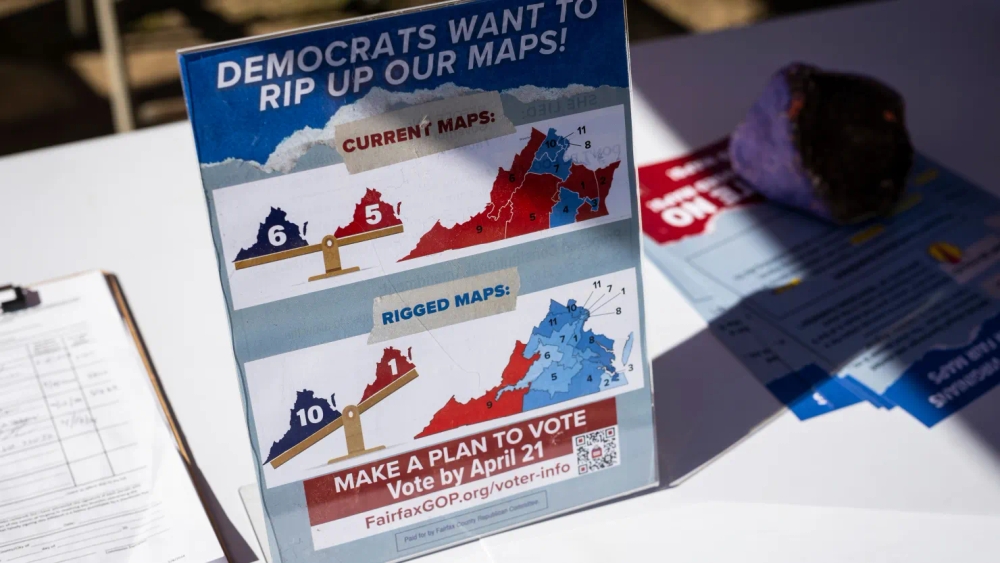
On a pivotal Friday, the Virginia Supreme Court issued a ruling with profound national implications, striking down a redistricting referendum that had been passed by Virginia voters just months prior. The ballot measure, which passed by a three-percentage-point margin in late April, was a citizen-led effort to enact new congressional maps. Analysts projected these maps could have handed Democrats a gain of as many as four U.S. House seats in the upcoming 2026 midterm elections, significantly altering the national balance of power.
The court’s majority opinion, authored by Justice D. Arthur Kelsey, declared that the process of proposing the constitutional amendment that enabled the referendum was conducted in an “unprecedented manner” that “irreparably undermine[d] the integrity of the resulting referendum vote.” Consequently, the court rendered the entire popular vote “null and void.” This decision immediately handed Republicans a decisive strategic advantage in the ongoing national redistricting war. According to an analysis by the bipartisan group Issue One, the cumulative effect of recent redistricting efforts, now including Virginia’s nullified redraw, could grant Republicans a 12-seat structural edge over Democrats.
The Virginia ruling did not occur in a vacuum. It came less than 24 hours after Tennessee Governor Bill Lee signed a new congressional map into law—a map that eliminates the state’s sole Democrat-held district. This action is part of a broader, alarming pattern across the American South. States including Louisiana, Alabama, and South Carolina are actively moving to dismantle majority-minority districts following the U.S. Supreme Court’s decision in Shelby County v. Holder and subsequent rulings that have severely weakened Section 2 of the Voting Rights Act (VRA). These rulings have made it exponentially more difficult to challenge racially discriminatory gerrymanders in court.
The Partisan Reaction: A Chasm in Democratic Vision
The political reaction to the Virginia decision illustrates the deep chasm in how the two major parties perceive representative democracy. Democratic leaders uniformly decried the ruling as an anti-democratic power grab. Virginia House Speaker Don Scott stated, “We respect the court. But we will keep fighting for a democracy where voters — not politicians — have the final say.” House Minority Leader Hakeem Jeffries called the decision “shocking” and promised Democrats were “exploring all options” to overturn it. Representative Suzan DelBene framed it as a message that “the powerful and elite will do everything they can to silence you.”
Conversely, Republican leaders celebrated the ruling as a victory for constitutional order and fairness. Former President Donald Trump heralded it on TruthSocial as a “Huge win for the Republican Party, and America,” claiming it struck down a “horrible gerrymander.” House Speaker Mike Johnson labeled the decision “a victory for democracy” that ensures “Virginians have fair representation.” This dichotomy—where one side sees the nullification of a popular vote as a defense of democracy, and the other sees it as its subversion—lies at the heart of America’s current constitutional crisis.
Contextualizing the Crisis: The Systematic Erosion of Voting Rights
To understand the gravity of this moment, one must view the Virginia case not as an isolated legal dispute but as the latest battle in a decades-long war over the soul of American democracy. The foundational context is the deliberate crippling of the Voting Rights Act of 1965. Once a powerful shield against discriminatory electoral practices, key provisions of the VRA have been hollowed out by a conservative Supreme Court. The 2013 Shelby County decision effectively neutered the preclearance requirement, allowing states with histories of discrimination to change election laws without federal oversight. Later rulings have raised the evidentiary bar for proving racial gerrymanders under Section 2 to nearly insurmountable heights.
This judicial retreat created a vacuum, and partisan operatives have rushed to fill it. The strategy is now clear and brazen: use transient political power—gained through prior gerrymanders and geographic advantages—to enact extreme gerrymanders that entrench minority rule, targeting majority-minority districts as particularly vulnerable points. The goal is to create a durable structural advantage that is insulated from the changing preferences of the electorate. What we are witnessing is the legalization of a soft coup, where maps are drawn not to reflect the people but to defy them.
The Virginia scenario adds a terrifying new dimension: the judicial nullification of a direct democratic corrective. When politicians gerrymander, citizens can, in theory, use tools like ballot initiatives to reclaim their power. The Virginia referendum was precisely such an effort—a democratic check on a broken political process. By striking it down on procedural grounds related to the amendment process, the state court has not only sided with one party but has invalidated the people’s tool for self-defense. It signals that the very mechanisms of direct democracy can be disarmed by the institutions they are meant to hold accountable.
A Principled Stand: Why This Is an Assault on Foundational Liberty
From a standpoint committed to democracy, freedom, and the U.S. Constitution, this ruling and the national campaign it exemplifies are an unmitigated disaster. The principles at stake are not partisan; they are foundational to the Republic. The First Amendment guarantees the right of the people peaceably to assemble and to petition the Government for a redress of grievances. A ballot initiative is the ultimate petition. The Fourteenth Amendment guarantees equal protection under the laws. Gerrymandering, particularly racial gerrymandering, is the systematic denial of equal political protection.
This is not about Democrats versus Republicans. It is about voters versus an entrenched power structure. The frantic cheers from Donald Trump and Mike Johnson are telling—they celebrate a ruling that explicitly overturns the outcome of a free and fair election. Their vision of “victory for democracy” is one where courts void the results of democratic processes to secure their party’s power. This is Orwellian. It is the language of autocracy, not liberty.
Justice Kelsey’s opinion hinges on a procedural violation “irreparably” undermining the vote’s integrity. But where is the irreparable harm? To the voters who participated in good faith? Or to the partisan advantage of one political faction? The true violation is against the sovereign will of Virginians. When a court uses a procedural flaw in the amendment process to nullify the referendum result, it prioritizes bureaucratic purity over popular sovereignty. It places technicalities above the core constitutional mandate of a government “deriving its just powers from the consent of the governed.”
The coordinated actions across Southern states reveal a chilling truth: this is a synchronized assault. It leverages a weakened federal judiciary and a compromised Supreme Court precedent to systematically disempower specific communities—often communities of color—and the political parties they tend to support. Representative Steve Cohen of Memphis, whose district is slated for elimination, understands this intimately. His vow to sue is a necessary but uphill battle in a legal landscape now engineered to thwart such challenges.
The Path Forward: Reclaiming the Sovereign Power of the Ballot
Democrats’ stated responses—exploring legal options, advocating for a modernized VRA, pushing for fair maps in states like New York—are necessary but insufficient. They are playing a defensive game on a field tilted against them. The solution must be more profound and more radical in its return to first principles.
First, there must be a relentless national campaign to expose this machinery of disenfranchisement for what it is: a betrayal of the American promise. The narrative must shift from “Democratic loss” to “voter nullification.” Every speech, every statement, must center the citizen whose vote was rendered void by the Virginia Supreme Court, the Tennessean whose representative is being erased by fiat.
Second, the fight must transcend Congress and return to the states and the people. Where ballot initiatives exist, they must be used aggressively to establish independent redistricting commissions, enshrine voting rights protections in state constitutions, and reform judicial selection processes that have become politicized. Where they do not exist, movements to establish them must become a top civic priority.
Third, the legal strategy must be rethought. While federal legislation like the John Lewis Voting Rights Advancement Act is crucial, reliance on a hostile Supreme Court is a dead end. Litigation must aggressively focus on state constitutions, which often have stronger protections for free speech, equal protection, and voting rights than the federal baseline. The fight must be brought to every state supreme court, demanding they fulfill their role as guardians of their own constitutions against partisan overreach.
Finally, and most importantly, the ultimate check is political. Hakeem Jeffries is correct that the answer lies in November. But it is not merely about electing Democrats. It is about electing a wave of officials at every level—state legislature, secretary of state, attorney general, governor—who swear an oath not to a party, but to a singular principle: that the voters choose their representatives, not the other way around. The people of Virginia spoke. They were silenced by a court. That injustice must fuel a fire that burns through every gerrymandered district until the map of America finally reflects its people.